Blanket of seaweed smothers coastlines from the Caribbean to Mexico
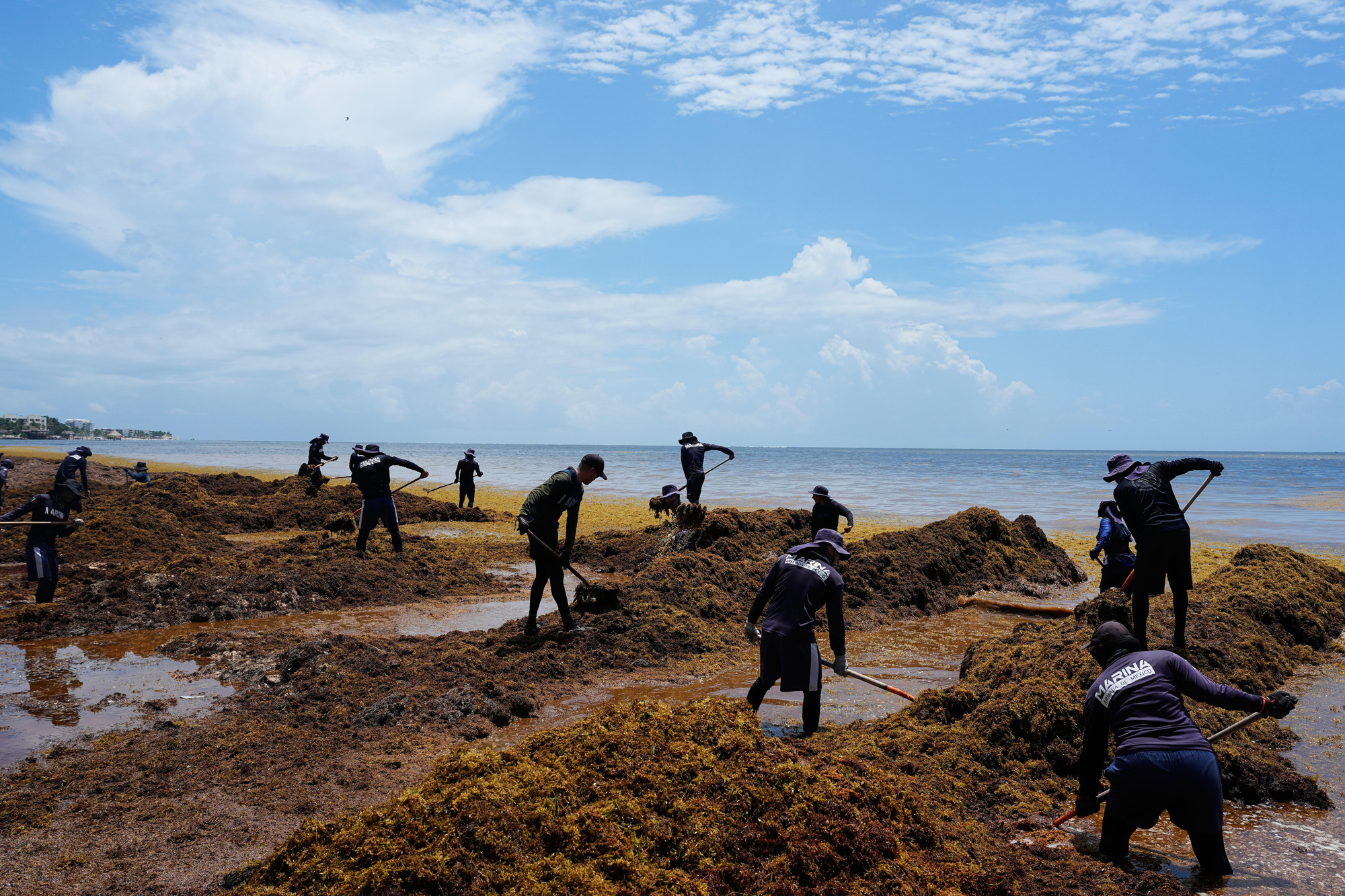
Huge quantities of seaweed are covering the beaches and coastlines of the Caribbean and Gulf of Mexico, suffocating shorelines and snuffing out marine life and deterring visitors in areas that depend heavily on tourism.
Some 27 million metric tons of self-sustaining sargassum have been recorded in the Atlantic, Caribbean and Gulf of Mexico in July, according to a report on Friday from the University of South Florida’s Optical Oceanography Laboratory.
The prickly seaweed covers miles of coastline, releasing a foul smell as it rots onshore.
This year marks the first time that scientists have observed sargassum growing in large quantities in areas including the Caribbean and Gulf of Mexico, instead of being swept into those areas by ocean currents.
The algae usually reproduces asexually as it travels from western Africa, said Brian Barnes, a marine scientist and research assistant professor at the University of South Florida.
“None of this is normal,” he said. “Every year is a little bit of a new story.”
The Great Atlantic Sargassum Belt has been growing since 2011, dumping an increasing amount of seaweed along coastlines in the Caribbean and Gulf of Mexico.
Experts have said that agricultural runoff, warming waters and changes in wind, current and rain could be factors.
The sargassum that began reproducing in the region earlier than usual this year stems from a record 40 million metric tons reported last year.
“The 2025 bloom was so big it never really left,” Mr Barnes said. “It was enough to start a new bloom locally.”
Sargassum levels in the Caribbean reached record levels in June, while the amount present in the Gulf hit five million metric tons in June, nearly double last year’s record, according to the University of South Florida.
Scientists expect 2026 to be the second largest amount of sargassum recorded in the Atlantic, Caribbean and Gulf of Mexico, noting that June alone there were 34 million metric tons, which was only 10% lower than the year-earlier period.
Mexico said Thursday it plans to invest £85 million to tackle the blooming algae, which poses an environmental and economic threat.
The government estimates that up to 9,000 tons reach its Caribbean coastline on the worst days. Given current resources, Mexico says it can only gather 1,200 tons of sargassum a day.
On a recent evening, Alan Vazquez closed the restaurant where he works as a waiter in the popular tourist town of Playa del Carmen because there were no customers.
He had resisted closing for several hours, hoping he would receive a tip and salvage the day, but vast quantities of decomposing sargassum are turning the famed turquoise waters black, driving away tourists.
“It’s sad that such a beautiful and lively place.. .has ended up like this,” he said.
He fears suffering the same fate as four of his colleagues who were laid off two months ago because of a drop in tourism that has devastated hotels and businesses in the state of Quintana Roo, one of Mexico’s tourism gems, where sales fell 30% in the first half of the year, according to estimates from local businesses.
In Puerto Rico, sargassum blankets the waters around popular tourist areas, including La Parguera.
“I don’t recall ever having that much concentration in so many places at once,” said Waldemar Quiles, the US territory’s natural resources secretary.
Much of the record sargassum reported last year ended up along Puerto Rico’s coastline, prompting the governor to declare a state of emergency.
It surpassed the previous record set in 2022 with a peak of some 22 million metric tons.
“It’s not a one-off event anymore,” said Emmanuel Maldonado Gonzalez, an environmental sociologist at East Carolina University. “It’s becoming a growing hazard.”
Patches of sargassum in open waters provide a healthy breeding ground for wildlife, including turtles, fish and seabirds, and can be “a bit of an oasis of life in the middle of the ocean,” Mr Barnes said.
But once it is closer to shore, it reduces oxygen in the water, smothers mangrove roots and blocks sunlight from reaching coral and sea grass.
Once it washes ashore it can prevent newly hatched sea turtles from reaching the sea, while the heavy machinery used to remove from beaches risk destroying fragile turtle nests, scientists say.
“The coastlines are not built for this,” Mr Barnes said.

CONNECT WITH US TODAY



Be the first to know the latest news and updates