Israel lifts restrictions at holy sites in Jerusalem amid fragile ceasefire
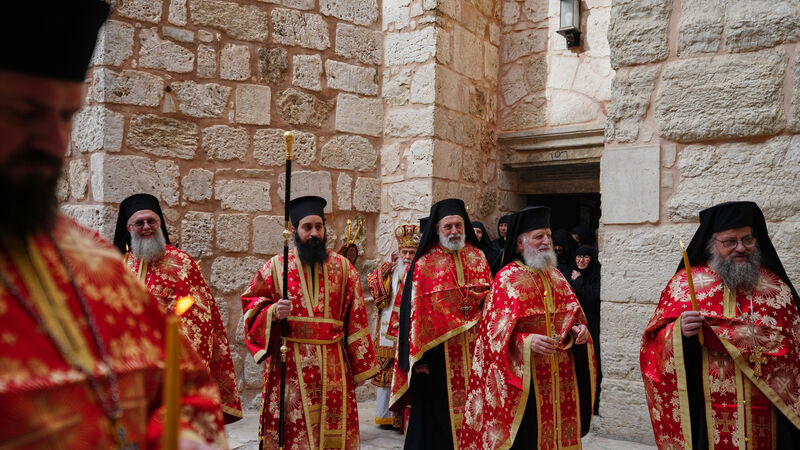
Worshippers were able to pray again at Jerusalem’s holy sites on Thursday after Israel lifted restrictions it imposed on large public gatherings because of the war with Iran.
Jerusalem’s police said on Wednesday that they would lift restrictions on all holy sites and deploy hundreds of officers and volunteers in the city.

Access had been prohibited altogether, or restricted to a few dozen faithful at a time, at Christian, Jewish and Muslim sites during the now-paused conflict, when missile attacks from Iran often sent Jerusalem residents into shelters.
The restrictions subdued Lent, Passover and Ramadan celebrations for many in some of the holiest sites for adherents of Christianity, Islam and Judaism.

The Al-Aqsa Mosque compound, closed for much of the holy month of Ramadan and the Eid al-Fitr holiday, reopened with dawn prayer on Thursday, according to Jerusalem’s Islamic Waqf, the Jordanian religious authority that administers the compound.
At the adjacent Western Wall in the Old City — the holiest site in the world where Jews can pray — dozens of men and women were seen bowing their heads in prayer.

The lifting of the restrictions comes just in time for Orthodox Christians, who celebrate Easter on Sunday, a week after Catholic and Protestant observances and before the centuries-old ceremony known as the Holy Fire that is associated with it.
On Saturday, thousands of Christians will gather in the cavernous Church of the Holy Sepulchre, holding unlit candles as they pack into the sprawling 12th-century basilica built on the site where, according to tradition, Jesus was crucified and buried.

The Greek patriarch will light candles and then the flame is passed from one candle to the next.
The restrictions sparked backlash last month when Israeli police prevented Catholic leaders from entering the Church of the Holy Sepulchre to celebrate a private Mass on the Christian holiday of Palm Sunday for the first time in centuries.
The decision set off a wave of criticism from the United States and others.

Israeli Prime Minister Benjamin Netanyahu said there was no “malicious intent” and that Cardinal Pierbattista Pizzaballa was prevented from accessing the church because of safety concerns.
He was later allowed to enter on Easter Sunday.
On Thursday, worshippers revelled as they entered Al-Aqsa for the first time in weeks.
“It is as if human beings are reborn,” said Mohammed Al-Qassas.

Being unable to pray during this period is like “feeling hungry all the time,” he said.
“It’s impossible to describe this feeling … It was one of the most happiest moments in my life,” said Biljana Vaslic, a tourist from Serbia who, until now, hadn’t been able to enter the church.
Still, others accused Israel of using the war as an excuse to restrict access.
Omar al-Kiswani, director of the mosque, said: “This is a grace from God after 40 days of using the war as a pretext, but God has granted steadfastness in this mosque.”

Even before the war, there were already heightened restrictions on people being able to access Al-Aqsa.
During Ramadan prayers on Friday in early February, Israel restricted the number of Palestinians allowed to enter from the West Bank to 10,000, and only allowed men over 55 and women over 50 as well as children up to 12.
It has imposed similar restrictions in the past, citing security concerns.
CONNECT WITH US TODAY



Be the first to know the latest news and updates