Yemen’s Houthis launch first attack on Israel since outbreak of conflict
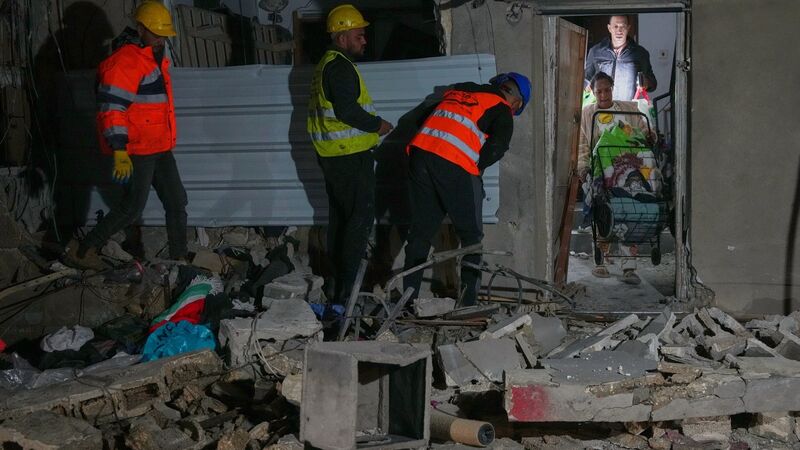
Residents carry personal belongings as they leave a building damaged in a missile strike in Tel Aviv (Maya Levin/AP)
e Yemen’s Iran-aligned Houthis have confirmed that they launched an attack on Israel for the first time since the outbreak of the Israel-US war on Iran, marking their entry to the conflict just hours after Marco Rubio said the US expected to conclude military operations within “weeks, not months”.
While Israel was again hitting targets across Iran’s capital on Saturday, it identified what it said was a missile launched from Yemen.
The Houthis said the attack came after continued targeting of infrastructure in Iran, Lebanon, Iraq and the Palestinian territories, adding that their operations would continue until the “aggression” on all fronts ends.
Houthi involvement in the war could risk broadening the conflict, given their ability to strike targets far beyond Yemen and disrupt shipping lanes around the Arabian Peninsula and the Red Sea, which they had done in support of Hamas in Gaza after the 7 October attacks on Israel.
Speaking to reporters on Friday, after meeting G7 foreign ministers in France, Mr Rubio – the US secretary of state – said of Iran: “When we are done with them here in the next couple weeks, they will be weaker than they’ve been in recent history.”
But soon after, US media reported an Iranian attack on a base in Saudi Arabia wounded at least 12 American soldiers, two of them seriously.
The attack on the Prince Sultan airbase in Saudi Arabia included at least one missile and several drones, the New York Times and the Wall Street Journal reported, citing unidentified officials.
The soldiers were inside a building at the base when it was struck, according to reports. Several aerial refuelling planes also suffered damage in the attack.
US officials have given conflicting signals about how long they anticipate continuing their joint offensive with Israel against Iran, which began with a surprise strike on 28 February that killed Iran’s supreme leader, Ali Khamenei.
Iran remains defiant, and has denied Donald Trump’s claims that talks are “going well”, saying no negotiations are taking place.
Meanwhile Mr Trump’s envoy, Steve Witkoff, said on Friday: “We think there will be meetings [with Iran] this week. We’re certainly hopeful for it.” Trump later claimed Iran sent the US 10 oil ships “to make up for their misstatement” about not being involved in negotiations.
In the Lebanese capital, Beirut, a pre-dawn Israeli strike killed two people, according to local authorities, while barrages of Iranian missiles and drones targeted Israel.
“Despite the warnings, the firing continues,” Israel Katz, the Israeli defence minister, said.
“And therefore attacks in Iran will escalate and expand to additional targets and areas that assist the regime in building and operating weapons against Israeli citizens.” Israel’s most recent strikes targeted nuclear facilities in Iran on Friday, possibly in an attempt to hit what are seen as strategically important targets before the White House forces Israel to halt or reduce sorties.
With stock markets reeling and economic fallout from the war extending far beyond the Middle East, Trump is under growing pressure. It is caused by Iran’s continuing chokehold on the strait of Hormuz, a strategic waterway through which a fifth of the world’s oil is usually shipped.
The Islamic Revolutionary Guard Corps (IRGC) said it had turned back three ships trying to transit the strait, adding that all shipping “to and from ports of allies and supporters of the Israeli-American enemies” was prohibited from passing.
“This morning, following the lies of the corrupt US president claiming that the strait of Hormuz was open, three container ships of different nationalities … were turned back after a warning from the IRGC navy,” the Guards said on their Sepah News website.
Rubio said ensuring the strait remained open to shipping was likely to pose an “immediate challenge” even after the US accomplished its military objectives in Iran. He said Iran may seek to set up a toll on the strait, which he said could cause economic damage to many countries.
“Not only is this illegal, it’s unacceptable … and it’s important that the world have a plan,” Rubio said.
CONNECT WITH US TODAY



Be the first to know the latest news and updates