Cases of meningitis expected to rise in ‘unusual outbreak’, British health chief says
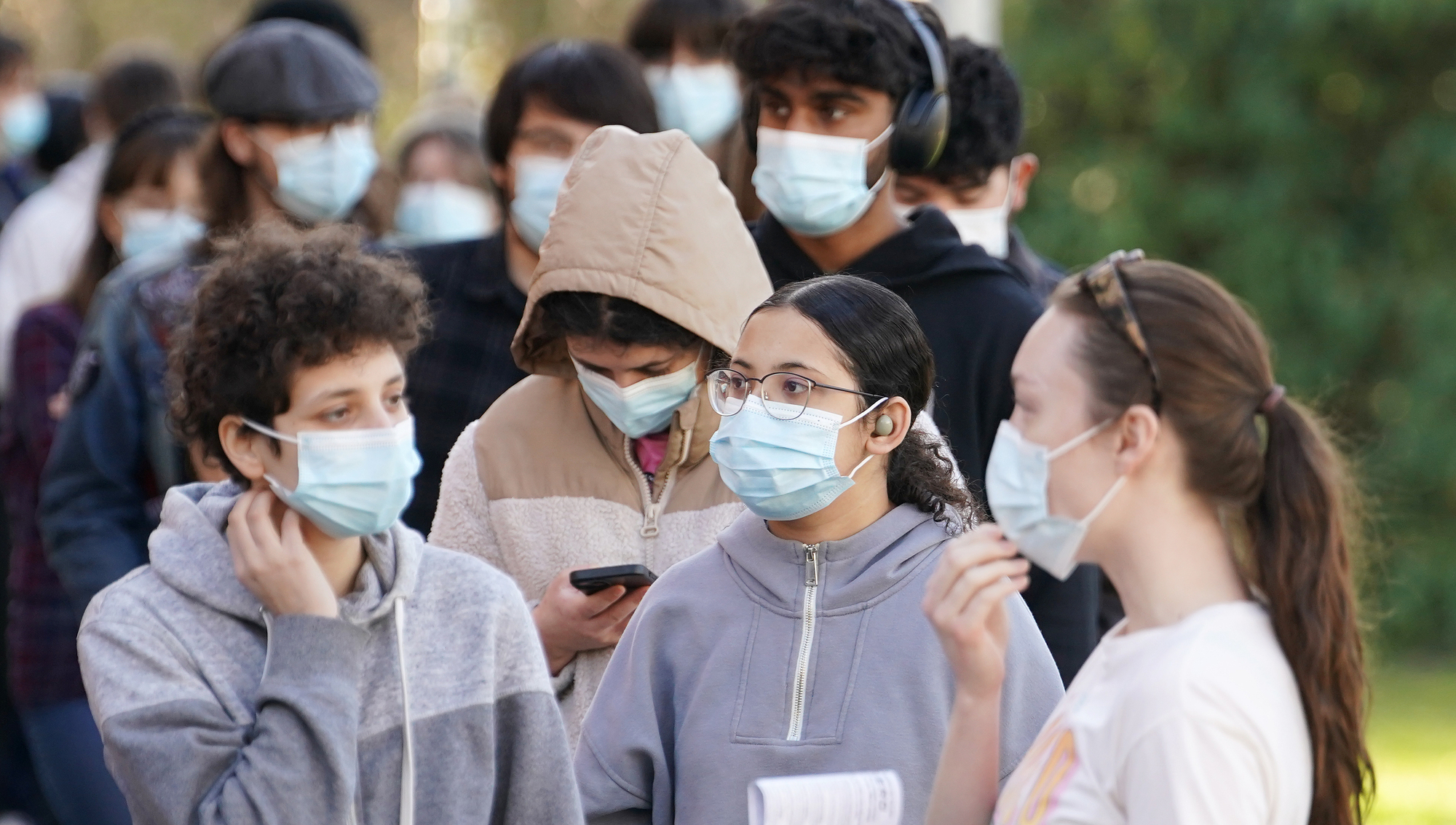
Students wait in line at the entrance to the sports hall at the University of Kent campus in Canterbury, where the rollout of a meningitis B vaccine has begun (Gareth Fuller/PA)
The number of cases of meningitislinked to the Kent, in the UK outbreak is likely to rise, a health leader has said, as experts look at whether the bacteria have become able to transmit more easily.
Professor Robin May, chief scientific officer at the UK Health Security Agency (UKHSA), said: “This is a very unusual outbreak.”
Five new cases of meningitis were announced by the UKHSA on Wednesday morning, taking the total number being investigated by health officials to 20.
New figures will be released on Thursday morning, which are expected to push this figure higher.
Speaking to BBC Breakfast, Prof May said: “I would say in outbreaks like this, you would typically expect a small increase in numbers still to go, so I suspect that number will go up slightly.”
He described the outbreak, linked to a nightclub in Canterbury, as unusual, adding: “So typically, you would expect to see sporadic cases of meningitis, typically individual patients.
“Most days, actually, we would see one in the UK. This is obviously a much larger number.
“What is particularly remarkable about this case, and unexpected about this case, is the large number of cases all originating from what seems to be a single event.
“There are two possible reasons for that. One is that there might be something about the kind of behaviours that individual people are doing.
“The other possibility is the bacteria itself may have evolved to be better at transmitting.”
To date, 600 meningitis B vaccines have been administered at the University of Kent, Canterbury campus after hundreds of students joined a queue outside the campus sports centre.
Those who have received the jab will need to return for their second dose after a minimum of four weeks, while 6,500 antibiotics have also been given out as a precaution, the university said.
In total, around 5,000 university campus students are eligible for a jab and are being urged to come forward for the immediate protection offered by antibiotics and longer-term protection from the vaccine.
It comes after one school pupil and one university student died and 18 more cases were being investigated by the UKHSA, with some young people placed in induced comas.
Prof May said the bacteria which can cause meningitis can be transmitted by sharing utensils, cups and vapes.
He said: “So this is a bacteria that is actually quite widespread.
“So a large number of us carry this, about 10% of people my age, slightly higher in younger people carry this bacteria at the back of their throat anyway, and obviously, the vast majority of us don’t have any problem with disease, but in some cases it can cause severe disease.
“And it is transmitted by this relatively close contact.
“So it’s transmitted by things like saliva and kissing in particular, but also sharing of utensils, sharing of cups or vapes or those kind of things.”
Prof May added: “Although it’s in the throat, it is not, for example, like Covid or flu. It’s not a respiratory disease in the sense of spreading very easily through the air.
“It does not survive very long on surfaces. So people do not need to be concerned about things like public transport, for instance, where you know potentially you might come into contact with somebody with that in your train carriage or your bus.
“But unless you’re in quite close contact for an extended period of time with them, you are not at risk from them.”
The UKHSA issued an alert for the NHS across England on Wednesday on signs and symptoms of meningitis to look out for, though this does not signal the outbreak is going to spread nationwide.
The alert said the illness being seen in the Kent outbreak “has been severe with rapid deterioration” and urges clinical staff to take infection control measures in the period before patients are put on antibiotics, such as face masks and other personal protective equipment (PPE).
It urges doctors to have a “high index of suspicion where a young person aged 16 to 30 attends with consistent signs or symptoms” of the bug.
Students from the university halls in Canterbury who have already left campus will be able to get a MenB jab from their GP, according to the Department of Health.
Six of the confirmed cases have been confirmed as the menB strain.
Canterbury Christ Church University, also in Kent, confirmed a meningitis case among its students on Wednesday, meaning confirmed or suspected cases have been reported at two universities and five schools.
GPs across the country have also been told to prescribe antibiotics to anyone who visited Club Chemistry in Canterbury from March 5-7, plus students from the University of Kent.
This is to ensure anyone who has left campus can make sure they get the right treatment.
The UKHSA stressed there are plenty of NHS stocks of menB vaccines after pharmacies reported they were struggling to obtain stock for people who want to pay privately.
All reported cases so far have a link to Kent, according to the UKHSA.
Meanwhile, French authorities said a person who was admitted to hospital with meningitis in France with links to the Kent outbreak is now in a “stable” condition.
The French Ministry of Health told the Press Association no other cases of meningitis linked to the outbreak in Kent have been reported in France.
On Wednesday, Keir Starmer expressed his “deepest condolences” for the friends and family of the two people who had died following the outbreak in Kent during Prime Minister’s Questions.
CONNECT WITH US TODAY



Be the first to know the latest news and updates