A&E for injured wild birds opens at Warsaw Zoo in Poland
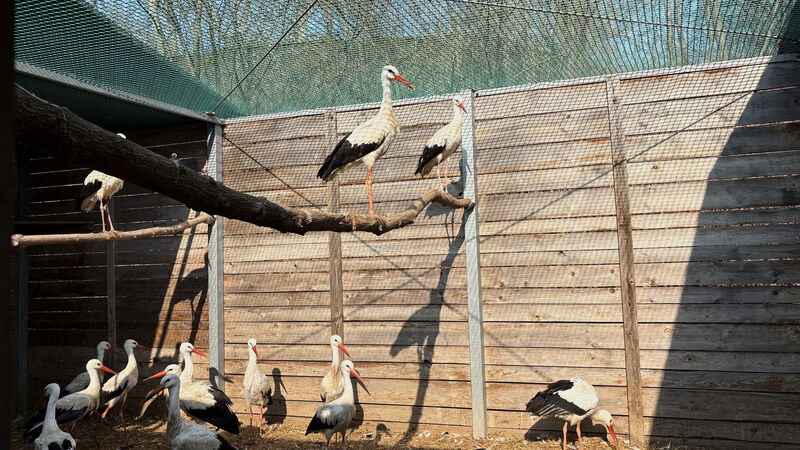
Treated storks in an external cage outside the birds’ hospital (Claudia Ciobanu/AP)
When a male bullfinch smashed into Marcin Jarzębski’s apartment window, he took it in but realised it needed expert treatment.
So the next morning he took it to Warsaw’s new emergency room for wild birds.
He placed the tiny, plump bird with a black head, grey back and reddish chest feathers into a shoebox and took it as one of the first patients to the new drop-off centre for sick and injured birds at the entrance of Warsaw Zoo.
“The bird stayed with us overnight, but unfortunately it probably has a broken wing so we took it to the bird hospital,” Mr Jarzebski said.

The 24/7 emergency room in the Polish capital is actually a system of automated metal containers, something like a parcel room, where the containers can keep the birds warm in winter.
The boxes send an immediate signal to the bird hospital just a few metres away, where vets take the birds for diagnosis and treatment.
Mr Jarzebski filled out a questionnaire and carefully placed the shoebox and the paper form into one of the containers, assured that the bullfinch would now have its best chance of surviving.
The box system, based on ideas of from workers at the bird hospital, locks the birds in to keep them safe until a doctor can collect them.

The drop-off centre, opened in February, is boosting the efficiency of a bird hospital that has operated at Warsaw Zoo since 1998 and now treats about 9,000 patients annually.
It is the brainchild of the zoo director, ornithologist Andrzej Kruszewicz, who said that people have a responsibility to care for creatures whose habitat they have altered, such as that of the bullfinch.
“This bird is a child of the forest who, during migration, didn’t understand the window,” Mr Kruszewicz said.
“Humans often cause problems: car accidents, crashes into windows, electrocutions, tangled strings on storks’ legs,” he said.
“All this is humans’ fault and they should feel responsible to give these birds a second chance.”

Typical patients at the Warsaw Zoo include common songbirds like tits, sparrows, thrushes and starlings, as well as pigeons.
However, in a green city like Warsaw, which has the river Vistula running through it, rarer species also can appear.
Hospital manager Andzelika Gackowska says that warm winters caused by climate change have meant birds that were previously migrating south, including cranes or herons, are choosing to stay in Poland.
“Birds who stopped migrating because of warm winters were caught off guard by such a harsh winter as this year,” Ms Gackowska said.
Some birds developed anaemia during the cold months because of tough conditions and insufficient nutrition, making them more vulnerable to disease.

The emergency room was financed in part with money from Warsaw’s citizen budget, a programme that chooses projects based on their popularity in online surveys of city residents.
Warsaw Zoo workers say residents have become more conscious about providing help if they see a sick bird, although they also warn against overzealousness, saying that people should not pick up young and healthy birds that they might believe are orphans.
“In spring, we always make an information campaign warning people not to ‘kidnap’ birds,” Ms Gackowska said.
“Birds take care of their small ones differently than humans. If we see a baby bird on the grass alone, it is likely just training how to fly independently.”
In the bird hospital, vet assistants are constantly on their feet, feeding and giving medicine to the various birds, located across multiple rooms depending on species and degree of illness.
Once birds are stronger, they are placed in large cages outside, to readjust to their natural environment before being released.
Releasing the cured birds back into their habitat is the ultimate goal, vet Ewelina Chudziak said.
“We are fighting for freedom,” she said.
CONNECT WITH US TODAY



Be the first to know the latest news and updates