Donald Trump says Iran will be 'hit very hard' on Saturday
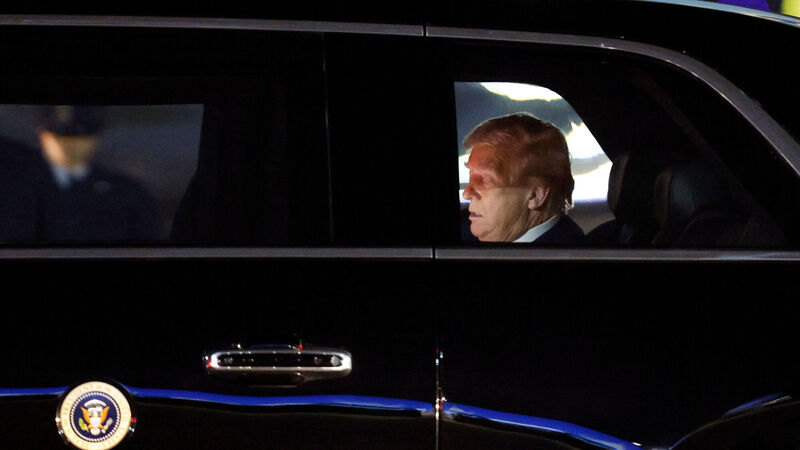
President Donald Trump is seen in his limousine, known as "The Beast," upon his arrival at Joint Base Andrews, Md., Friday, March 6, 2026. (AP Photo/Luis M. Alvarez)
US president Donald Trump has warned that more Iranian officials would become targets in the war in the Middle East, writing in a social media post: “Today Iran will be hit very hard!”
Mr Trump made the comments on his Truth Social website, noting an apology by Iranian president Masoud Pezeshkian earlier in the day to neighbouring nations over Tehran’s attacks.
“Under serious consideration for complete destruction and certain death, because of Iran’s bad behavior, are areas and groups of people that were not considered for targeting up until this moment in time,” Mr Trump wrote, without elaborating.
The Iranian president had earlier said that a demand by the United States for an unconditional surrender is a “dream that they should to take to their grave”.
Mr Pezeshkian made the statement in a pre-recorded address aired by Iranian state television.
— Rapid Response 47 (@RapidResponse47) March 7, 2026
He also apologised for Iran’s attacks on regional countries, insisting that Tehran would halt them and suggesting they were caused by miscommunication in the ranks.
Read More
The comments came as intense Iranian fire targeted the Gulf Arab states on Saturday morning as Israel and the United States kept up their air strikes targeting the Islamic Republic.
There were repeated attacks on Saturday morning on Bahrain, Saudi Arabia and the United Arab Emirates.
In Dubai, several blasts were heard on Saturday morning and the government said it had activated air defences.
Passengers waiting for flights out at Dubai International Airport, the world’s busiest for international travel, found themselves ushered down into train tunnels at the sprawling airfield after the alert sounded.
Later that morning, long-haul carrier Emirates resumed operations, after briefly suspending all flights to and from Dubai.
Authorities have not explained if there was an interception or damage at the airport.
Donald Trump’s administration has approved a new $151m arms sale to Israel after the US president said he would not negotiate with Iran without its “unconditional surrender”.
US officials also warned of a forthcoming bombing campaign they said would be the most intense yet in the week-long conflict.

Earlier, Iran’s UN ambassador said the country would “take all necessary measures” to defend itself.
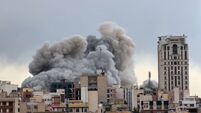
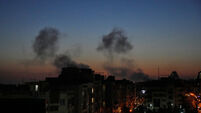
Footage showed explosions and smoke rising over western Tehran as Israel said it had begun a broad wave of strikes.
Also early on Saturday, loud booms sounded in Jerusalem and incoming missiles from Iran had people heading to bomb shelters across Israel.
There were no immediate reports of casualties by Israel’s emergency services.
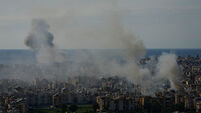
Meanwhile, Israeli warplanes have also hammered Beirut and Tehran. Death tolls continued to rise on Saturday with at least 1,230 people killed in Iran, more than 200 in Lebanon and around a dozen in Israel, according to officials. Six US troops were reported killed.
The US and Israel have battered Iran with strikes, targeting its military capabilities, leadership and nuclear programme.

The stated goals and timelines for the war have repeatedly shifted, as the US has at times suggested it seeks to topple Iran’s government or elevate new leadership from within.
In a sign of the widening nature of the conflict, sirens sounded early on Saturday in Bahrain as Iranian attacks targeted the island kingdom.
Saudi Arabia said it had destroyed drones heading for its vast Shaybah oil field and shot down a ballistic missile launched toward Prince Sultan Air Base, which hosts US forces.
Bahrain’s military intercepted two missiles and a drone on Saturday, the defence ministry said.
That brought to 86 missiles and 148 drones that have been intercepted over Bahrain since the US and Israel launched war against Iran last weekend.

Qatar’s energy minister, Saad al-Kaabi, warned in an interview with the Financial Times that the war could “bring down the economies of the world”, predicting a widespread shutdown of Gulf energy exports that could send oil to 150 dollars a barrel.
The price for a barrel of benchmark US crude rose above 90 dollars on Friday for the first time in more than two years.
Writing for the Qatar-funded satellite news network Al Jazeera, a regional analyst warned Iran was making “a strategic miscalculation of historic proportions”.
Sultan al-Khulaifi, a senior researcher at the Centre for Conflict and Humanitarian Studies, wrote: “By spreading the conflict to the Gulf, Tehran is doing precisely what Israel could not do alone: steering the war away from the Israeli-Iranian axis and transforming it into a confrontation between Iran and its Arab neighbours.”
On Saturday, the defence minister of Saudi Arabia and Pakistan’s army chief met to discuss ways to stop the attacks coming from Iran, the state-run Saudi Press Agency reported.
Saudi Prince Khalid bin Salman, a son of King Salman, spoke to Field Marshal Asim Munir in Riyadh about the Iranian attacks. Saudi Arabia and nuclear-armed Pakistan have signed a mutual defence pact that defines any attack on either nation as an attack on both.
Russia has provided Iran with information that could help Tehran strike American warships, aircraft and other assets in the region, according to officials.
They cautioned that the US intelligence has not uncovered that Russia is directing Iran on what to do with the information.
This marks the first indication that Moscow has sought to get involved in the war.

Israel has said that over the past week it has heavily bombed an extensive underground bunker that Iranian leaders had planned to use during the hostilities.
New information has surfaced suggesting that a deadly explosion at a school in the Iranian city of Minab, some 680 miles south-east of Tehran, was likely caused by US air strikes. The information includes satellite images, expert analysis, and public information released by US and Israeli military forces.
Iranian state media has said more than 165 people were killed in the blast, most of them of children.
Iran has blamed Israel and the US for the explosion. Neither country has accepted responsibility, though American defence secretary Pete Hegseth said the US is investigating.
Meanwhile, India’s foreign minister said on Saturday that an Iranian naval vessel has docked in India, after a US submarine sank an Iranian warship and another vessel sought assistance from Sri Lanka.
Subrahmanyam Jaishankar said the IRIS Lavan is docked in southern Kochi city, after India granted permission when the vessel reported “having problems” on March 1. “I think it was the humane thing to do,” Mr Jaishankar said.
A US submarine sank the Iranian warship IRIS Dena off the coast of Sri Lanka on Wednesday. Another vessel, the IRIS Bushehr, requested assistance from Sri Lanka and more than 200 sailors were brought ashore. Both ships had previously taken part in naval exercises hosted by India, but Mr Jaishankar said they had been “caught on the wrong side of events” once the war began.


CONNECT WITH US TODAY



Be the first to know the latest news and updates