Middle East: Three people killed, 68 injured in UAE; evacuation orders issued for residents in southern Lebanon
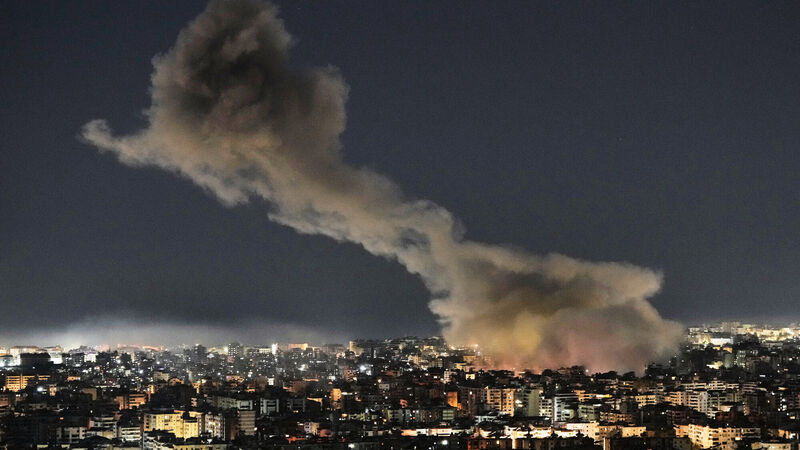
Smoke rises from Israeli airstrikes in Dahiyeh, a southern suburb of Beirut, Lebanon, early on Tuesday, March 3 2026 Picture: Bilal Hussein/AP
The United Arab Emirates and its air defences have dealt with 186 missiles launched toward the country since the start of the US-Israeli conflict with Iran, the UAE Ministry of Defence said Tuesday.
Brigadier General Abdul Nasser Mohammed Al-Humaidi, a defence spokesperson, said only one missile fell on the country’s territories – the UAE’s air defences were able to intercept 172 missiles while 13 fell into the sea.
Air defences also detected 812 Iranian drones flown at the UAE, 57 of which fell within the country’s territory.
In addition to the 755 remaining drones that air defences were able to intercept, the UAE also detected and destroyed eight cruise missiles.
Read More
In total, three people were killed in the UAE since the start of the conflict, the spokesman said. There have been 68 cases of minor injuries as well as some minor to moderate damage to civilian facilities.
It comes after the Israeli military issued evacuation orders for residents of more than two dozen towns in southern Lebanon.
Israeli troops were carrying out incursions along some parts of the Lebanese border, a Lebanese official told on Tuesday. Witnesses said the Lebanese army had pulled out of at least seven forward operating positions along the border.
At least 30,000 displaced people have sought protection in shelters in Lebanon since hostilities between Israel and Hezbollah began on Monday, the United Nations refugee agency said on Tuesday.
"Conservative estimates suggest that nearly 30,000 people were hosted and registered at collective shelters," said UNHCR spokesperson Babar Baloch.
"Many more slept in their cars on the side of roads or were still stuck in traffic jams on the roads," he added.
It comes as the US Embassy in Riyadh came under attack, as President Donald Trump said the US could take “far longer” than its projected four-to-five-week time frame for its military operations against Iran.
The US and Israel have continued to pound Iran since killing its Supreme Leader Ayatollah Ali Khamenei on Saturday, while Tehran and its allies have hit back against Israel, neighbouring Gulf states and targets critical to the world’s production of oil and natural gas.
Saudi Arabia’s Defence Ministry said early on Tuesday that the embassy in Riyadh came under attack from two drones, which caused a “limited fire” and minor damage.
The Israeli military on Tuesday said it has deployed additional soldiers to southern Lebanon as part of the Israeli Defence Forces’ efforts to provide additional security for the residents of northern Israel, the IDF said on Telegram.
According to Reuters, military spokesman Lieutenant Colonel Nadav Shoshani told an online briefing of reporters that troopers are “only at the borderline area in a defensive manner to prevent attacks against civilians and very strategic important points”.
The AFP reports that Israeli defence minister Israel Katz said Tuesday he has instructed the military to take control of more positions in Lebanon following an attack from Hezbollah, the Iranian-backed militant group.
“Prime Minister Benjamin Netanyahu and I have authorized the Israel Defense Forces to advance and take control of additional strategic positions in Lebanon in order to prevent attacks on Israeli border communities,” Katz said in a statement.
Meanwhile, the International Atomic Energy Agency has confirmed that the entrance buildings of Iran’s Natanz Fuel Enrichment Plant sustained some damage in the recent strikes.
However, there was no additional impact detected at the nuclear facility itself, nor were any radiological consequences expected, said the IAEA, which made its assessment based on the latest available satellite imagery.
The underground nuclear facility had been “severely damaged” in the June strikes, the IAEA said.
Meanwhile, in a post on X, the US Mission to Saudi Arabia asked American citizens in Jeddah, Riyadh and Dhahran to immediately shelter in place.
The US Embassy in Kuwait was targeted on Monday in an attack, and the State Department on Monday evening urged US citizens to leave more than a dozen Middle Eastern countries because of safety risks.
US Assistant Secretary of State for Consular Affairs Mora Namdar posted on X that Americans in countries including Iran, Iraq, Jordan, Lebanon and Israel, should “DEPART NOW” using any available commercial transportation.
Sirens sounded in Bahrain early on Tuesday, the Interior Ministry said as it called for people to head to the nearest safe place.
Iranian drones struck an Australian military facility in the United Arab Emirates, but there were no injuries, Australia’s defence minister Richard Marles said on Tuesday.
The US state department has reportedly ordered the departure of non-emergency government personnel and family members from Qatar and Kuwait.
The move came after the department said earlier on Tuesday it had ordered non-emergency personnel and their families to leave Bahrain and Jordan.
It also announced it had ordered staff in Iraq to leave a day earlier, amid Iran’s retaliation over US-Israeli strikes.
The department said in a post on X before the latest order that it had updated travel advisories for Bahrain and Jordan “to reflect the ordered departure of non-emergency US government personnel and family members of government personnel”.
In an updated travel advisory on Iraq, the department said it had on Monday “ordered non-emergency US government employees to leave Iraq due to security concerns”.

The death toll in Iran has risen to 787, according to information from the Iranian Red Crescent, the report said. On Monday, the death toll stood at 555. More than 130 cities across the country have come under attack. In Israel, 11 people have been killed, with 31 in Lebanon, according to authorities.
The US military announced on Monday that two previously unaccounted-for service members were confirmed dead, bringing the total American casualties during the operations against Iran up to six.
Mr Trump said on Monday that the operation was “substantially ahead of schedule” and would take four to five weeks, but added: “We have capability to go far longer than that.”
He said US forces were determined to destroy Iran’s missile capabilities, wipe out its naval capacity, stop the country from obtaining a nuclear weapon and ensure that Iran cannot continue to support allied groups such as Lebanon’s Hezbollah, which fired missiles at Israel, drawing retaliatory airstrikes.
“This was our last, best chance to strike, what we’re doing right now, and eliminate the intolerable threats posed by this sick and sinister regime,” Mr Trump said.
Defence secretary Pete Hegseth insisted “this is not endless” while US secretary of state Marco Rubio said regime change in Iran was not the objective of the attacks.
“We would love for there to be an Iran that’s not governed by radical Shia clerics,” he said. “That’s not the objective.

“The objectives of this operation are to destroy their ballistic missile capability and make sure they can’t rebuild it, and make sure that they can’t hide behind that to have a nuclear programme.”
The Trump administration and its allies in Congress presented a shifting new justification for the attack on Iran on Monday, with House Speaker Mike Johnson suggesting the White House believed Israel was determined to act on its own, leaving the president with a “very difficult decision”.
Speaking late on Monday after a classified briefing at the Capitol, Mr Johnson said the attack on Iran was a “defensive operation” because Israel was ready to act against Iran, “with or without American support”, and Mr Trump and his team determined that Iran would immediately retaliate against US personnel and assets.
“The commander in chief has said this is going to be an operation that is short in duration,” Mr Johnson said. “We certainly hope that’s true.”
Israeli Prime Minister Benjamin Netanyahu told Fox News that Iran was rebuilding “new sites, new places” that would make “their ballistic missile programme and their atomic bomb program immune within months”.
He did not offer evidence to support his claim.
Iran’s foreign minister Abbas Aragchi said on Tuesday the US had entered “a war of choice on behalf of Israel”.
After Mr Trump called on Iranians to seize control of their country, Mr Araghchi wrote on X: “American people deserve better and should take back their country.”
The chaos of the conflict became apparent when the US military said Kuwait had “mistakenly shot down” three American F-15E Strike Eagles while Iran was attacking with aircraft, ballistic missiles, and drones.
US Central Command said all six pilots ejected safely and are in a stable condition.
With world markets already rattled by the fighting, QatarEnergy said it would stop its production of liquefied natural gas, taking one of the world’s top suppliers off the market.
It offered no timeline for restoring its production. European natural gas prices surged by 40% in response.
Meanwhile, Saudi Arabia’s Ras Tanura oil refinery came under attack from drones, with defences downing the incoming aircraft, a military spokesman told the state-run Saudi Press Agency.


CONNECT WITH US TODAY



Be the first to know the latest news and updates