Trump links Greenland threat to Nobel Peace Prize snub, EU prepares to retaliate
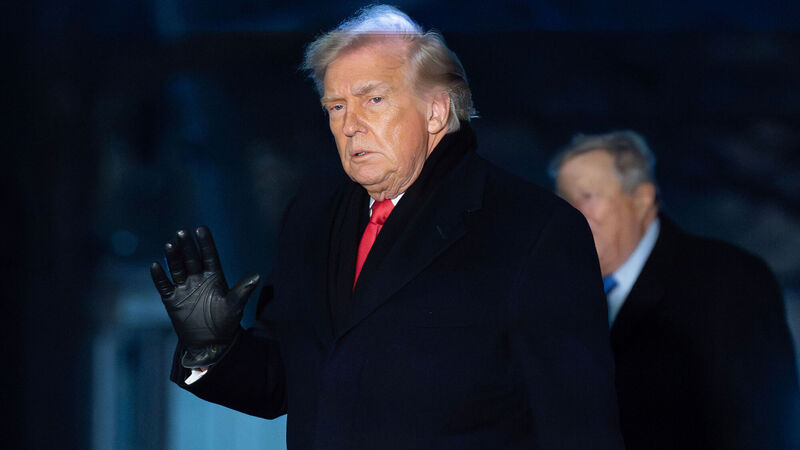
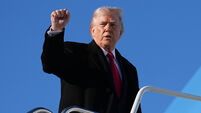
President Donald Trump waves to the media as he walks on the South Lawn of the White House, Tuesday, Jan. 20, 2026, in Washington. (AP Photo/Jose Luis Magana)
US president Donald Trump has linked his drive to take control of Greenland to his failure to win the Nobel Peace Prize, saying he no longer thought "purely of Peace" as the row over the island threatened to reignite a trade war with Europe.
Trump declined to tell NBC News in an interview whether he would use force to seize Greenland. He did reiterate his threat to hit European nations with tariffs if a deal is not reached.
Trump has intensified his push to wrest sovereignty over Greenland from fellow NATO member Denmark, prompting the European Union to weigh hitting back with its own measures.
The dispute threatens to upend the NATO alliance that has underpinned Western security for decades and which was already under strain over the war in Ukraine and Trump's refusal to protect allies unless they increase defence spending.
Trump's threat has rattled European industry and sent shockwaves through financial markets. Investors fear a return to the volatility of 2025's trade war, which only eased when the sides reached tariff deals in the middle of the year.
In a text message on Sunday to Norway's prime minister Jonas Gahr Stoere, Trump said: "Considering your Country decided not to give me the Nobel Peace Prize for having stopped 8 Wars PLUS, I no longer feel an obligation to think purely of Peace, although it will always be predominant, but can now think about what is good and proper for the United States of America."
Norway's government released the messages on Monday.
Stoere had sent an initial message with Finnish president Alexander Stubb calling for a de-escalation of tensions, eliciting a response from Trump less than half an hour later.
The Norwegian Nobel Committee annoyed Trump by awarding the 2025 Nobel Peace Prize not to him but to Venezuelan opposition leader Maria Corina Machado.
In his message, Trump also repeated his assertion that Denmark cannot protect Greenland from Russia or China.
"... And why do they have a 'right of ownership' anyway?" he wrote, adding: "The World is not secure unless we have Complete and Total Control of Greenland.” Trump vowed on Saturday to implement a wave of increasing tariffs from February 1 on EU members Denmark, Sweden, France, Germany, the Netherlands and Finland, along with Britain and Norway, until the US is allowed to buy Greenland, home to only 57,000 people.
"We are living in 2026, you can trade with people, but you don't trade people," Denmark's Foreign Minister Lars Lokke Rasmussen said during a visit to London on Monday.

In a post on Facebook, Greenland prime minister Jens-Frederik Nielsen said the territory should be allowed to decide its own fate.
"We will not let ourselves be pressured. We stand firm on dialogue, on respect and on international law," he said.
Denmark's military told Reuters that Danish soldiers would land in Kangerlussuaq, western Greenland, on Monday, as part of the Arctic Endurance military exercise.
Trump dismissed the arrival of NATO allies in Greenland.
“That wasn't a military," Trump told reporters on Monday in Florida before he boarded a flight back to Washington, DC.
"They sent a few people, and they say they sent them not for me, but to guard against Russia. But you know, NATO has been warning Denmark for about 20 years now, longer than that, 25 years, they've been warning Denmark about the Russian threat, and it's not only Russia, it's also China."
Norway's Stoere said he would change his schedule to attend the World Economic Forum in Davos on Wednesday and Thursday, overlapping with Trump's planned appearance at the annual gathering of the global political and business elite. The country will not change its stance on Greenland, the country's foreign minister Espen Barth Eide said.

German chancellor Friedrich Merz said he too would try to meet Trump on Wednesday, adding that a trade dispute was not wanted. "But if we are confronted with tariffs that we consider unreasonable, then we are capable of responding," Merz said.
Asked by reporters on Monday what he planned to say to European leaders in Davos about his Greenland plan, Trump said: "I don't think they're going to push back too much. Look, we have to have it."
"They have to have this done. They can't protect it. Denmark, they're wonderful people, and I know the leaders – they’re are very good people, but they don't even go there."
US Treasury Secretary Scott Bessent said it would be "very unwise" for European governments to retaliate.
"I think it’s a complete canard that the president will be doing this because of the Nobel prize. The president is looking at Greenland as a strategic asset for the United States," he told reporters in Davos.
EU leaders will discuss options at an emergency summit in Brussels on Thursday. One option is a package of tariffs on €93bn of US imports that could automatically kick in on February 6 after a six-month suspension.
Another option is the "Anti-Coercion Instrument" (ACI), which has never yet been used and which could limit access to public tenders, investments or banking activity or restrict trade in services, in which the US has a surplus with the bloc, including in digital services.
The EU said it was continuing to engage "at all levels" with the US but said the use of its ACI was not off the table.
British prime minister Keir Starmer called for calm discussion between the allies, adding he did not believe Trump was considering military action to seize Greenland.
Russia declined to comment on whether the US designs on Greenland were good or bad but said it was hard to disagree with experts that Trump would "go down in... world history" if he did take control of the island.

Speaking on Monday afternoon, Tánaiste Simon Harris warned that the threats against Greenland and sweeping new tariffs could have an “enormous” destabilising effect.
Mr Harris has called for “cool heads” and that the EU is not seeking a confrontation with the United States, amid Mr Trump’s proposals to introduce a 10% tariff on goods from Denmark, Norway, Sweden, France, Germany, the UK, the Netherlands and Finland from 1 February.
These tariffs would then increase to 25% on 1 June, unless a deal is reached to allow the US purchase Greenland, Mr Trump said.
Mr Harris said the EU had worked hard to reach a trade deal with the US last year and moving away from that would potentially have “very, very significant consequences”.
“The destabilising effects of the recent geopolitical developments could potentially be enormous, that’s why it’s more important than ever now that we seek dialogue,” Mr Harris said.
“It’s really important that Europe stands united.
“But we will, of course, prepare to respond accordingly should that be required.” The Finance Minister said much more can be achieved when the EU and US work together.
“It’s President Trump who, in recent days, has decided to threaten Europe with additional tariffs, ones that have a very significant destabilising effect. The destabilising effect could potentially be enormous, the cascading effect could be very, very significant,” Mr Harris said.
Mr Harris added the EU would be preparing for “all eventualities”.
The Tánaiste was speaking as he arrived for a meeting of EU Finance Minister's in Brussels, where normal discussions have been overshadowed by threats from the US President.
Meanwhile, Taoiseach Micheál Martin, Mr Harris and ministers Thomas Byrne and Sean Canney met with senior officials at the Department of Finance to be briefed on the possible impact of US tariffs on the EU.
Discussions also focused on the current situation surrounding Greenland, ahead of an emergency meeting of the EU council this Thursday.
It’s understood ministers discussed the need for continued solidarity across the EU, alongside respect for the rights of people living in Greenland.