Former EU foreign policy chief arrested in corruption probe
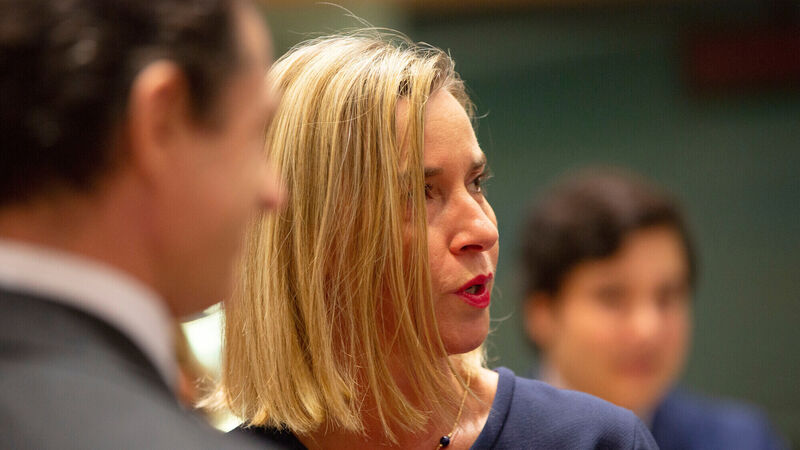
The European Union’s former foreign policy chief faces corruption accusations alongside two other people arrested this week as part of a fraud investigation, prosecutors said on Wednesday, in the latest scandal to hit the 27-nation bloc.
The arrest of Federica Mogherini, who led the EU foreign service from 2014 to 2019, risked tarnishing the EU’s international image just as it seeks to assert influence in negotiations aimed at ending the war in Ukraine. The EU has been urging Ukraine to tackle rampant corruption.

Authorities in Belgium made the arrests on Tuesday after raiding the offices of the EU diplomatic service in Brussels and a college in Bruges. Ms Mogherini now serves as the rector of the College of Europe, a prestigious institute of European studies.
The European Public Prosecutor’s Office said in a statement that Ms Mogherini, a senior staff member of the college and a senior official from the European Commission were detained at its request and questioned by the Belgian Federal Judicial Police.
“The accusations concern procurement fraud and corruption, conflict of interest and violation of professional secrecy,” the prosecutor’s office said.
The three were not considered flight risks and were released, the office said.
As the bloc’s top diplomat, Ms Mogherini was responsible for supervising the Iran nuclear talks, leading efforts to improve long-strained relations between Serbia and Kosovo, and a host of other foreign policy and security issues.
Police searched the properties of the suspects, several buildings of the college and the headquarters of the European External Action Service, or EEAS, the EU’s equivalent of a foreign office, which sits at the centre of the bloc’s institutions in Brussels, the prosecutors said.
No outside actor, or country, has been named so far in the investigation.
Ms Mogherini did not comment on the allegations, but her lawyer, Mariapaola Cherchi, told The Associated Press that her client was “transparent, clear and serene” during her 10-hour questioning. She said she was confident Ms Mogherini would be cleared “on the basis of such a clear interrogation, without any tension on either side”.
The college said it will co-operate with the investigation and that it “remains committed to the highest standards of integrity, fairness, and compliance — both in academic and administrative matters”.
The prosecutor’s office, an independent public organisation of the EU, said it had “strong suspicions” of fraud in the awarding of a tender to run a 2021-22 training programme at the EU Diplomatic Academy for junior diplomats. The former vice president of the European Commission, Josep Borrell, ran the EEAS.
The sums involved are relatively small. In establishing the EU Diplomatic Academy, the EU allocated 1.7 million euros (£1.49 million) to cover spending on the training programme from July 2024 to June 2025.
The corruption case targeting Ms Mogherini is the latest to hit European institutions.
Revelations of a cash-for-influence scheme dubbed Qatargate, involving high-profile centre-left EU lawmakers, assistants, lobbyists and their relatives, emerged in 2022.
Qatari and Moroccan officials were alleged to have paid bribes to influence decision-making. Both countries deny involvement. No one has been convicted or is in pretrial detention, and prospects for a trial are unclear.
In March this year, several people were arrested in a probe linked to the Chinese company Huawei, which is suspected of bribing EU politicians.
Last year, the aide of prominent far-right EU politician Maximilian Krah was arrested in a separate case. German prosecutors alleged the aide was a Chinese agent.
Mr Krah, who has since switched to the federal legislature of his native Germany, denied knowledge of the suspicions against his former employee.