Europeans accuse Putin of feigning interest in peace after talks with US envoys
Ukraine and its European allies accused Russian President Vladimir Putin on Wednesday of feigning interest in peace efforts after five hours of talks with US envoys at the Kremlin produced no breakthrough.
The Russian leader “should end the bluster and the bloodshed and be ready to come to the table and to support a just and lasting peace,” said British Foreign Secretary Yvette Cooper.
Ukrainian Foreign Minister Andrii Sybiha urged Mr Putin to “stop wasting the world’s time”.
The remarks reflect the high tensions and gaping gulf that remain between Russia on one side and Ukraine and its European allies on the other over how to end a war that Moscow started when it invaded its neighbour nearly four years ago.
A day earlier, Mr Putin accused the Europeans of sabotaging the US-led peace efforts and warned that, if provoked, Russia would be ready for war with Europe.
Since Moscow invaded Ukraine in 2022, European governments, along with the US, have spent billions of dollars to support Kyiv financially and militarily. Under US President Donald Trump, however, the US has tempered its support – and instead made a push to end the war.
On Wednesday, the Kremlin spokesman said he would not discuss the substance of the talks but pushed back on any suggestion that Mr Putin had rejected the US peace plan.
Where the peace talks go from here depends largely on whether the Trump administration decides to increase the pressure on Russia or on Ukraine to make concessions.
A US peace proposal that became public last month was criticised for being tilted heavily toward Moscow because it granted some of the Kremlin’s core demands that Kyiv has rejected as nonstarters.
Many European leaders worry that if Russia gets what it wants in Ukraine, it will have free rein to threaten their countries, which already have faced incursions from Russian drones and fighter jets, and an alleged widespread sabotage campaign.
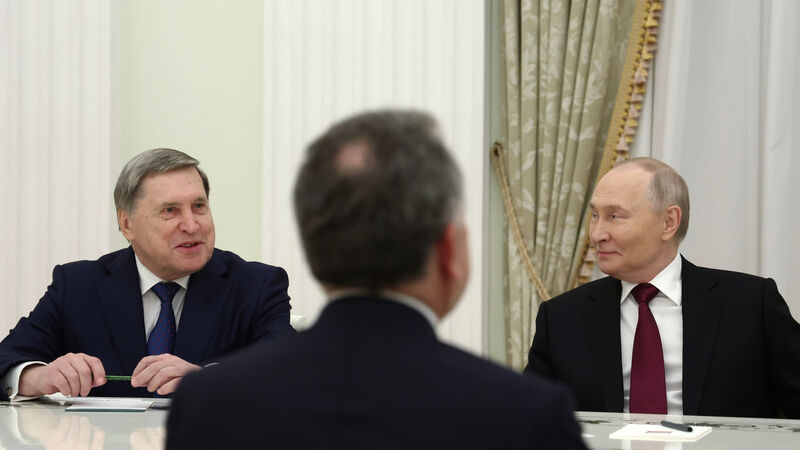
Mr Putin met on Tuesday in Moscow with Mr Trump’s envoy Steve Witkoff and son-in-law Jared Kushner. The Russian and American sides agreed not to disclose the substance of the talks, but at least one major hurdle to a settlement – the fate of four Ukrainian regions Russia partially seized and occupies and claims as its own – remains.
After the talks, Yuri Ushakov, a senior adviser to Mr Putin, told reporters that “so far, a compromise hasn’t been found” on the issue of territory, without which, he said, the Kremlin sees “no resolution to the crisis”.
Ukraine has ruled out giving up territory that Russia has captured.
Asked whether peace was closer or further away after these talks, Mr Ushakov said: “Not further, that’s for sure.”
“But there’s still a lot of work to be done, both in Washington and in Moscow,” he said.
Kremlin spokesman Dmitry Peskov said on Wednesday that it was “not correct” to say that Mr Putin had rejected the US peace plan. He declined to comment further on the talks.
“We’re deliberately not going to add anything,” he said. “It’s understood that the quieter these negotiations are conducted, the more productive they will be.”
Foreign ministers from European Nato countries, meeting in Brussels on Wednesday, showed little patience with Moscow.
“What we see is that Putin has not changed any course. He’s pushing more aggressively on the battlefield,” Estonian Foreign Minister Margus Tsahkna said.
“It’s pretty obvious that he doesn’t want to have any kind of peace.”
Finnish Foreign Minister Elina Valtonen struck the same note. “So far we haven’t seen any concessions from the side of the aggressor, which is Russia, and I think the best confidence-building measure would be to start with a full ceasefire,” she told reporters.
Nato secretary-general Mark Rutte said Ukraine’s partners will keep sending it military aid to ensure pressure is maintained on Moscow.
“The peace talks are ongoing. That’s good,” Mr Rutte said.
“But at the same time, we have to make sure that whilst they take place and we are not sure when they will end, that Ukraine is in the strongest possible position to keep the fight going, to fight back against the Russians,” he said.
Canada, Germany, Poland and the Netherlands announced that they will spend hundreds of millions of dollars more together to buy US weapons to donate to Ukraine.
This year, European countries in Nato, and Canada, began buying American weapons for Ukraine under a financial arrangement known as the Prioritised Ukraine Requirements List, or Purl.
Russian drones hit the town of Ternivka in Ukraine’s Dnipropetrovsk region, killing two people and injuring three more, the head of the regional military administration, Vladyslav Haivanenko, said on Wednesday.
Two people were in critical condition, he said, after the attack destroyed one house and damaged six more.
Overall, Russia fired 111 strike and decoy drones at Ukraine overnight, Ukraine’s air force said.
Meanwhile, Russia’s Ministry of Defence said on Wednesday that air defences destroyed 102 Ukrainian drones overnight.
Falling drone debris sparked a fire at an oil depot in the Tambov region, about 200 kilometres (120 miles) south of Moscow, local governor Yegveniy Pervyshov said.
Mr Putin will be in India this week for a summit aimed at deepening economic, defence and energy ties, a visit that will also test New Delhi’s efforts to balance relations with Moscow and Washington as the war in Ukraine grinds on.
Mr Putin is scheduled to arrive on the state visit on Thursday and hold talks with Indian Prime Minister Narendra Modi on Friday.