Polish court blocks extradition and frees Ukrainian suspected in pipeline blasts
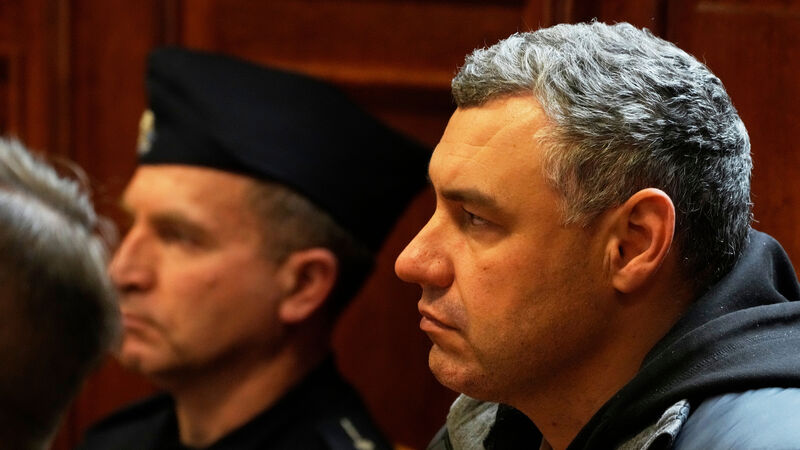
A Polish court has blocked the extradition to Germany of a Ukrainian man suspected of involvement in the 2022 attack on the Nord Stream gas pipelines and ordered his release, a ruling welcomed by Polandâs prime minister.
Volodymyr Zhuravlov, 46, was arrested near Warsaw on September 30 on a German warrant.
German prosecutors have described him as a trained diver and allege that he was part of a group that placed explosives on the pipelines near the Danish island of Bornholm three years ago.
The Warsaw District Court rejected his extradition on Friday and ordered his immediate release.
The manâs lawyer, Tymoteusz Paprocki, said ahead of the hearing that âmy client doesnât admit guilt, he didnât commit any crime against Germany and he doesnât understand why these charges were made by the German sideâ.
He also said he would argue that no Ukrainian should be charged with any action directed against Russia.
Speaking as he announced his ruling, Judge Dariusz Lubowski said that the attack on the pipelines should be understood as a military action in a âjust warâ, and therefore not subject to criminal responsibility on the part of an individual.
He also questioned German jurisdiction for various reasons, including the fact that the explosions occurred in international waters.
Poland, whose successive governments have been staunchly anti-Russian, has a history of opposition to the pipelines.
Prime Minister Donald Tusk has said it would not be in Polandâs interest to hand over the suspect.
Polish court denied extradition to Germany of a Ukrainian national suspected of blowing up Nord Stream 2 and released him from custody. And rightly so. The case is closed.
— Donald Tusk (@donaldtusk) October 17, 2025
Mr Tusk noted in a post on X Friday that the court had rejected extradition, âand rightly soâ.
He added that âthe case is closedâ.
Undersea explosions on September 26 2022 severely damaged the pipelines.
The damage added to tensions over the war in Ukraine as European countries moved to wean themselves off Russian energy sources, following the Kremlinâs full-scale invasion of Ukraine.
The explosions ruptured the Nord Stream 1 pipeline, which was inaugurated in 2011 and carried Russian natural gas to Germany under the Baltic Sea until Russia cut off supplies at the end of August 2022.
They also damaged the parallel Nord Stream 2 pipeline, which never entered service because Germany suspended its certification process shortly before Russia invaded Ukraine in February 2022.
Germany had previously pushed ahead with the Nord Stream 2 project despite opposition from central and eastern European countries and the US, which argued it would increase Europeâs dependence on Russian gas and give Russia the possibility of using gas as a geopolitical weapon.
Mr Tusk said earlier this month that âthe problem of Europe, the problem of Ukraine, the problem of Lithuania and Poland is not that Nord Stream 2 was blown up, but that it was builtâ.
He said that âthe only people who should be ashamed of and quiet about Nord Stream 2 are those who decided to build itâ.
At the time of his arrest, Mr Zhuravlov was a resident of Poland, where he lived with his wife and children, Polish prosecutors said.
His wife has told Polish media her husband is innocent and that they were together in Poland at the time the pipelines were blown up.
He is one of two Ukrainians whose extradition German judicial authorities have been trying to secure in the case.
A man suspected to have been one of the co-ordinators of the attack was arrested in Italy in August.
This week, Italyâs top court annulled a lower courtâs decision to order his extradition and called for another panel of judges to reassess the case, his lawyer said.
The German government has declined to comment on Mr Tuskâs remarks this month, and has noted that the ongoing proceedings are in prosecutorsâ hands.
Neither the government nor German federal prosecutors, who are in charge of the case, had any comment on Fridayâs ruling.