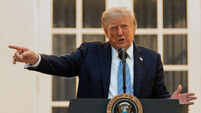
World shares mixed ahead of meeting between Trump and Putin
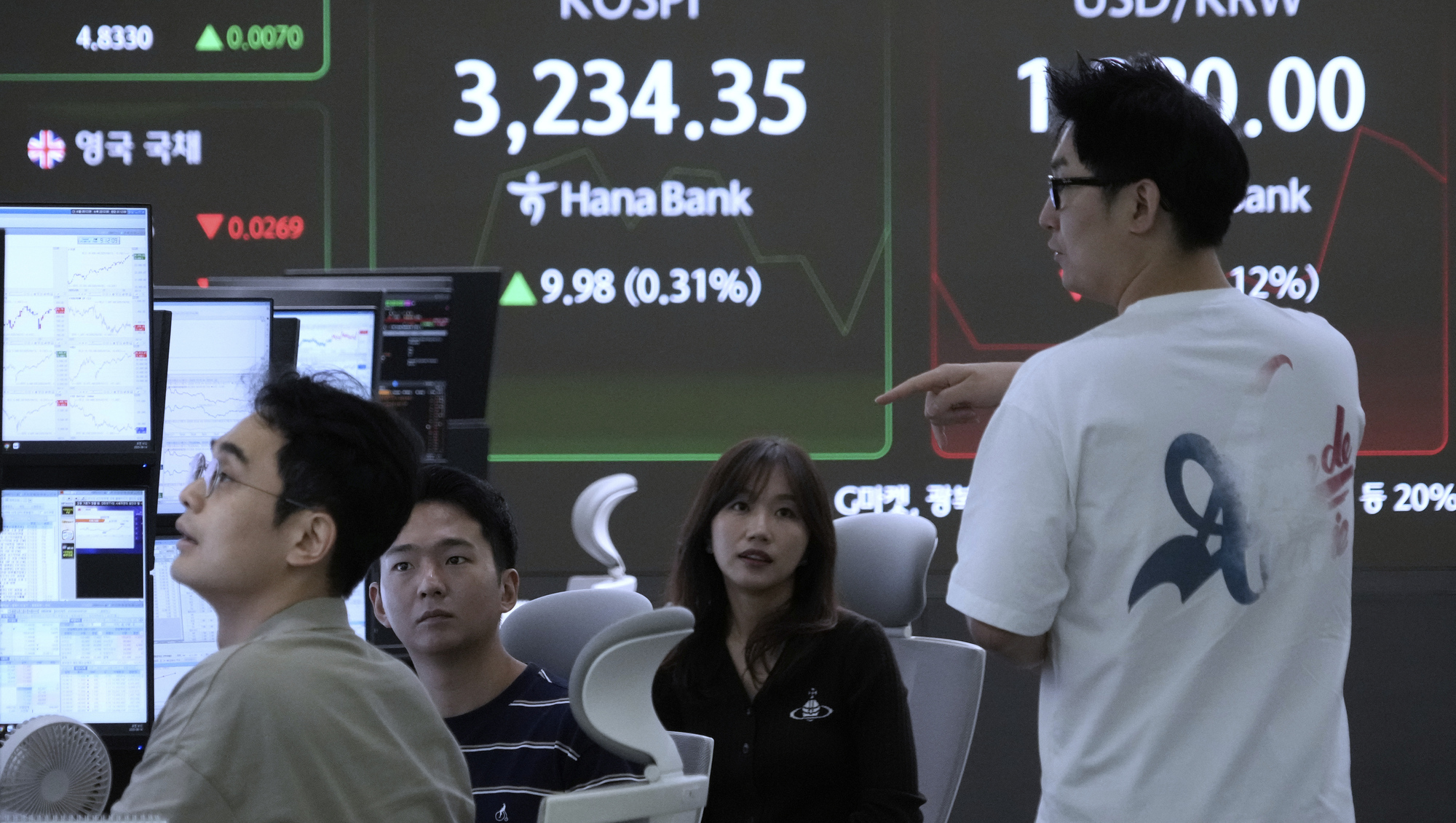
Currency traders work near a screen showing the Korea Composite Stock Price Index (Kospi) and the foreign exchange rate between US dollar and South Korean won, right, at the foreign exchange dealing room of the Hana Bank headquarters in Seoul, South Korea. Picture: Ahn Young-joon/AP
World shares are mixed ahead of a key meeting between Us President Donald Trump and Russian President Vladimir Putin at the end of this week.
Bitcoin briefly rose more than 3% to a new record of over 123,000 dollars, according to CoinDesk.
It later fell back below 122,000 dollars.

The future for the S&P 500 was unchanged, while that for the Dow Jones Industrial Average edged 0.1% higher.
Later Thursday, a report will show how bad US inflation was at the wholesale level across the US.
Economists expect it to show inflation ticked up to 2.4% in July from 2.3% in June.
In early European trading, Germany’s DAX rose 0.5% to 24,296.02.
In Paris, the CAC 40 added 0.4% to 7,832.60.
Europe is bracing for Mr Trump’s encounter with Mr Putin, though the US president has said he will prioritise trying to achieve a ceasefire in Ukraine when he meets with Mr Putin on Friday in Anchorage, Alaska.
The Trump-Putin meeting could have major implications for energy markets, potentially leading to an easing of sanctions against Moscow, or an escalation if no progress is made on ending the war in Ukraine.
Early on Thursday, US benchmark crude rose 28 cents to 62.93 dollars per barrel.
Brent crude, the international standard, added 32 cents to 65.95 dollars per barrel.
During Asian trading, Tokyo’s Nikkei 225 fell nearly 1.5% to 42,649.26 as investors sold to lock in recent gains that have taken the benchmark to all-time records.

The Japanese yen rose against the dollar after US treasury secretary Scott Bessent said in an interview with Bloomberg that Japan was “behind the curve” in monetary tightening.
He was referring to the slow pace of increases in Japan’s near-zero interest rates.
Low interest rates tend to make the yen weaker against the dollar, giving Japanese exporters a cost advantage in overseas sales.
The dollar fell to 146.50 Japanese yen Thursday, down from 147.39 yen.
The euro slid to 1.1681 dollars from 1.1705 dollars.
In Chinese markets, Hong Kong’s Hang Seng index shed 0.4% to 25,519.32, while the Shanghai composite index slid 0.5% to 3,666.44.
South Korea’s Kospi rose less than 0.1% to 3,225.66.
In Australia, the S&P ASX 200 index added 0.5% to 8,873.80.
Taiwan’s Taiex fell 0.5% and India’s Sensex edged 0.2% higher.
On Wednesday, US stocks ticked higher, extending a global rally fuelled by hopes the Federal Reserve will cut US interest rates.
The S&P 500 rose 0.3% and the Dow climbed 1%.
The Nasdaq composite added 0.1%.
Treasury yields eased in the bond market in anticipation that the Fed will cut its main interest rate for the first time this year at its next meeting in September.
Lower rates can boost investment prices and the economy by making it cheaper for US households and businesses to borrow to buy houses, cars or equipment, though they risk worsening inflation.
Mr Trump has angrily been calling for cuts to help the economy, often insulting the Fed chairman Jerome Powell while doing so.
But the Fed has hesitated, worried that Mr Trump’s sweeping higher tariffs could make inflation much worse.
Fed officials have said they want to see more fresh data about inflation before moving.
CONNECT WITH US TODAY



Be the first to know the latest news and updates