S&P 500 jumps 1.8% as Wall Street closes a chaotic and historic week
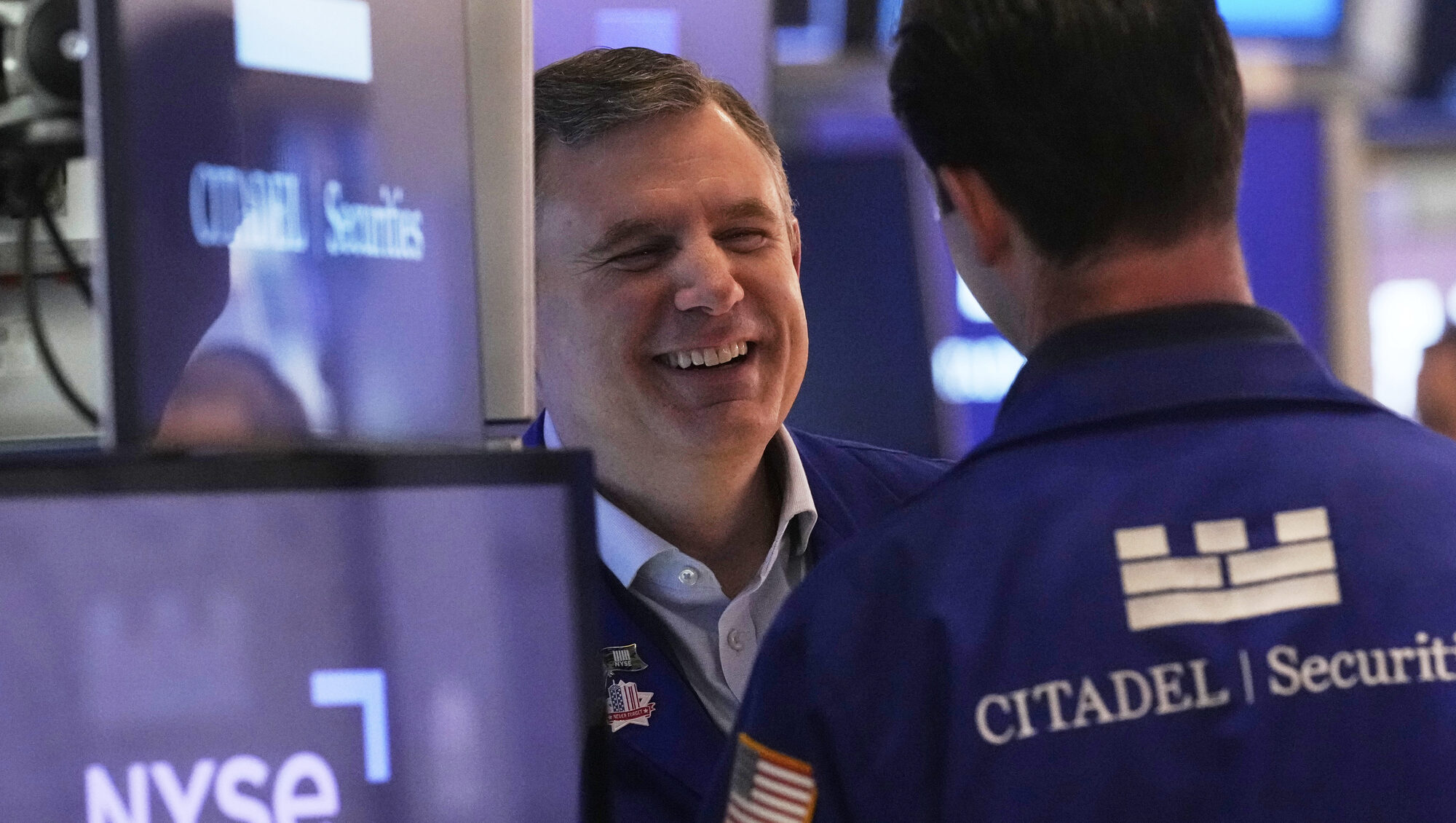
Another manic day on Wall Street ended with a slight rise for the S&P 500 of 1.8%. Picture: Richard Drew/AP
US stocks jumped on Friday in another manic day on Wall Street, while the falling value of the US dollar and other swings in financial markets suggested fear is still high about escalations in President Donald Trumpâs trade war with China.
The S&P 500 rallied 1.8%, after veering repeatedly between gains and losses, to cap a chaotic and historic week full of monstrous swings. The Dow Jones Industrial Average went from an early loss of nearly 340 points to a gain of 810 before settling at a rise of 619 points, or 1.6%, while the Nasdaq composite jumped 2.1%.
Stocks kicked higher as pressure eased a bit from within the US bond market. Itâs typically the more boring corner of Wall Street, but itâs been flashing serious enough signals of worry this week that itâs demanded investorsâ and Mr Trumpâs attention.
The yield on the 10-year Treasury topped 4.58% in the morning, up from 4.01% a week ago. Thatâs a major move for a market that typically measures things in hundredths of a percentage point. Such jumps can drive up rates for mortgages and other loans going to US households and businesses, which would slow the economy, and they can indicate stress in the financial system.
But Treasury yields eased back as the afternoon progressed, and the 10-year yield regressed to 4.48%. Thatâs still higher than the day before, but not by as eye-wateringly much.
Susan Collins, president of the Federal Reserve Bank of Boston, told the Financial Times that the Fed âwould absolutely be preparedâ if markets become disorderly and âdoes have tools to address concerns about market functioning or liquidity should they ariseâ.
Several reasons could be behind this weekâs jump in US Treasury yields, which is unusual because yields typically fall when fear is high.
Investors outside the United States could be selling their US bonds because of the trade war, and hedge funds could be selling whateverâs available in order to raise cash to cover other losses.
More worryingly, doubts may be rising about the United Statesâ reputation as the worldâs safest place to keep cash because of Mr Trumpâs frenetic, on-and-off tariff actions.
The value of the US dollar also fell again on Friday against everything from the euro to the Japanese yen to the Canadian dollar.
That comes even though gold, another place where investors have instinctually flocked when fear is high, rose to bolster its reputation as a safer haven.
The shaky trading came after China announced that it was boosting its tariffs on US products to 125% on Friday in the latest tit-for-tat increase following Mr Trumpâs escalations on imports from China.
The repeated US tariff increases âon China has become a numbers game, which has no practical economic significance, and will become a joke in the history of the world economy,â a Finance Ministry spokesman said in a statement announcing the new tariffs.
âHowever, if the US insists on continuing to substantially infringe on Chinaâs interests, China will resolutely counter and fight to the end.â
Rising tensions between the worldâs two largest economies could cause widespread damage and a possible global recession, even after Mr Trump recently announced a 90-day pause on some of his tariffs for other countries, except for China.
All the uncertainty caused by the trade war is eroding confidence among US shoppers, which could affect their spending and translate into damage to the economy, which came into this year running at a solid rate.
A preliminary survey by the University of Michigan suggested sentiment among US consumers is falling even more sharply than economists expected.
The surveyâs director, Joanne Hsu said: âThis decline was, like the last monthâs, pervasive and unanimous across age, income, education, geographic region, and political affiliation.â
According to Darrell Cronk, president of Wells Fargo Investment Institute: âWe remain in the early innings of this global trade regime change, and while the 90-day pause on reciprocal tariffs temporarily reversed the market selloff, it does prolong uncertainty.â
That is why many on Wall Street are prepared for more swings to hit markets.
This past week began with huge swings for US stocks each day as rumours swirled and then got batted down about a possible 90-day pause on Mr Trumpâs tariffs.
Then the US stock market surged to one of its best days in history after Mr Trump delivered a pause, before swinging to end the week.
All told, the S&P 500 rose 95.31 points Friday to 5,363.36. The Dow Jones Industrial Average climbed 619.05 to 40,212.71, and the Nasdaq composite climbed 337.14 to 16,724.46.
Fridayâs swings came after a set of stronger-than-expected profit reports from some of the biggest US banks, which traditionally help kick off each earnings reporting season.
JPMorgan Chase, Morgan Stanley and Wells Fargo all reported stronger profits for the first three months of the year than analysts expected. JPMorgan Chase rose 4%, Morgan Stanley added 1.4% and Wells Fargo lost 1%.
Another report on inflation also came in better than expected. That could give the Federal Reserve more leeway to cut interest rates if it feels the need to support the economy.
But Fridayâs report on inflation at the wholesale level was backward-looking, measuring Marchâs price levels. The worry is that inflation will rise in the coming months as Mr Trumpâs tariffs make their way through the economy. And that could tie the Fedâs hands.
The University of Michiganâs survey suggested US consumers are bracing for inflation of 6.7% in the year ahead, which is the highest forecast since 1981, and such expectations can create a feedback loop that pushes inflation higher.
In stock markets abroad, indexes were scattershot around the world.
Germanyâs DAX lost 0.9%, but the FTSE 100 in London added 0.6% as the government reported the economy, the worldâs sixth largest, enjoyed a growth spurt in February.
Japanâs Nikkei 225 dropped 3%, while Hong Kongâs Hang Seng climbed 1.1%.