Spacecraft set to map water on the Moon
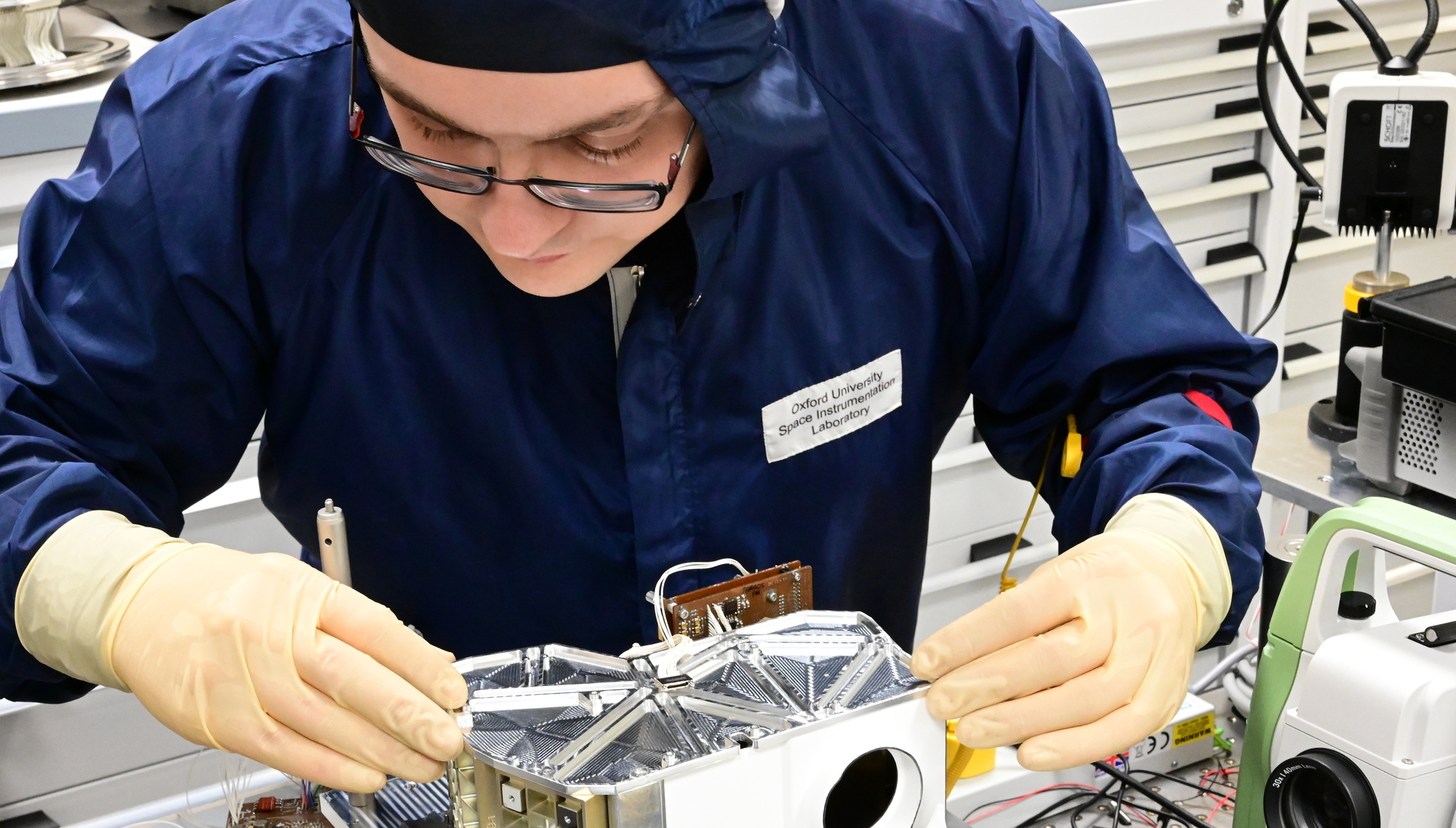
Dr Rory Evans performing optical assembly and alignment on a component of the Lunar Trailblazer spacecraft. Picture: Department of Physics/University of Oxford/PA
Scientists are set to launch a spacecraft this week to map water on the Moon, which could help future efforts to colonise its surface.
The Lunar Trailblazer spacecraft, which will launch from Nasaâs Kennedy Space Centre in Florida, carries a state-of-the-art camera designed by a team of University of Oxford scientists to measure lunar surface temperature and confirm locations where water supplies may be found for future extraction.
Professor Neil Bowles, instrument scientist at the University of Oxfordâs physics department, said the mission will be âuseful scientifically to understand the lunar water cycle and it is also important as a potential for future human explorationâ.
Scientists have suspected that there is water on the Moon since Indian and American spacecraft detected signs of hydrated minerals in 2009.
âAlthough it is a relatively small spacecraft, around 200 kilogrammes, it has a very important science goal,â Prof Bowles said.
âWe think there is water at the Moonâs poles as ice and that there may be very thin layers of water on the surface,â Prof Bowles continued, adding âthe Lunar Trailblazer spacecraftâs mission is to try to map and understand thisâ.
The Trailblazer craft is scheduled to be launched onboard SpaceXâs Falcon 9 rocket at 7.17pm Eastern Standard Time on Wednesday, which is 17 minutes past midnight in the UK on Thursday, at the earliest and has a four-day launch window.
It will share the journey with Intuitive Machineâs privately owned Athena lunar lander and a probe ship made by an asteroid mining company.
With the Trailblazerâs relatively small engines, the satellite will use the gravity of the Sun, Moon and Earth once it leaves the Falcon 9 rocket to guide it to the Moonâs surface.
The Lunar Thermal Mapper (LTM) camera, which was designed by Oxford scientists, is one of two instruments on the spacecraft.
The LTM camera will measure the surface temperature on the Moon, while an instrument known as the HVM3 made by scientists at Nasaâs jet propulsion laboratory will measure how sunlight is absorbed and reflected by water layers.
Prof Bowles said he hopes the mission will provide information on soil chemistry, whether the amount of water is usable, and whether âchemical processes are there so that we could make more water if we needed toâ.
âThe team worked extremely hard to get the instrument built, doing a lot of the work during the pandemic in a really challenging environment,â Prof Bowles said, âbut we got there in the end, which is the most important thing, and now we are ready to go to the Moon.â