Impeached South Korean president issues defiant message
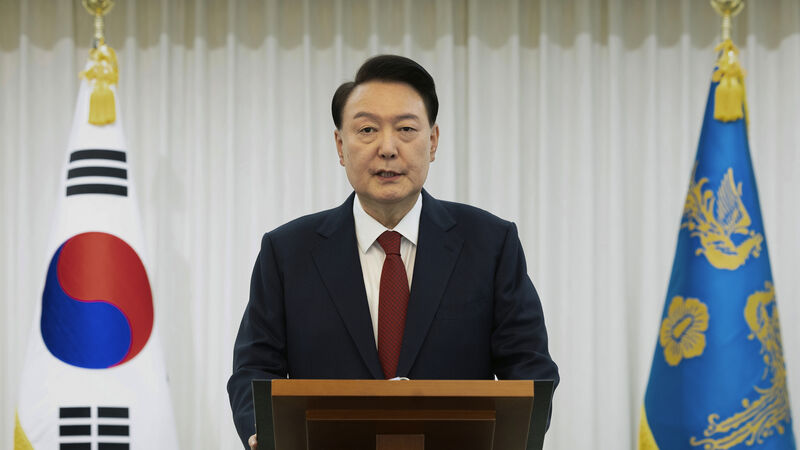
Impeached South Korean President Yoon Suk Yeol issued a defiant statement to his conservative supporters gathered outside his residence in the capital of Seoul, vowing to âfight to the endâ against what he called âanti-state forcesâ.
It comes as law enforcement prepared to detain him over last monthâs martial law decree.
The Corruption Investigation Office for High-Ranking Officials has a week to execute its detainment warrant against Mr Yoon, issued by a Seoul court on Tuesday.
The warrant came after Mr Yoon defied several requests to appear for questioning and blocked searches of his office, hindering an investigation into whether his short-lived power grab on December 3 amounted to rebellion.
Oh Dong-woon, the anti-corruption agencyâs chief prosecutor, has indicated that police forces might be deployed if Mr Yoonâs security service resists the detention attempt, which could occur as early as Thursday. But it remains unclear whether Mr Yoon can be compelled to submit to questioning.
In a message to hundreds of supporters gathered outside his residence on Wednesday evening, Mr Yoon said he would continue to fight against anti-state forces âviolating our sovereigntyâ and putting the nation in âdangerâ.
He applauded his supporters for their efforts to protect the countryâs âliberal democracy and constitutional orderâ and said he was watching their protests on live YouTube broadcasts, according to a photo of the message shared by Mr Yoonâs lawyers.
The liberal opposition Democratic Party, which drove the legislative vote that impeached Mr Yoon on December 14 over the martial law imposition, accused the president of trying to mobilise his supporters to block his detention and called for law enforcement authorities to execute the warrant immediately.
A growing number of Mr Yoonâs supporters were again gathering near his residence on Thursday morning amid a heavy police presence, waving small South Korean and American flags and holding signs opposing his impeachment.
Mr Yoonâs lawyers have argued that the courtâs detainment warrant is âinvalidâ, claiming that the anti-corruption agency lacks legal authority to investigate rebellion charges.
They also accuse the court of bypassing a law that says locations potentially linked to military secrets cannot be seized or searched without the consent of the person in charge.
Some experts believe the anti-corruption agency, which is leading a joint investigation with police and military authorities, would not risk clashing with Mr Yoonâs security service, which has said it will provide security to Mr Yoon in accordance with the law.
The office may instead issue another summons for Mr Yoon to appear for questioning if they are not able to execute the detainment warrant by January 6.
Mr Yoonâs presidential powers were suspended following the National Assembly vote to impeach him on December 14 over his imposition of martial law, which lasted only hours but has triggered weeks of political turmoil, halted high-level diplomacy and rattled financial markets.
Mr Yoonâs fate now lies with the Constitutional Court, which has begun deliberations on whether to uphold the impeachment and formally remove Mr Yoon from office or reinstate him.
To formally end Mr Yoonâs presidency, at least six justices on the nine-member Constitutional Court must vote in favour.
The National Assembly voted last week to also impeach prime minister Han Duck-soo, who had assumed the role of acting president after Mr Yoonâs powers were suspended, over his reluctance to fill three Constitutional Court vacancies ahead of the courtâs review of Mr Yoonâs case.
In the face of growing pressure, the countryâs new interim leader, deputy prime minister Choi Sang-mok, appointed two new justices on Tuesday, which possibly increased the chances of the court upholding Mr Yoonâs impeachment.