More bad weather could hit Iowa, where three tornadoes caused millions in damage
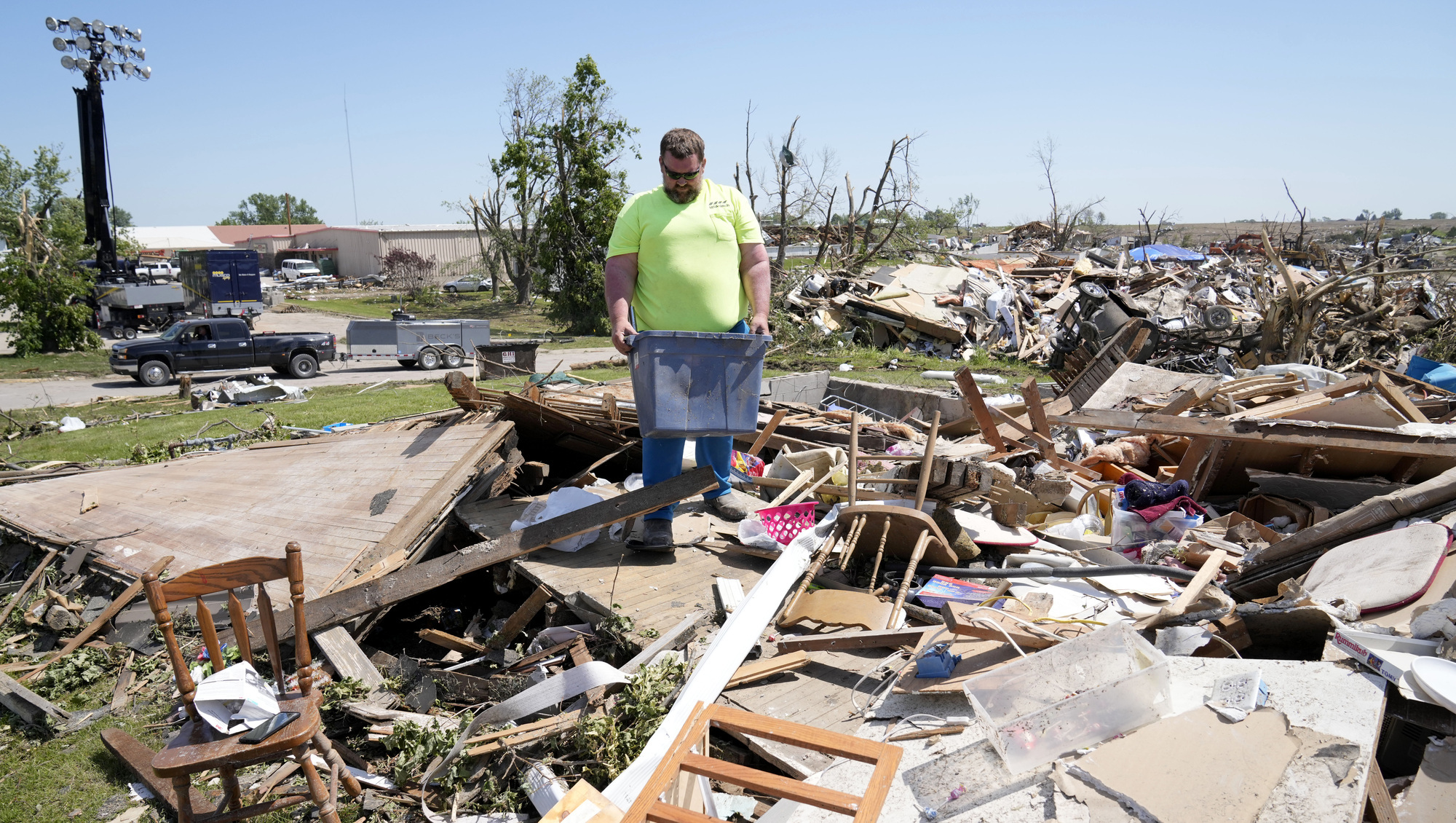
Mitch Ernst, of Adair, Iowa, sorts through debris from his mother-in-law’s tornado damaged home, Thursday, May 23, 2024, in Greenfield, Iowa (Charlie Neibergall/AP)
For block after block through the small city of Greenfield, Iowa, the destructive power of an EF-4 tornado that ripped apart more than 100 of the town’s homes in just one minute is evident in the muddy, shattered mess left behind.
All along the mile-long swath on Thursday were the noisy clamour of heavy equipment scooping up the splintered homes, smashed vehicles and shredded trees.
But on either side of that path, picturesque houses and lawns seem untouched, and one might be hard-pressed to believe a twister packing peak winds of 175-185 mph had ravaged the community of 2,000, killing four people and injuring at least 35.
Iowa Governor Kim Reynolds said at a news conference on Thursday that more than 202 homes were destroyed by a series of tornadoes that raked the state on Tuesday.
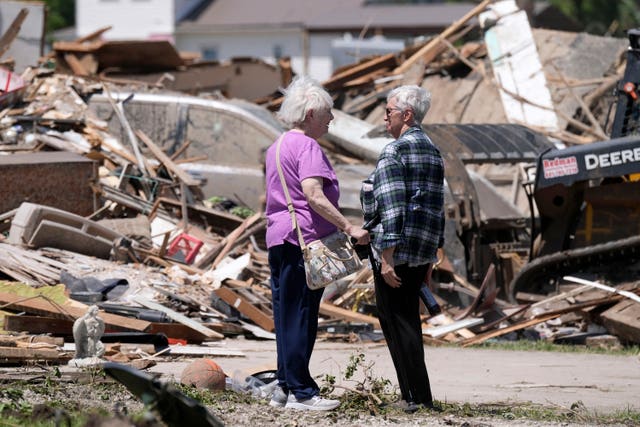
Most were in and around Greenfield. The count does not include businesses or other buildings destroyed or damaged, like Greenfield’s 25-bed hospital.
The havoc spun by the tornado now shows on the faces of people still processing how quickly homes and lives were shattered.
Among those killed were Dean and Pam Wiggins, said their grandson Tom Wiggins.
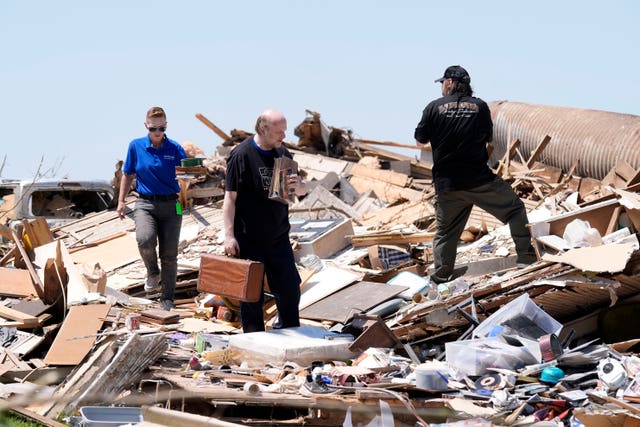
On Thursday, Tom Wiggins tried to find any of his grandparents’ mementoes that remained after the tornado demolished their home, leaving little more than the structure’s foundation. He described them as “incredibly loved by not only our family but the entire town”.
Not far away, Bill Yount, 64, also was cleaning up.
“It’s like somebody took a bomb,” said Mr Yount, gesturing to the land — covered with wood, debris, trees stripped of their leaves, heavy machinery and equipment to clean up the mess.
Mr Yount’s house was the only one “that really survived. And I don’t know why”, he said, pointing to the devastated remains of his neighbours’ homes.
Also surveying the damage was 80-year-old Edith Schaecher, who was briefly trapped in her collapsed house with her daughter until neighbours helped them out. They sought shelter in a basement concrete shower, holding pillows over their heads to protect them from the falling debris.
“It was over within probably 30 seconds,” she said, destroying the home where she had lived for 47 years.
Ms Schaecher’s neighbour, Joan Mitchell, was with her 57-year-old son in the home she had lived in for 10 years when the tornado roared through.
She had ignored the tornado warnings — until she was knocked to the floor and two recliners flew on top of her.
“I kept praying and praying, and after that, I started hollering, ‘Help! Help! Help!’” Ms Mitchell recalled. Both she and her son survived with bumps and bruises.
The governor praised the Federal Emergency Management Agency (Fema)’s response on Thursday as she sought a disaster declaration for multiple counties.
After surveying Tuesday’s destruction, the National Weather Service (NWS) determined that three separate powerful tornados carved paths totalling 130 miles across Iowa, according to Donna Dubberke, the meteorologist in charge in Des Moines.
Colton Newbury, 24, was working in Des Moines when the twister hit, nearly 60 miles away from his wife and 10-month-old daughter at their home in Greenfield.
He rushed back only to find their home was “a hole in the ground”, he said. His wife had not heard the sirens.
Mr Newbury said his cousin ran out to get his wife and baby, and they rode out the tornado in the cousin’s basement. The winds pulled entire homes away, he said: “About every house on the block, just foundations left.”
Still, more severe weather was moving across the Midwest. The weather service’s Storm Prediction Centre shows an enhanced severe storm risk late on Thursday into Friday morning for much of Nebraska and western Iowa, including areas where tornadoes hit Iowa and hurricane-force winds, large hail and torrential rain flooded streets and basements in Nebraska.
This latest band of severe weather — including possible tornadoes — will hit Iowa “when people are sleeping”, warned NWS meteorologist Andrew Ansorge of Des Moines.
“Because of the damage already there, it won’t take much wind to inflict even more damage on these homes,” Mr Ansorge said. “It’s just a bad deal all the way around.”
More severe weather could also hit on Saturdays and Sundays in storm-damaged parts of Texas, Oklahoma, and Kansas.
An emergency was declared in Temple, Texas after powerful storms ripped through the city of more than 90,000.
Thousands lost power, Thursday’s classes were cancelled, and nearby Fort Cavazos reported debris blocking traffic at the Army installation.
Before Tuesday’s twister in Greenfield, this year’s deadliest tornado was the one that killed three people in Logan County, Ohio, on March 14.
The Greenfield tornado set a new grim record as it obliterated homes and crumpled massive power-producing wind turbines outside the city.
The Greenfield tornado, initially rated an EF-3, was identified on Thursday as the third EF-4 tornado of 2024. The first was in Marietta-Lake Murray, Oklahoma, in April and the second in Barnsdall, Oklahoma, earlier this month.
According to Storm Prediction Centre Warning Coordination Meteorologist Matt Elliott, on average, there are three or four EF-4 tornadoes a year, with a record high of 13 in 2011.
It was so destructive that it took authorities more than a day to account for the area’s residents, and Iowa’s Department of Public Safety said the number of injured is likely even higher. Officials have not yet released the names of the Greenfield victims.
A fifth person was killed on Tuesday about 25 miles from Greenfield when her car was blown off the road in a tornado, according to the Adams County Sheriff’s Office. Monica Zamarron, 46, died in the crash on Tuesday afternoon, officials said.
Reynolds has requested an expedited presidential disaster declaration for Iowa counties that sustained significant damage. Fema administrator Deanne Criswell joined her at the news conference in Greenfield and said that her agency would process the request as quickly as possible to provide resources—which could include funding for temporary housing—to those left without homes.
This is a historically busy tornado season in the US, in an era when climate change is heightening the severity of storms around the world. April had the country’s second-highest number of tornadoes on record.
Through Tuesday, 859 tornadoes had been confirmed this year, 27% more than the US sees on average, according to the National Oceanic and Atmospheric Administration Storm Prediction Centre in Norman, Oklahoma. Iowa has recorded the most, with 81 confirmed twisters.

CONNECT WITH US TODAY



Be the first to know the latest news and updates