Nato marks 75th birthday as Russia’s war in Ukraine gnaws at unity
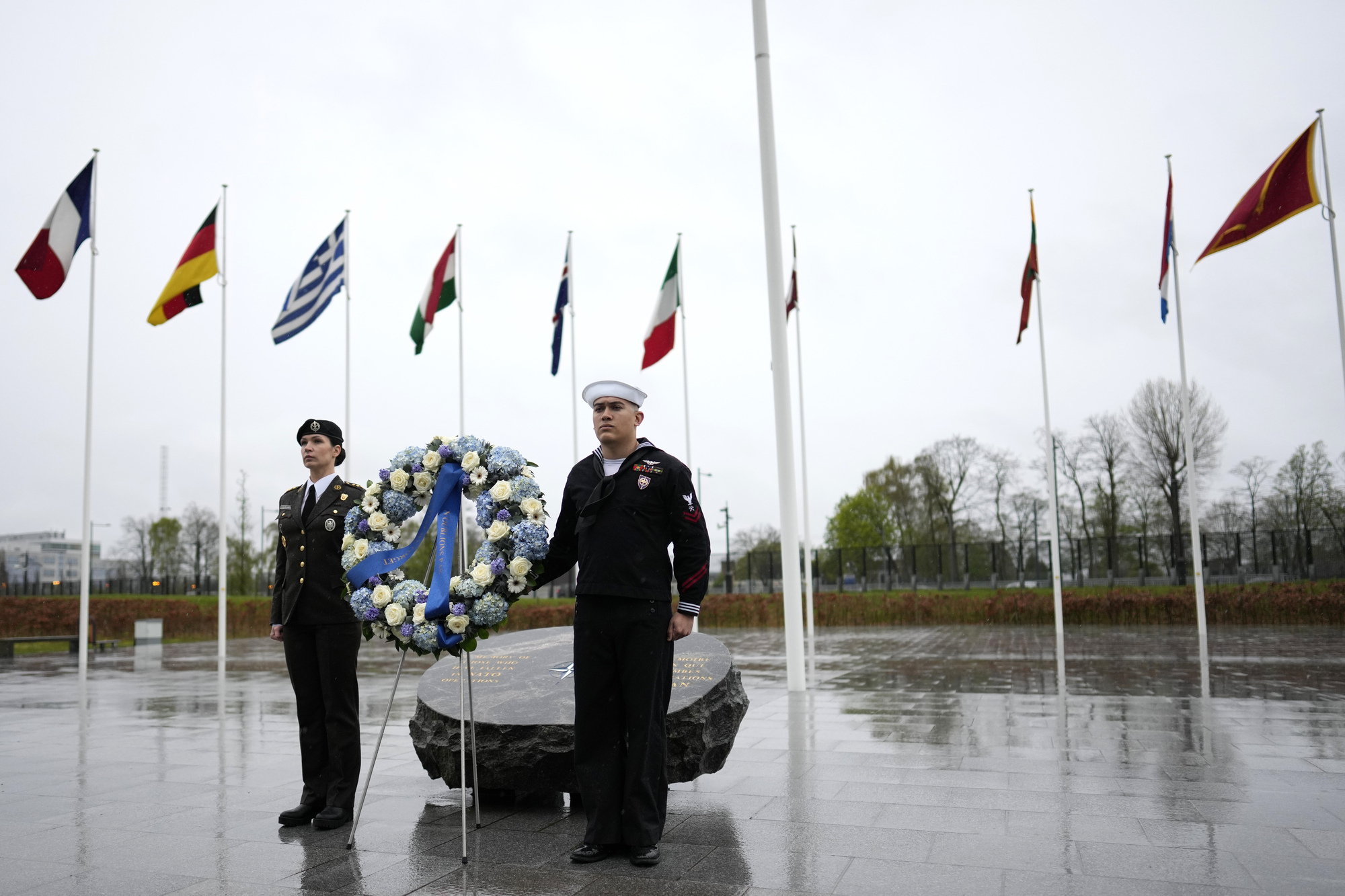
Nato has marked 75 years of collective defence across Europe and North America, with its top diplomats vowing to stay the course in Ukraine as better armed Russian troops assert control on the battlefield.
The anniversary comes as the now-32-nation alliance weighs a plan to provide more predictable longer-term military support to Ukraine.
Plagued by ammunition shortages, Ukraine this week lowered the military conscription age from 27 to 25 in an effort to replenish its depleted ranks.
“Ukraine is under heavy attacks, like daily, 24-7,” Estonian foreign minister Margus Tsahkna told reporters, appealing for more military materiel for Ukraine such as air defence systems, drones and artillery shells.
“We need to give these systems which we are not using to Ukraine, to take and protect their people, civil infrastructure and also energy infrastructure,” he said, before a ceremony with his counterparts to mark the day Nato’s founding treaty was signed: April 4 1949 in Washington.
A bigger celebration is planned when Nato leaders meet in Washington from July 9 to 11.
Hundreds of staff filled the vast air terminal-like space at the centre of Nato’s sprawling Brussels headquarters, while scores of others looked down from glassed walkways and stairways as Belgian and Dutch military bands played the Nato Hymn, the original Washington Treaty laid before them.
“I like the Washington Treaty. Not least because it is very short,” Nato secretary general Jens Stoltenberg said with a smile.
“Just 14 paragraphs over a few pages. Never has a single document with so few words meant so much to so many people. So much security. So much prosperity, and so much peace.”
Outside Brussels on Wednesday evening, US secretary of state Antony Blinken paid tribute “to the millions of soldiers, sailors, and aviators whose courage and willingness to put their lives on the line have given weight to our sacred commitment to defend one another”.
Mr Blinken said that even as foreign ministers mark more than seven decades of peace, “that security – together with the alliance’s core principles of democracy, liberty, and the rule of law – is once again being threatened by those who believe that might makes right… and who seek to redraw borders by force”.
Sweden’s foreign minister, Tobias Billstrom, is taking part in the first ministerial-level meeting since his country became Nato’s 32nd ally last month.
Russia’s full-scale invasion of Ukraine in February 2022 drove Sweden and Finland into Nato’s arms.
“Nato represents the freedom to choose,” Finnish foreign minister Elina Valtonen said, reflecting on the way the Nordic neighbours recently joined.
NATO has never been stronger.
— David Cameron (@David_Cameron) April 3, 2024
With Ukraine closer to the Alliance than ever, we must sustain the support they need to win the war.
This means spending more, producing more and delivering more on defence. #NATO75 pic.twitter.com/w707PjkHP1
“Democratic nations, free people chose to join. Unlike how Russia expands by aggression or by illegal annexation.”
The alliance’s ranks have almost tripled from its 12 founding members, but Finland and Sweden joined in record time to shelter under Nato’s collective security guarantee, after coming under pressure for compensation from populist leaders in Turkey and Hungary.
That promise – Article 5 of the Washington Treaty, which has been shipped to Brussels for the ceremony – stipulates that an attack on any one of their number must be met with a united response.
It has only ever been used once, after the al Qaida attacks on US soil in 2001.
“Nato was founded on a single, solemn promise: An attack on one ally is an attack on all,” Mr Stoltenberg said on the eve of the anniversary.
“From that foundation, we have built the most powerful and successful alliance in history.”
Among the more recent successes as it grew from the Cold War and after the Berlin Wall collapsed, Nato would count its 1999 air campaign against former Yugoslavia to end a bloody crackdown on separatist ethnic Albanians and its effort to avert near civil war in Macedonia in 2001.
At the other end of the scale lies the operation in Afghanistan.
Nato took command of the security effort in 2003 and it became the longest, costliest and deadliest in alliance history.
It was marked by a chaotic retreat in August 2021, many of the successes over almost two decades abandoned.
Today, Ukraine also wants a seat at Nato’s table, but the alliance works on unanimity and there is no consensus on whether it should join.
Most allies oppose membership while war rages on anyway.
For now, Nato promises only that its door is open for Ukraine in the future.
Russian President Vladimir Putin said he launched the war, in part at least, because Nato was expanding closer to Russia’s borders.
Nato allies cannot agree on whether to arm Ukraine either.
As an organisation, the alliance only provides non-lethal support such as transport vehicles, fuel, combat rations, medical supplies and demining equipment.
However, many members provide arms and ammunition bilaterally or in groups.
The bulk of Nato’s efforts since Russian troops began massing for the invasion has focused on reinforcing its own borders near Russia and Ukraine to dissuade Mr Putin from targeting any of the allies next.
Article 5 was given perhaps its toughest test during Donald Trump’s term as president of the United States – by far Nato’s most powerful member country.
Mr Trump suggested the US might not come to the defence of any Nato ally who declined to boost their own defence spending to at least 2% of gross domestic product, as they had agreed to do in 2014.
He has repeated the threat during election campaigning this year.
Nato predicts that 18 of its 32 members will reach that target this year, up from only three a decade ago.