Brother of Israeli hostage killed in Gaza says Israeli army 'murdered' him
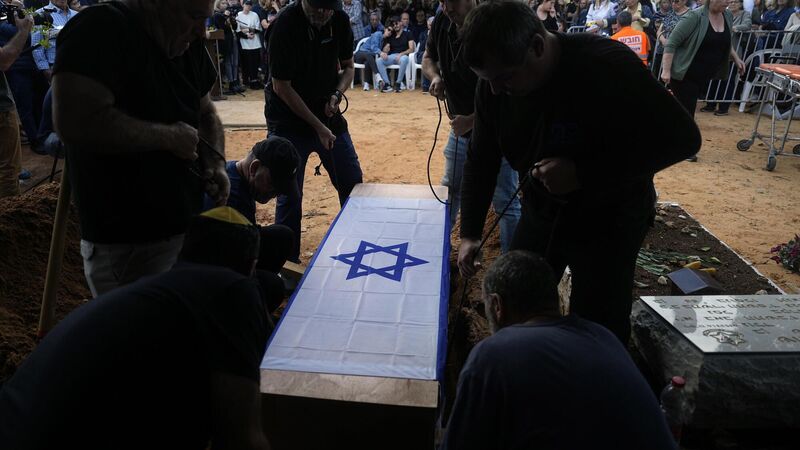
The coffin containing the remains of Alon Shamriz, 26, is lowered to his grave during his funeral in the cemetery of Kibbutz Shefayim, southern Israel on Sunday December 17, 2023. Picture: AP Photo/Ohad Zwigenberg
The brother of an Israeli hostage mistakenly killed by Israeli soldiers in the Gaza strip earlier this week has hit out at the Israeli army for having "abandoned and murdered him."
"Those who abandoned you also murdered you after all that you did right," Ido Shamriz told mourners at the funeral for his brother, Alon, on Sunday.
Alon Shamriz, 26, was one of the three Israeli hostages shot dead by soldiers during an operation in the Gaza City suburb of Shejaiya on Friday, even as they carried a white flag and cried for help in Hebrew.
Israeli troops opened fire after mistaking Mr Shamritz, Yotam Haim, and Samer El-Tagala for a threat.

"You survived 70 days in hell," Mr Shamriz's mother, Dikla, said at his funeral.
"Another moment and you would have been in my arms."
According to Israeli media, Samer El-Talalqa was buried on Saturday. The funeral of Mr Haim is scheduled for Monday.
Israel’s government faced calls for a ceasefire from some of its closest European allies and from protesters at home on Sunday after the shooting of the three hostages, mounting concerns about its conduct in the 10-week-old war in Gaza.
The protesters urged the government to renew hostage negotiations with Gaza’s Hamas rulers, whom it has vowed to destroy.

Israel could also face pressure to scale back major combat operations when US Defence Secretary Lloyd Austin visits this week, as Washington has expressed growing unease with civilian casualties even while providing vital military and diplomatic support.
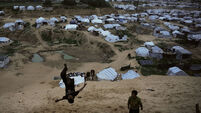
The air and ground war has flattened large parts of northern Gaza, killed thousands of civilians and driven most of the population to the southern part of the besieged territory, where many are packed into crowded shelters and tent camps.
Some 1.9 million Palestinians – nearly 85% of Gaza’s population – have fled their homes and are surviving on a trickle of humanitarian aid.
Israel said that, from Sunday, UN aid trucks would be able to enter Gaza from a second location, Kerem Shalom.
In a sign of desperation, dozens of Palestinians surrounded aid trucks after they drove in through the Rafah crossing with Egypt, forcing some to stop before climbing on board, pulling boxes down and carrying them off. Other trucks appeared to be guarded by masked people carrying sticks.
Prime Minister Benjamin Netanyahu said Israel “will continue to fight until the end”, with the goal of eliminating Hamas, which triggered the war with its attack on southern Israel on October 7. Palestinian militants killed some 1,200 people that day, mostly civilians, and captured scores of hostages.
Mr Netanyahu has vowed to bring back the estimated 129 hostages still in captivity.
Anger over the mistaken killing of hostages is likely to increase pressure on him to renew Qatar-mediated negotiations with Hamas over swapping more of the remaining captives for Palestinians imprisoned in Israel.
Israeli media reported that over the weekend David Barnea, the head of Israel’s Mossad spy agency, met Qatar’s prime minister, Sheikh Mohammed bin Abdulrahman Al Thani, who has mediated with Hamas, to discuss renewed talks.
Meanwhile, Gaza remained under a communications blackout for a fourth day, the longest of several outages during the war. Aid groups said they complicate rescue efforts and make it even more difficult to monitor the toll on civilians.
In Israel on Sunday, French Foreign Minister Catherine Colonna called for an “immediate truce” aimed at releasing more hostages, getting larger amounts of aid into Gaza and moving towards “the beginning of a political solution”.
Earlier, France’s Foreign Ministry said one of its employees was killed in an Israeli strike on a home in Rafah last Wednesday. It condemned the strike, which it said killed several civilians, and demanded clarification from Israeli authorities.
The foreign ministers of the UUK and Germany, meanwhile, called for a “sustainable” ceasefire, saying “too many civilians have been killed”.
“Israel will not win this war if its operations destroy the prospect of peaceful co-existence with Palestinians,” British Foreign Secretary Lord Cameron and German Foreign Minister Annalena Baerbock wrote in the UK’s Sunday Times.
US Defence Secretary Mr Austin is set to travel to Israel to continue discussions on a timetable for ending the war’s most intense phase.
Israeli and US officials have spoken of a transition to more targeted strikes aimed at killing Hamas leaders and rescuing hostages, without saying when it would occur.
Scores of protesters set up tents outside the Defence Ministry in Tel Aviv on Saturday, saying they would stay until the government resumes hostage negotiations with Hamas.
“The hostages are experiencing hell and they are in mortal peril,” said Raz Ben-Ami, a hostage released in the last exchange. “Israel must offer another hostage-release deal.”
Hamas has said no more hostages will be released until the war ends, and that in exchange it will demand the release of large numbers of Palestinian prisoners, including high-profile militants.
Hamas released some 100 of the more than 240 hostages captured on October 7 in exchange for the release of scores of Palestinian prisoners during a brief ceasefire in November. Nearly all freed on both sides were women and minors. Israel has rescued one hostage.