Twins accept Nobel Peace Prize on behalf of mother jailed in Iran
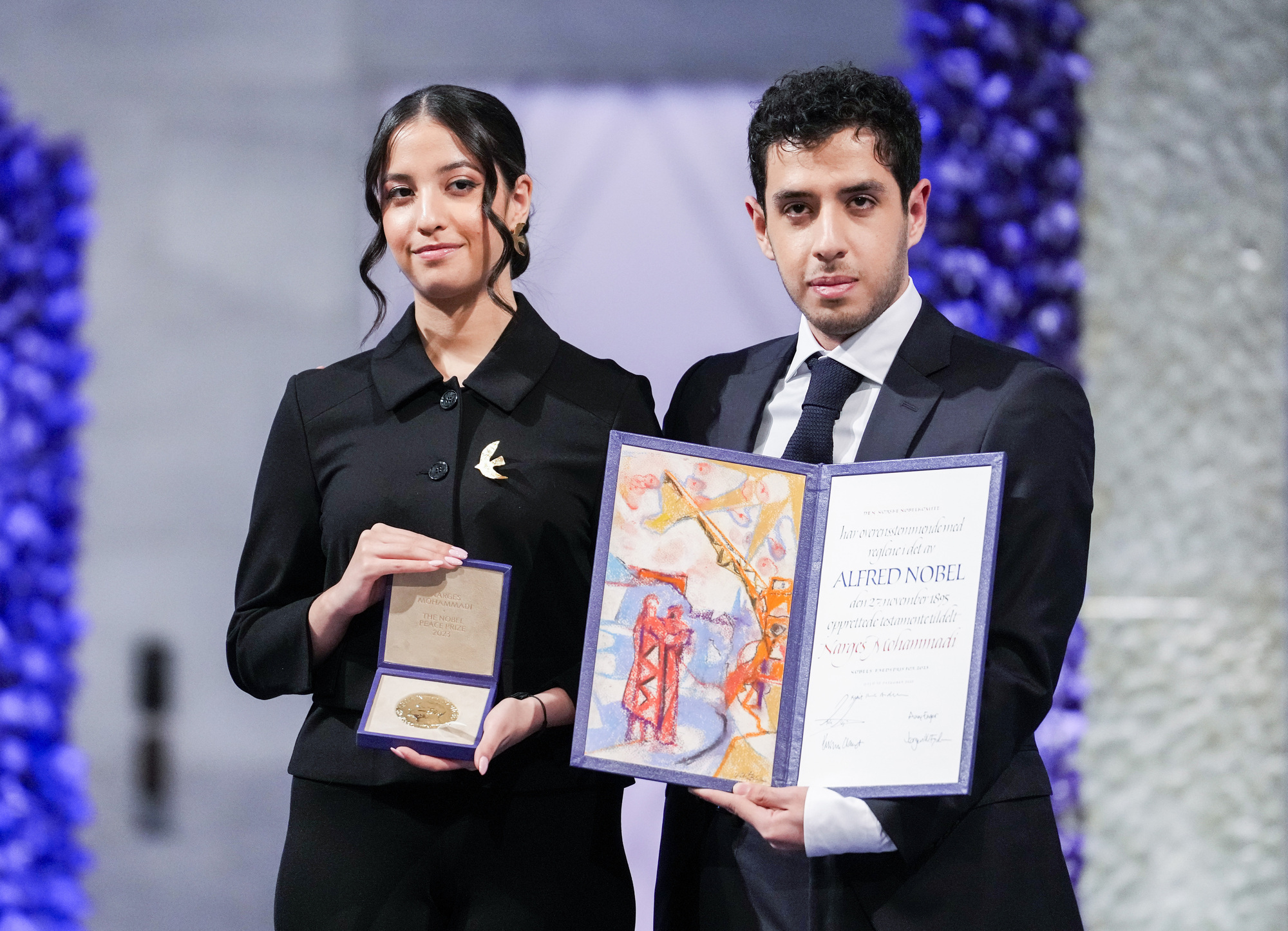
The children of imprisoned Iranian activist Narges Mohammadi have accepted this year’s Nobel Peace Prize on her behalf in a ceremony in the Norwegian capital.
Ms Mohammadi is renowned for campaigning for women’s rights and democracy in her country, as well as fighting against the death penalty.
Ali and Kiana Rahmani, Ms Mohammadi’s twin 17-year-old children who live in exile in Paris with their father, were given the award at Oslo City Hall, before giving the Nobel Peace Prize lecture in their mother’s name.
Ms Mohammadi, 51, was awarded the 2023 Nobel Peace Prize in October for her decades of activism despite numerous arrests by Iranian authorities and spending years behind bars. She is currently detained in a prison in Tehran.

At a news conference in Oslo on Saturday, Kiana read out a message from her mother, in which she praised the role international media played in “conveying the voice of dissenters, protesters and human rights defenders to the world”.
“Iranian society needs global support and you, journalists and media professionals are our greatest and most important allies in the difficult struggle against the destructive tyranny of the Islamic Republic government. I sincerely thank you for your efforts, for all you’ve done for us,” Ms Mohammadi said in her note.
Kiana said she held little hope of seeing her mother again.
“Maybe I’ll see her in 30 or 40 years but I think I won’t see her again. But that doesn’t matter because my mother will always live on in my heart, values that are worth fighting for,” she said.

In the presence of Norway’s King Harald and Queen Sonja and other dignitaries, Berit Reiss-Andersen, chairwoman of the Norwegian Nobel Committee, cited Ms Mohammadi’s “life-long struggle in support of human rights and strong civil society”.
A large portrait on display showed Ms Mohammadi in pastel colors and smiling.
“She has asked us to use this particular photograph, which expresses how she wants to lead her life, looking happy in colorful garments, exposing her hair and with a steady gaze towards us,” Ms Reiss-Andersen said.
“No punishment has stopped her,” Ms Reiss-Andersen said, citing the sentences of imprisonment and more than 150 lashes that have been imposed on her.
She said when Ms Mohammadi needed medical treatment recently, she was told she would be taken to a hospital on condition she wear a hijab. She refused, and was eventually taken to a different medical facility.
“When everything has been denied her, she still mobilises the willpower and courage to make a statement,” Ms Reiss-Andersen said.
“This year’s Peace Prize recognises the brave women in Iran and around the world who fight for basic human rights and for an end to the discrimination and against segregation of women.”
Ms Mohammadi’s brother and husband told reporters in Oslo that she planned to go on a hunger strike on Sunday in solidarity with the Baha’i Faith religious minority in Iran.
Her husband Taghi Rahmani previously said that he has not been able to see his wife for 11 years, and their children have not seen their mother for seven.
Ms Mohammadi played a leading role in protests triggered by the death of 22-year-old Mahsa Amini last year while in police custody for allegedly violating the country’s strict headscarf law which forces women to cover their hair and entire bodies.

Iranian authorities banned members of Ms Amini’s family from travelling to accept the European Union’s top human rights prize — the Sakharov Prize For Freedom Of Thought — on her behalf, the US-based HRANA said late on Saturday.
Ms Mohammadi is the 19th woman to win the Nobel Peace Prize and the second Iranian woman after human rights activist Shirin Ebadi won the award in 2003.
It is the fifth time in the 122-year history of the awards that the peace prize has been given to someone who is in prison or under house arrest.
The rest of the Nobel prizes are set to be handed out in separate ceremonies in Stockholm later on Sunday.

CONNECT WITH US TODAY



Be the first to know the latest news and updates