Gaza ceasefire: What are the terms of the hostage deal agreed by Israel and Hamas?
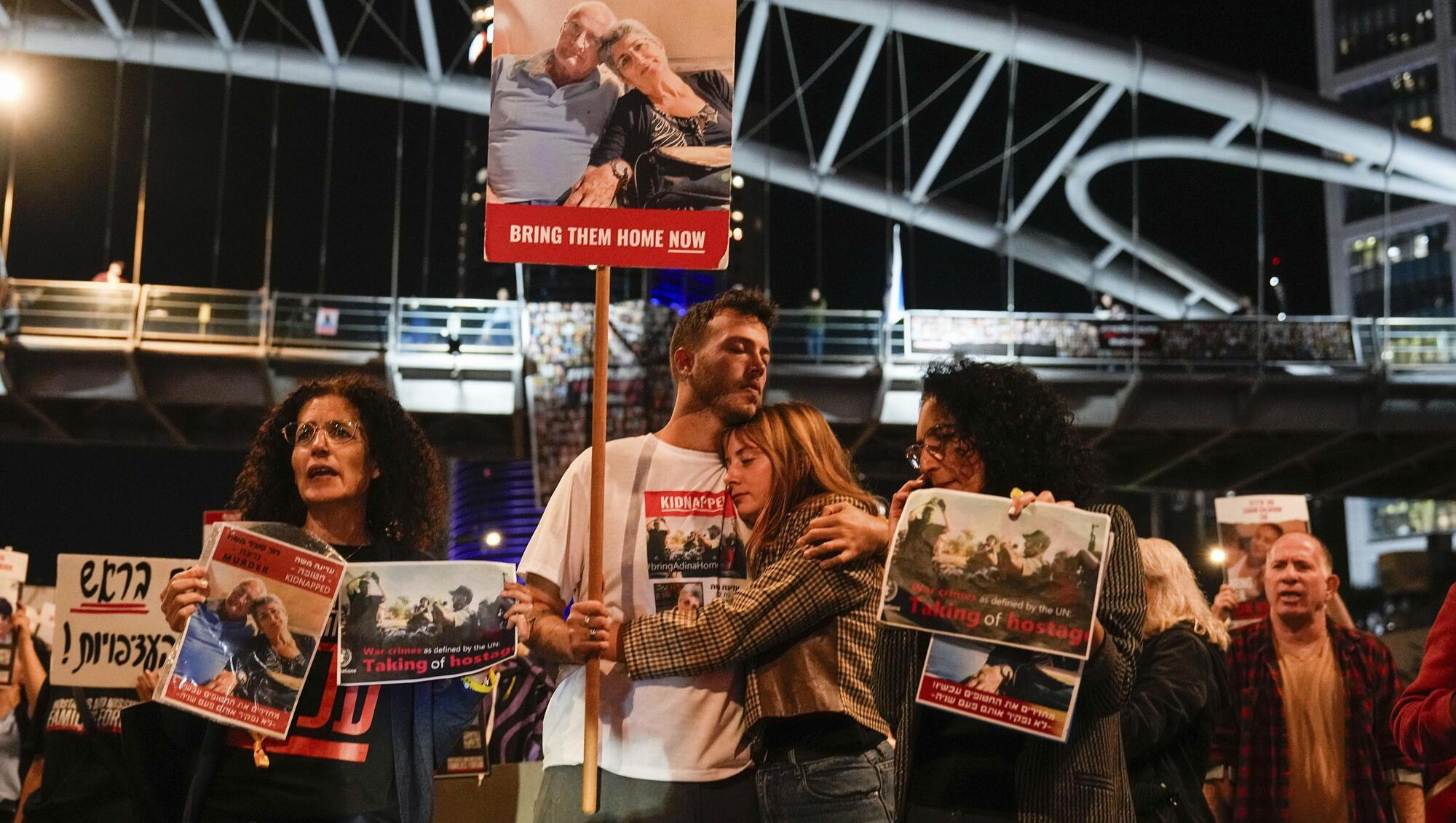
According to the Israeli government, Hamas militants took about 240 hostages and killed 1,200 people when they raided Israel on October 7
Families and friends of about 240 hostages held by Hamas in Gaza call for Israeli prime minister Benjamin Netanyahu to bring them home during a demonstration in Tel Aviv. Picture: AP Photo/Ariel Schalit

Families and friends of about 240 hostages held by Hamas in Gaza call for Israeli prime minister Benjamin Netanyahu to bring them home during a demonstration in Tel Aviv. Picture: AP Photo/Ariel Schalit

Fifty women and children held hostage by Hamas and other groups in Gaza since October 7 are set to be released in exchange for a four-day ceasefire, the office of Israeli prime minister Benjamin Netanyahu said.

According to the Israeli government, Hamas militants took about 240 hostages and killed 1,200 people when they raided Israel on October 7. 

The hostages were taken from communities, including collective farms, kibbutzim and military bases in southern Israel as well as people attending an outdoor music festival.

More than half the hostages held foreign and dual citizenship from some 40 countries including the US Thailand, Britain, France, Argentina, Germany, Chile, Spain and Portugal. 

Nine-year-old Israeli-Irish girl Emily Hand is also believed to be among the hostages held in the enclave. 

Hamas has said it has hidden the captives in "safe places and tunnels" in Gaza.

Family members of Israeli hostages who are currently being held in Gaza, Thomas Hand (second right), the father of nine-year-old Irish-Israeli child Emily Hand, Iris Haim (left), the mother of Yotam Haim and Orit Meir (right) the mother of Almog Meir, 21, during a press conference at the Israel Embassy in London. Picture: Victoria Jones/PA Wire

Here is everything we know so far about the four-day pause in fighting:

Who brokered the deal?

The deal between Israel and Hamas was brokered by Qatar with the support of the United States. 

A US official said three Americans would be among those freed, including a girl who turns four this week, and that the first release should take place by Thursday.

What are the terms of the deal?

Palestinians gather in front of a building hit by an Israeli on the Gaza Strip at the Nusseirat refugee camp. Picture: AP Photo/Adel Hana

According to Hamas, Israel will release 150 Palestinian prisoners—all women and children—from Israeli jails and allow hundreds of aid trucks a day to cross the Rafah border with Egypt, providing humanitarian supplies to Palestinians in Gaza.

Israel will cease air strikes in southern Gaza and restrict them to six hours a day in the north, according to the Hamas account of the deal, which also says Israeli forces have committed to not bring military vehicles into Gaza during the ceasefire, nor try to detain anyone.

The ceasefire would be extended by a day for every 10 additional hostages released, the Israeli government said.

The agreement temporarily pauses a war that has lasted more than six weeks so far

The conflict has already cost the lives of 14,128 Palestinians in Gaza, according to the government media office in Gaza, and more than 1,200 people in Israel.

Why has an agreement been reached now?

Israel’s government has come under intense pressure domestically to make progress on returning hostages. 

Their families mounted a high-profile “bring them home” campaign, meeting members of the Israeli war cabinet on Monday night. The military assault on northern Gaza had resulted in only one hostage being rescued alive.

A woman takes a photo of a poster showing Israelis held captive in Gaza plastered underneath a picture of Benjamin Netanyahu in Tel Aviv. Picture: AP Photo/Ariel Schalit

International pressure has also been mounting in response to the increasingly desperate humanitarian situation in Gaza. Bombing by the Israeli military followed by the ground invasion have caused a civilian crisis: food, water, fuel and medicines are desperately short, 1.7 million people out of 2.3 million have been displaced, and only 10 out of 36 hospitals are functioning.

Last week, 68% of Americans said they supported a ceasefire, reflecting concerns in the US that Israel had gone too far in its military response.

Hamas is losing ground on the battlefield, as Israel’s forces have been able to capture large parts of northern Gaza, including Gaza City.

Will fighting restart once the ceasefire is over?

Hamas is likely to want to use any ceasefire to re-group, and it is possible it could seek to extend it by offering to gradually release more of the hostages. Israel has re-iterated its vow to eliminate Hamas, so its survival as a group would represent a victory.

Israel has greater motives to return to the battlefield. The Israeli military has not yet occupied all of northern Gaza. 

On Tuesday, it had surrounded Jabalia, which it considers a Hamas stronghold, and the nearby Indonesian hospital, the only functioning large medical facility in the north.

Israeli commanders are also focused on the south of Gaza, and in particular the city of Khan Younis, where they believe Hamas’s leadership is based and the remaining hostages may be held. 

Palestinians look at houses destroyed in the Israeli bombardment of the Gaza Strip in Rafah on Monday. Picture: AP Photo/Hatem Ali)

Some in the Israeli military establishment argue that delivering a knockout blow to Hamas would require attacking the city, though it would kill and displace even more civilians in an already crowded country.

The US has made clear it will not support a ground offensive in the south, unless there are much greater safeguards against civilian casualties.

- The Guardian

More in this section

Cookie Policy Privacy Policy Brand Safety FAQ Help Contact Us Terms and Conditions

© Examiner Echo Group Limited