North Korea claims third attempt to put spy satellite into orbit was successful

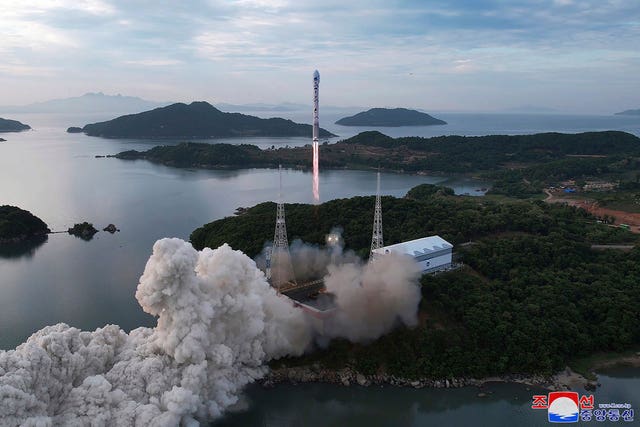
North Korea claims it has successfully placed a military spy satellite into orbit.
The North’s space authorities said in a statement issued early on Wednesday that its space launch vehicle placed the Malligyong-1 satellite into orbit on Tuesday night.
The North Korean statement adds leader Kim Jong Un observed the launch and says the spy satellite would enhance North Korea’s war readiness in response to its rivals’ hostile military moves.
The statement says the country plans to fire more spy satellites.
The North’s claim could not immediately be independently confirmed.
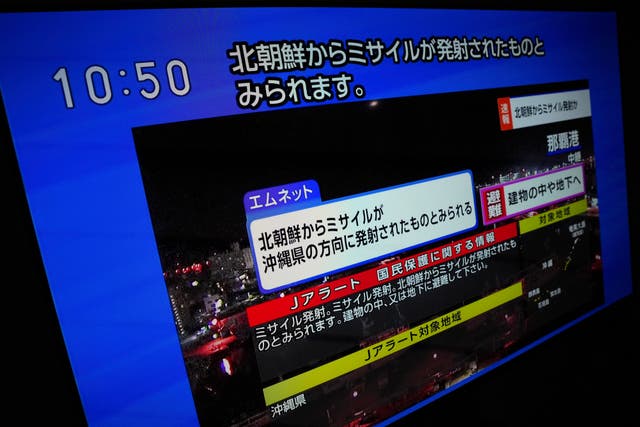
Japan’s Prime Minister’s Office initially issued a J-Alert missile warning for Okinawa late on Tuesday, saying North Korea fired a possible missile.
It urged residents to take shelter inside buildings or underground. Within 10 minutes, the office said on X, formerly Twitter, that the missile had passed into the Pacific Ocean, saying it was lifting the earlier advisory.
The office, however, urged residents to stay away from any suspicious objects and to report anything to police or fire departments.
Japan’s Defence Ministry also announced that North Korea had fired a possible ballistic missile late on Tuesday but offered no other details.
South Korea’s military said it maintains its readiness in close coordination with the US and Japan.
Japanese Prime Minister Fumio Kishida said: “Even if North Korea calls it a satellite, the firing that uses ballistic missile technology is a clear violation to related United Nations Security Council resolutions. It is also a serious threat that affects the safety of the people.”
A spy satellite is among the key military assets coveted by North Korean leader Kim Jong Un, who wants to modernise his weapons systems to cope with what he calls escalating US threats.
North Korea attempted to launch a spy satellite twice earlier this year but both launches ended in failure due to technical issues.
North Korea had vowed a third launch would take place some time in October but did not follow through with that launch plan without giving any reason.
South Korean officials have said the delay occurred likely because North Korea was receiving Russian technological assistance for its spy satellite launch programme.
North Korea and Russia, both US adversaries that are increasingly isolated globally, have been pushing hard to expand their relationships in recent months.
In September, Mr Kim travelled to Russia’s Far East to meet President Vladimir Putin and visit key military sites, touching off intense speculation of a weapons deal between the two nations.
The alleged deal involves North Korea supplying conventional arms to refill Russia’s ammunition stock drained in its war with Ukraine.
In return, foreign governments and experts say that North Korea seeks Russian help in enhancing its nuclear and other military programmes. During Mr Kim’s Russia visit, Mr Putin told state media that his country would help North Korea build satellites, saying Mr Kim “shows keen interest in rocket technology”.
Both Russia and North Korea dismissed outside accusations of their alleged arms transfer deal as groundless. Such a deal would violate UN Security Council resolutions that prohibit any weapons trading involving North Korea.
The White House said in October that North Korea had delivered more than 1,000 containers of military equipment and munitions to Russia. But South Korean defence minister Shin Wonsik said in a media interview this week that North Korea had sent about 3,000 containers to Russia.
Mr Kim previously said North Korea needed spy satellites to better monitor South Korean and US activities and enhance the effective use of its nuclear missiles. But South Korea has said a North Korean spy launch programme also involves efforts to manufacture more powerful intercontinental ballistic missiles.
“If North Korea succeeds in launching the military reconnaissance satellite, it would signify that North Korea’s ICBM capabilities have been taken to a higher level,” South Korean President Yoon Suk Yeol said in responses to questions from The Associated Press earlier in November. “Therefore, we will have to come up with reinforced countermeasures.”

CONNECT WITH US TODAY



Be the first to know the latest news and updates