Joe Biden says US outreach to Vietnam is not about containing China
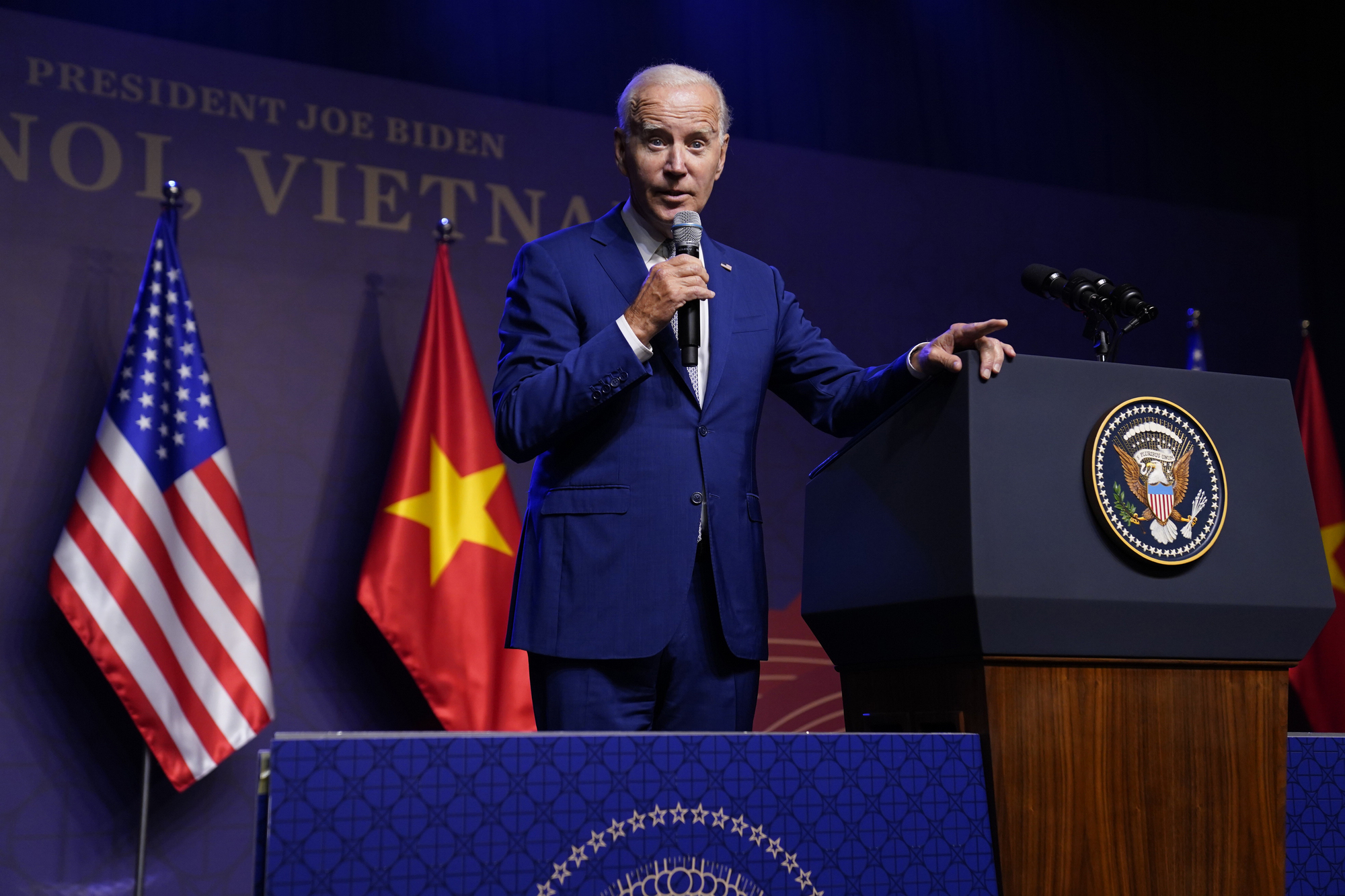
Joe Biden has said his visit to Vietnam is not aimed at starting a “cold war” with China, but was part of a broader effort to provide global stability by building US relationships throughout Asia at a time of tensions with Beijing.
“It’s not about containing China,” the US president said at a news conference in Vietnam’s capital after attending the G20 summit in India. “It’s about having a stable base.”
He arrived in Hanoi as Vietnam was elevating the US to its highest diplomatic status: comprehensive strategic partner. That is evidence of how far the relationship has evolved from what Mr Biden referred to as the “bitter past” of the Vietnam War.

The expanded partnership reflects a broader effort across Asia to counter China’s influence. Mr Biden has said Vietnam wants to flex a degree of independence, and US companies are seeking an alternative to imports from Chinese factories. He is pursuing possible allies while also trying to soothe tensions with China.
“I think we think too much in… cold war terms,” Mr Biden said at his news conference. “It’s not about that. It’s about generating economic growth and stability in all parts of the world. And that’s what we’re trying to do.
“We have an opportunity to strengthen alliances around the world to maintain stability. That’s what this trip is all about.”
Mr Biden opened his news conference by saying he had “travelled around the world in five days”, from Washington to New Delhi and now Hanoi, showcasing efforts by his administration to forge alliances. The president will stop in Alaska on the way home on Monday to commemorate the anniversary of the September 11 attacks.
In response to one question, he told reporters he had met Chinese premier Li Qiang in India. The contact is the highest-level interaction between US and Chinese officials since Mr Biden and China’s President Xi Jinping held talks at last year’s G20 in Indonesia. Mr Xi skipped the India talks and sent Mr Li in his place.

“We talked about stability. It wasn’t confrontational at all,” Mr Biden said.
The exchange, between G20 sessions on Saturday, was brief, according to a senior Biden administration official. It was not clear who approached whom, but Mr Biden was interested in seeing Mr Li and underscoring his desire to stabilise the relationship between the two countries, said the official.
Mr Biden went into meetings with Vietnam’s leaders after his arrival in the country. He welcomed the new partnership and said he hoped for progress on climate, the economy and other issues during his 24-hour stop in Hanoi.
“We can trace a 50-year arc of progress between our nations from conflict to normalisation to this new elevated status,” Mr Biden said with Nguyen Phu Trong, general secretary of the Communist Party of Vietnam, at party headquarters.
The US president has described himself as being part of the “Vietnam generation”, although he did not serve in a war. He was given five draft deferments and was exempted from military service because he had asthma as a teenager.

He called Vietnam “a friend, a reliable partner and a responsible member of the international community”, and noted that veterans such as John Kerry, his climate tsar, and the late John McCain, a Vietnam PoW and Republican senator from Arizona, found ways to build a relationship with Vietnam after the war.
“Both men saw so clearly, as I and so many others did, how much we had to gain by working together to overcome a bitter past,” he said.
Mr Trong pledged that his country will work hard to implement the agreement. “Only then can we say it is a success,” he said.
Mr Biden described the US and Vietnam as “critical partners at what I would argue is a very critical time”.
Neither leader specifically discussed how China’s economic and geopolitical rise had contributed to their countries’ expanded partnership, but it was hard to explain the mutual embrace without Beijing’s growing influence.
Vietnam previously bestowed the same level of relations on China and Russia. Elevating the US suggests Hanoi wants to hedge its friendships as US and European companies look for alternatives to Chinese factories.

CONNECT WITH US TODAY



Be the first to know the latest news and updates