Elderly pilots to try to be first to cross Atlantic in hydrogen gas balloon
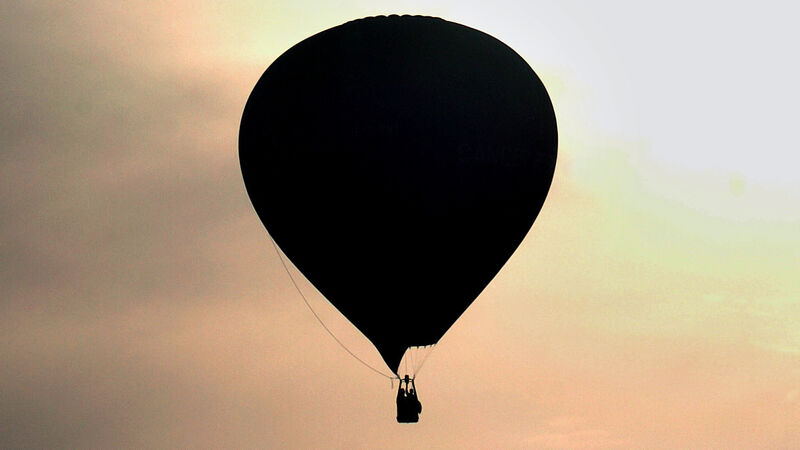
Route will take them from Maine in the US, over Newfoundland in Canada, across the Atlantic Ocean, and then Ireland and Scottish waters before they land in Europe. File picture Denis Minihane
Three pilots with a combined age of more than 200 are to attempt the first hydrogen open-basket gas balloon crossing of the Atlantic next month.
British explorer David Hempleman-Adams, 66, American balloon manufacturer Bert Padelt, 62, and Swiss scientist and entrepreneur Dr Frederik Paulsen, 72, will embark on the adventure and will be the oldest people to cross the Atlantic in an open-basket gas balloon.
Their route will take them from Maine in the US, over Newfoundland in Canada, across the Atlantic Ocean, and then Ireland and Scottish waters before they land in Europe.
They will travel many thousands of miles during the trip, which is expected to take between four and five days in September, flying at an altitude of 6,000 to 8,000ft.
If successful, it will be the first Atlantic crossing in a hydrogen balloon and may also mark the longest distance covered in this type of balloon.
David Hempleman-Adams will also become the only person to have flown across the Atlantic three times in an open-basket balloon, having first achieved the feat in 2003 and completing it again in 2007.
The explorer described how he and his crew are becoming "more adventurous with age".
"People think we're kind of crazy to be doing this but it really does make you feel alive to be pushing the boundaries and seeing just what is possible at any age," he said.
During the crossing, the team will be collecting air samples as part of a scientific study supported by Basecamp Research.
It is hoped this will uncover new microbes that could lead to the discovery of new natural proteins which could be used to develop new products such as medicines, biofuels or bioplastics.
Mr Hempleman-Adams added: "A balloon is the perfect platform to investigate a location where the biome has never been sampled and the scientists we've partnered with are extremely excited about what we might find and what they will be able to learn from our adventures."
A secondary scientific study, to measure the impact of the Canadian forest fires, will also be undertaken during the challenge in collaboration with the Institute for Climate and Atmospheric Science at the University of Leeds.
The team will be able to collect samples at between 6,000 to 8,000ft, weather permitting, from a mid-Atlantic location at an altitude that has not been sampled before.
They will carry the Explorers Club Flag on their balloon — an honour given to expeditions that further the cause of exploration and field science.


CONNECT WITH US TODAY



Be the first to know the latest news and updates