Missiles and drones hit civilian buildings in Ukraine
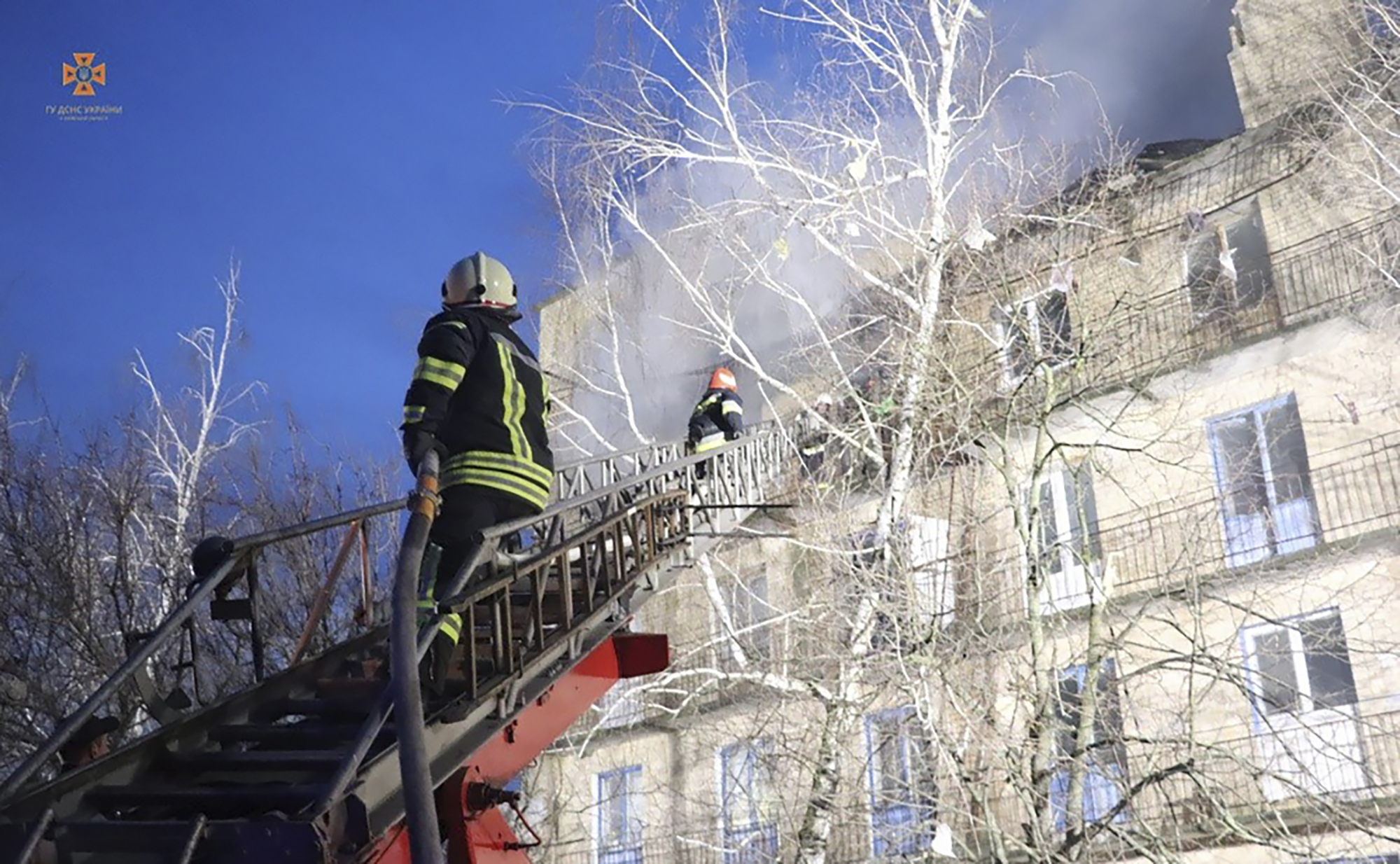
Emergency personnel work at the scene of a drone attack in Rzhyshchiv (Ukrainian Emergency Service via AP Photo)

Ukraine’s president posted a video showing what he said was a Russian missile slamming into an apartment building in the southeastern city of Zaporizhzhia, after Russia launched exploding drones that killed at least four people at a student dormitory near Kyiv before dawn.

Just hours earlier, Japan’s prime minister had left the Ukrainian capital following a show of support for the country.

The same day, Chinese leader Xi Jinping left Moscow after discussing his proposal for ending the war, which has been rejected by the West as a non-starter.

The video posted by President Volodymyr Zelensky to Telegram appeared to be CCTV footage that captured the moment a missile hit the nine-storey residential block by a busy road.

Ukrainian media carried pictures showing charred apartments on several storeys of the affected buildings, and flames billowing from some of them. The number of causalities was unknown.

But Vladimir Rogov, an official with the Moscow-appointed regional administration for the Russia-occupied part of the Zaporizhzhia region, claimed the building was hit by a Ukrainian air defence missile that was launched to intercept a Russian missile.

He did not offer any evidence to back up his claim.

Emergency personnel work at the scene of a drone attack in the town of Rzhyshchiv (Ukrainian Emergency Service via AP)

Russia has denied targeting residential areas even though artillery and rocket strikes hit apartment buildings and civilian infrastructure on a daily basis. Russian officials have blamed Ukrainian air defences for some of the deadliest strikes on apartment buildings in the past, charging that the deployment of air defence systems in residential areas puts civilians at risk.

An overnight drone attack partially destroyed a secondary school and two dormitories in the city of Rzhyshchiv, south of the Ukrainian capital, local officials said. It was not clear how many people were in the dormitories at the time.

The body of a 40-year-old man was pulled from the rubble on a dormitory’s fifth floor, according to regional police chief Andrii Nebytov. More than 20 people were hospitalised, he added, while a few other people were unaccounted for.

Ukrainian air defences downed 16 of the 21 drones launched by Russia, the Ukraine general staff said. Eight of them were shot down near the capital, according to the city’s military administration. Other drone attacks struck central-western Khmelnytskyi province.

The drone barrage and other Russian overnight attacks that struck civilian infrastructure drew a scathing response from Mr Zelensky, a day after Mr Xi and Russian president Vladimir Putin discussed China’s proposals for negotiating an end to the war.

“Over 20 Iranian murderous drones, plus missiles, numerous shelling occasions, and that’s just in one last night of Russian terror,” Mr Zelensky wrote in English on Twitter.

“Every time someone tries to hear the word ‘peace’ in Moscow, another order is given there for such criminal strikes,” he wrote.

Russian president Vladimir Putin, right, and Chinese president Xi Jinping at the Kremlin in Moscow (Pavel Byrkin, Sputnik, Kremlin Pool Photo via AP)

Japanese prime minister Fumio Kishida, who is the current chair of the G7, made a surprise visit to Kyiv on Tuesday, throwing his support behind Mr Zelensky’s government as his Asian rival Mr Xi sided with Mr Putin.

After returning to Poland on Wednesday morning, Mr Kishida said he had expressed the “unwavering determination of solidarity” of Japan and G7 to Ukraine during his talks with Mr Zelensky.

“Through Prime Minister Kishida’s visit to Ukraine, Japan was able to show not only to other members of the G7 but also the international society including the Global South (nations) its determination to defend the rules-based international society,” Japan’s top government spokesman Hirokazu Matsuno said.

Mr Kishida’s visit snatched away some of the attention from Mr Xi’s trip to Moscow where he promoted Beijing’s peace proposal for Ukraine, which western nations had already dismissed as a way to consolidate Moscow’s gains. Mr Xi left Moscow early on Wednesday.

Japanese prime minister Fumio Kishida made a surprise visit to Kyiv on Tuesday and met Ukrainian president Volodymyr Zelensky (Ukrainian Presidential Press Office via AP)

The visits by Mr Xi and Mr Kishida, about 800km (500 miles) apart, highlighted how countries are lining up behind Moscow or Kyiv during the nearly 13-month-old war.

In a joint statement, Russia and China emphasised the need to “respect legitimate security concerns of all countries” to settle the conflict, echoing Moscow’s argument that it sent in troops to prevent the US and its NAto allies from turning the country into an anti-
Russian bulwark.

Mr Kishida, by contrast, called Russia’s invasion a “disgrace that undermines the foundations of the international legal order” and pledged to “continue to support Ukraine until peace is back on the beautiful Ukrainian lands”.

Japan’s prime minister later pledged to provide Poland with development support to help the European country assist neighbouring Ukraine as it defended itself from Russia’s invasion.

x

More in this section

Cookie Policy Privacy Policy Brand Safety FAQ Help Contact Us Terms and Conditions

© Examiner Echo Group Limited