Israeli PM Benjamin Netanyahu presses on with legal changes despite protests
Israelâs government is pressing ahead with a plan to overhaul the countryâs legal system, despite an unprecedented uproar that has included mass protests, warnings from military and business leaders and calls for restraint from the US.
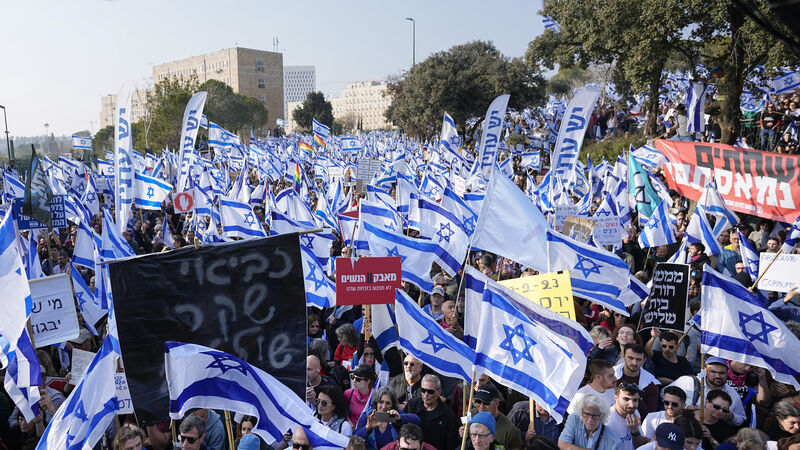
Tens of thousands of demonstrators gathered outside the Knesset parliament for a second straight week to rally against the plan as legislators prepared to hold an initial vote.
Prime Minister Benjamin Netanyahu and his allies, a collection of ultra-religious and ultra-nationalist legislators, say the plan is meant to fix a system that has given the courts and government legal advisers too much say in how legislation is crafted and decisions are made.
Critics say it will upend the countryâs system of checks and balances and concentrate power in the hands of the prime minister. They also say that Netanyahu, who is on trial for corruption, has a conflict of interest.
Simcha Rothman, a far-right legislator leading the legislative initiative, presented the proposal to the Knesset during a stormy debate.
Several opposition legislators were escorted out of the hall by security for screaming at him, while a spectator was carried away by guards from the viewing gallery after smashing the protective glass in anger.
The standoff has plunged Israel into one of its greatest domestic crises, sharpening a divide among Israelis over the character of their state and the values they believe should guide it.
âWe are fighting for our childrenâs future, for our countryâs future. We donât intend to give up,â opposition leader Yair Lapid told a meeting of his party in the Knesset as protesters massed outside.
Small groups demonstrated outside the homes of some legislators, preventing one member of Netanyahuâs Likud party from taking her special-needs daughter to school.
Netanyahu accused the demonstrators of inciting violence and said they were ignoring the will of the people who voted the government into power last November.
The premier and his political allies denied the legitimacy of the short-lived previous government which briefly unseated him in 2021.
âThe people exercised their right to vote in the elections and the peopleâs representatives will exercise their right to vote here in Israelâs Knesset. Itâs called democracy,â he told his Likud party.
Netanyahu showed no sign of backing down before the vote despite the pressure, but left the door open for dialogue on the planned changes.
Mondayâs vote on part of the legislation is the first of three readings required for parliamentary approval. While that process is expected to take months, the vote is a sign of the coalitionâs determination to forge ahead and is seen by many as an act of bad faith.
Israelâs figurehead president has urged the government to freeze the legislation and seek a compromise with the opposition. Leaders in the booming tech sector have warned that weakening the judiciary could drive away investors.
Tens of thousands of Israelis have been protesting in Tel Aviv and other cities each week.
Last week, 100,000 people demonstrated outside the Knesset as a committee granted initial approval to the plan â the largest protest in the city in years.
For a second straight week, thousands of people poured into the city from around the country for a mass demonstration against the planned changes. Many waved Israeli flags, blew horns and held signs reading âsaving democracyâ.
âAll the steps that are going to take place now in the Knesset will change us to a pure dictatorship,â said Itan Gur Aryeh, a 74-year-old retiree. âAll the power will be with the government, with the head of the government and weâll all be without rights.â
Earlier in the day, protesters launched a sit-down demonstration at the entrance of the homes of some coalition legislators and briefly halted traffic on Tel Avivâs main highway.
Hundreds waved Israeli flags in Tel Aviv and also in the northern city of Haifa, holding signs reading âresistance is mandatoryâ.
âWeâre here to demonstrate for the democracy. Without democracy thereâs no state of Israel. And weâre going to fight till the end,â said Marcos Fainstein, a protester in Tel Aviv.
The overhaul has prompted otherwise stoic former security chiefs to speak out, and even warn of civil war.
In a sign of the rising emotions, a group of army veterans in their 60s and 70s stole a decommissioned tank from a war memorial site and draped it with Israelâs declaration of independence before being stopped by police.
The plan has even sparked rare warnings from the US, Israelâs chief international ally.
US ambassador Tom Nides told a podcast over the weekend that Israel should âpump the brakesâ on the legislation and seek a consensus on reform that would protect Israelâs democratic institutions.