How life in Russia has changed after three months of war
After three months of war, Russia faces a summer of economic misery, one expert said.
It took just days for the conflict to come home after Vladimir Putin announced the invasion of Ukraine in February – not with cruise missions and mortars but in the form of unprecedented and extensive volleys of sanctions by western governments and economic punishment by corporations.
Now, many ordinary Russians are reeling from those blows to their livelihoods and emotions.
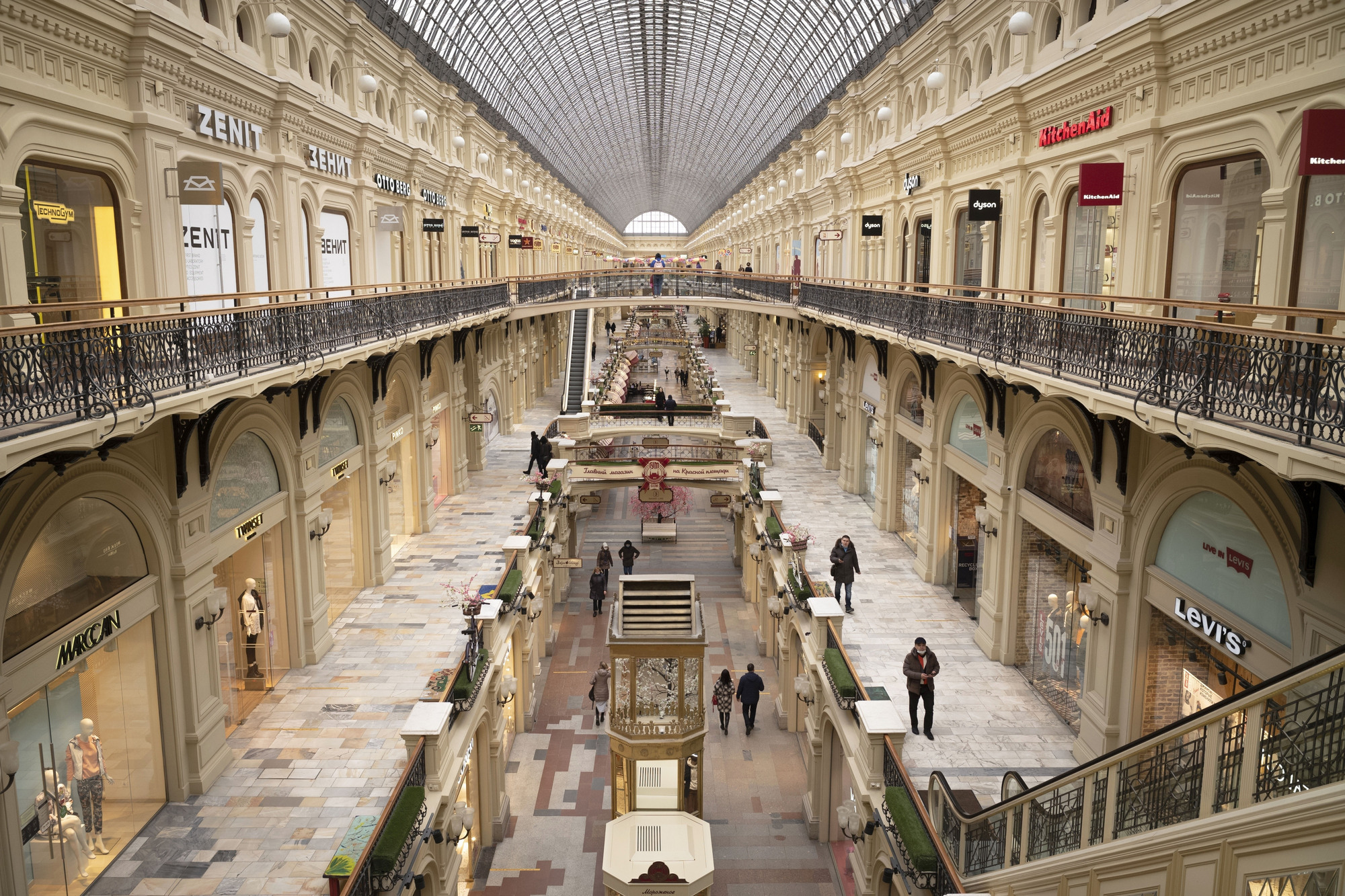
Moscow’s vast shopping centres have turned into eerie expanses of shut stores once occupied by western retailers.
McDonald’s — whose opening in Russia in 1990 was a cultural phenomenon, a shiny modern convenience coming to a dreary country ground down by limited choices — pulled out of Russia entirely in response to its invasion of Ukraine.

Ikea, the epitome of affordable modern comforts, suspended operations.
Tens of thousands of once-secure jobs are now suddenly in question in a very short time.
Major industrial players including oil giants BP and Shell and car maker Renault walked away, despite their huge investments in Russia.
Shell has estimated it will lose about £4 billion by trying to unload its Russian assets.
While the multinationals were leaving, thousands of Russians who had the economic means to do so were also fleeing, frightened by harsh new government moves connected to the war that they saw as a plunge into full totalitarianism.
Some young men may have also fled in fear that the Kremlin would impose a mandatory draft to feed its war machine.
But fleeing had become much harder than it once was — the European Union’s 27 nations, along with the United States and Canada, had banned flights to and from Russia.
The Estonian capital of Tallinn, once an easy long-weekend destination 90 minutes by air from Moscow, suddenly took at least 12 hours to reach on a route through Istanbul.
Even vicarious travel via the internet and social media has narrowed for Russians.
Russia in March banned Facebook and Instagram — although that can be circumvented by using VPNs — and shut access to foreign media websites, including the BBC, the US government-funded Voice of America and Radio Free Europe/Radio Liberty and the German broadcaster Deutsche Welle.
After Russian authorities passed a law calling for up to 15 years’ imprisonment for stories that include “fake news” about the war, many significant independent news media shut down or suspended operations.

Those included the Ekho Moskvy radio station and Novaya Gazeta, the newspaper whose editor Dmitry Muratov shared the most recent Nobel Peace Prize.
The psychological cost of the repressions, restrictions and shrinking opportunities could be high on ordinary Russians, although difficult to measure.
Although some public opinion polls in Russia suggest support for the Ukraine war is strong, the results are likely skewed by respondents who stay silent, wary of expressing their genuine views.
Andrei Kolesnikov of the Carnegie Moscow Centre wrote in a commentary that Russian society right now is gripped by an “aggressive submission” and that the degradation of social ties could accelerate.
“The discussion gets broader and broader. You can call your compatriot — a fellow citizen, but one who happens to have a different opinion — a ‘traitor’ and consider them an inferior kind of person.
“You can, like the most senior state officials, speculate freely and quite calmly on the prospects of nuclear war. (That’s) something that was certainly never permitted in Soviet times during Pax Atomica, when the two sides understood that the ensuing damage was completely unthinkable,” he wrote.
“Now that understanding is waning, and that is yet another sign of the anthropological disaster Russia is facing,” he said.
The economic consequences have yet to fully play out.
In the early days of the war, the Russian rouble lost half its value.
But government efforts to shore it up have actually raised its value to higher than its level before the invasion.
But in terms of economic activity, “that’s a completely different story”, said Chris Weafer, a veteran Russia economy analyst at Macro-Advisory.
“We see deterioration in the economy now across a broad range of sectors. Companies are warning that they’re running out of inventories of spare parts. A lot of companies put their workers on part-time work and others are warning to them they have to shut down entirely.
“So there’s a real fear that unemployment will rise during the summer months, that there will be a big drop in consumption and retail sales and investment,” he told The Associated Press.

The comparatively strong rouble, however heartening it may seem, also poses problems for the national budget, Mr Weafer said.
“They receive their revenue effectively in its foreign currency from the exporters and their payments are in roubles. So the stronger the rouble, then it means the less money that they actually have to spend,” he said.
“(That) also makes Russian exporters less competitive, because they’re more expensive on the world stage.”
If the war drags on, more companies could exit Russia. Mr Weafer suggested that those companies who have only suspended operations might resume them if a cease-fire and peace deal for Ukraine are reached, but he said the window for this could be closing.
“If you walk around shopping malls in Moscow, you can see that many of the fashion stores, western business groups, have simply pulled down the shutters. Their shelves are still full, the lights are still on. They’re simply just not open. So they haven’t pulled out yet. They’re waiting to see what happens next,” he explained.
Those companies will soon be pressed to resolve the limbo that their Russian businesses are in, Mr Weafer said.
“We are now getting to the stage where companies are starting to run out of time, or maybe run out of patience,” he said.

CONNECT WITH US TODAY



Be the first to know the latest news and updates