Survivors unite to deliver message on Holocaust remembrance
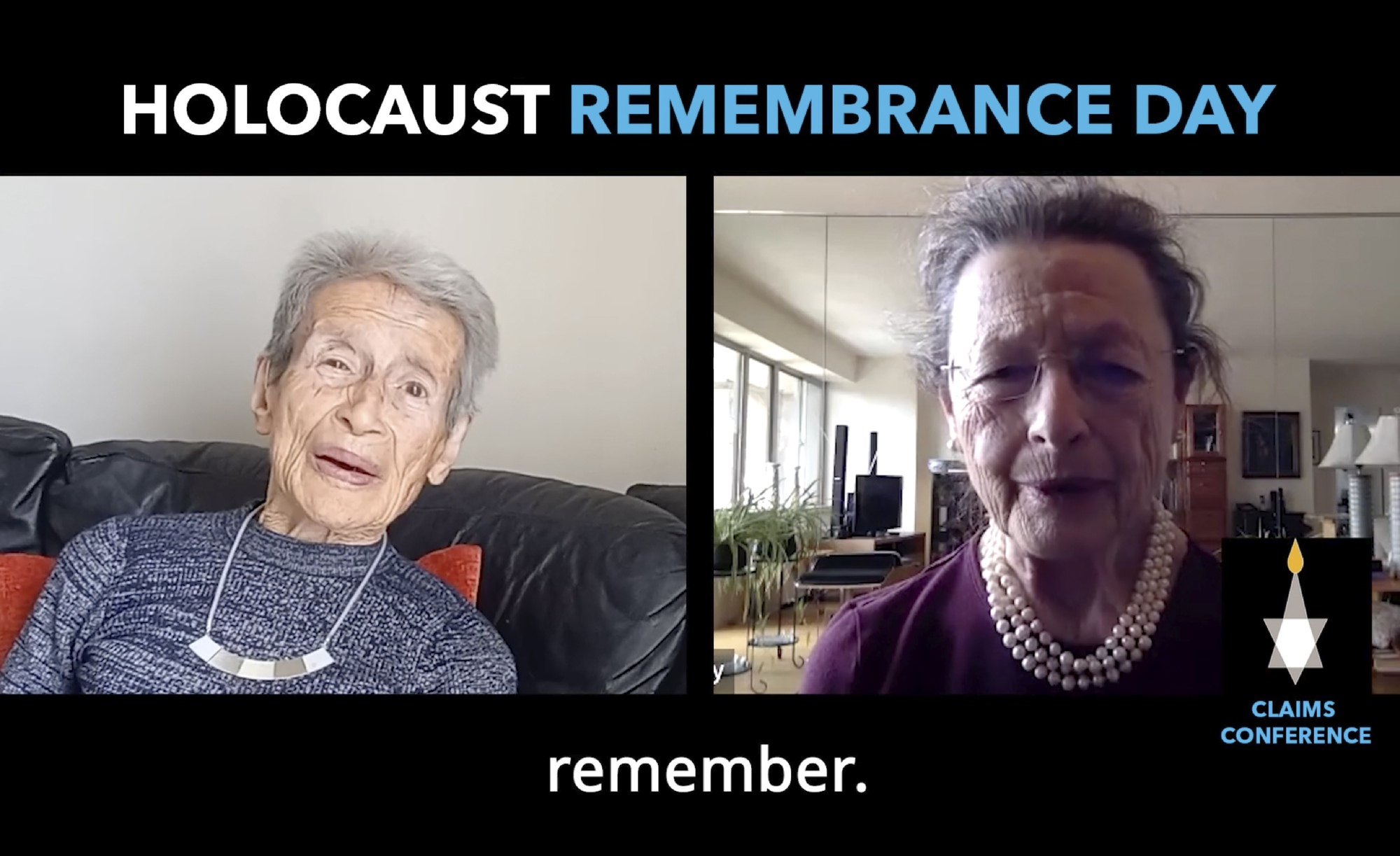
Two of 100 Holocaust survivors, Eva Evans, left, and Judith Bihaly, who participated in a video marking Yom HaShoah, Israel’s Holocaust Remembrance Day. Picture: Greg Schneider/AP
Holocaust survivors around the world have united to deliver a message on the dangers of unchecked hate and the importance of remembrance at a time of rising global antisemitism.
In a video released on Thursday to mark Yom HaShoah — Israel’s Holocaust Remembrance Day — 100 survivors asked people to stand with them and remember the Nazi genocide to avoid repeating the horrors of the past.
The 100 Words project video was released by the New York-based Conference on Jewish Material Claims Against Germany, also referred to as the Claims Conference.
The group represents the world’s Jews in negotiating for compensation and restitution for victims of Nazi persecution and their heirs, and provides welfare for Holocaust survivors around the globe.

“The world is full of strife — from the pandemic to the crisis happening in Ukraine. On remembrance days like Yom HaShoah, it is so important to stop and reflect,” Gideon Taylor, president of the Claims Conference, said in a statement.
“The call to action these survivors put forth today is not only one of remembrance, but one of action, a reminder that we do not have to be bystanders. We can all stand up in our own way and we can choose to not let our collective history repeat itself.”
The project is being released as Russia faces widespread revulsion and accusations of war crimes over attacks on civilians in its invasion of Ukraine.
It also comes at a time when Holocaust survivors — now in their 80s and 90s — are dying, while studies show younger generations lack even basic knowledge of the Nazi genocide, in which a third of the world’s Jews were annihilated.

“If we do not remember them, we are murdering them twice because we have forgotten them. And we have forgotten the tragic travesty that was visited upon millions of people,” said Ginger Lane, a Holocaust survivor who along with her siblings was hidden in a fruit orchard near Berlin by non-Jews.
“It is important to remember because it is a part of our heritage and our legacy that we pass on to the younger generation,” said Ms Lane, whose mother was killed at the Auschwitz death camp, and who has made it her lifelong mission to educate others.
“Holocaust denial, we know it has always existed, but it seems to be on the upswing and … a huge number of young people don’t even know what the word Holocaust means … These young people are eager to move forward with their lives. But their lives today are shaped by the past. And they need to know what happened in the past.”
In a 50-state study of millennials and generation Z-age people in the US in 2020, researchers found 63% of respondents did not know 6m Jews were killed in the Holocaust and 48% could not name a death or concentration camp.

The 100 Word Project statement by Holocaust survivors says:
“Today is Holocaust Remembrance Day
“We all survived the Holocaust
“We are here to give voice to the six million Jews who were murdered
“We are a reminder unchecked hatred can lead to actions, actions to genocide
“Just over 75 years ago, one-third of the world’s Jews were systematically murdered
“Among them, over 1.5 million children were killed in the name of indifference, intolerance, hate
“Hatred for what was feared
“Hatred for what was different
“We must remember the past or it will become our future
On Holocaust Remembrance Day, we ask the world to stand with us and remember.”
The annual remembrance known as Yom HaShoah is one of the most solemn on Israel’s calendar, with the nation coming to a standstill during a two-minute siren on Thursday morning.
According to the Hebrew calendar, Holocaust Remembrance Day marks the anniversary of the 1943 Warsaw Ghetto uprising — the most significant act of Jewish resistance during the Holocaust.
Although the uprising ultimately failed, it is remembered in Israel as a symbol of strength and the struggle for freedom in the face of annihilation.
It means “resilience, tenacity, strength. It’s the hallmark of being a Holocaust survivor, the very concept of surviving, of everyday problems, of fighting until the end,” said Greg Schneider, executive vice-president of the Claims Conference.
“And for some people, unfortunately, the end was the gas chamber. For other people the end was the Warsaw ghetto, where a very small group of people who weren’t well-equipped held out for nearly a month,” Mr Schneider said.
“And that’s why it’s such an important day in Israel and around the world for the Jewish community — because it symbolises the fight of certainly the Jewish people, but of any people facing this type of incredible adversity.”
The Claims Conference is working with its partners, among them the American Jewish Joint Distribution Committee, or JDC, to get as many Holocaust survivors out of Ukraine as possible.
Thousands of people have been killed and more than 5m have fled Ukraine since the Russian invasion began on February 24.
Holocaust survivors from Canada, England, France, Germany, Israel, the US and Ukraine were part of the video.
“Survivors from many different countries and languages who have vastly different persecution experiences — some were in concentration camps, some were in ghettos, some fled, some were in hiding,” Mr Schneider added.
“And yet they come together to speak in one voice of the hope for the future.”

CONNECT WITH US TODAY



Be the first to know the latest news and updates