Ukraine: What happened today, Tuesday, March 8?
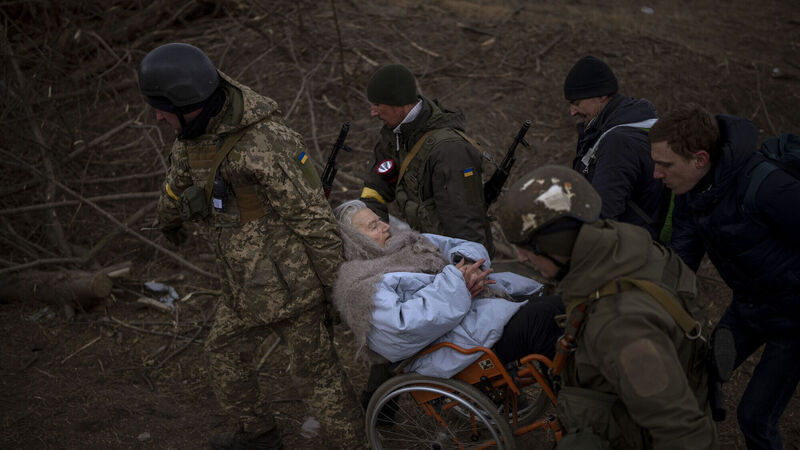
Ukrainian soldiers and militiamen carry a woman in a wheelchair as the artillery echoes nearby, while people flee Irpin on the outskirts of Kyiv, Ukraine. Picture: AP Photo/Emilio Morenatti
As the conflict in Ukraine entered its 13th day, buses carried civilians out of one embattled city and supplies towards another, as officials tried to move people away from a Russian onslaught and ease a dire humanitarian situation for those still stuck.
But reports of renewed Russian attacks in one area threatened to again derail those efforts.

According to the UN, more than two million people have now fled Ukraine in Europe’s worst refugee crisis since the Second World War.
Demands for ways to safely evacuate civilians have surged along with intensifying shelling by Russian forces, who have made significant advances in southern Ukraine but stalled in some other regions.

Efforts to put in place ceasefires along humanitarian corridors have repeatedly failed amid Russian shelling.
Since the invasion began, more than 400 civilian deaths have been recorded by the UN human rights office, which said the true number is much higher.
Ukrainian defence minister Oleksiy Reznikov said Russian military actions have killed 38 children and wounded more than 70.
- Ukraine has begun evacuating civilians from the northeastern city of Sumy and from the town of Irpin near the capital Kyiv, Ukrainian officials said. The evacuations began after Russian and Ukrainian officials agreed to establish "humanitarian corridors" to allow civilians out of some towns and cities besieged by Russian forces.
- However, as the Kremlin again promised safe corridors for civilians, the mayor of one besieged Kyiv suburb has described artillery fire as being so relentless residents are unable to gather up their dead.
- Joe Biden has decided to ban Russian oil imports, toughening the toll on Russia’s economy in retaliation for its invasion of Ukraine.

In addition to the unfolding humanitarian disaster, the fighting has sent energy prices surging worldwide and stocks plummeting, and threatened the food supply and livelihoods of people around the globe who rely on crops farmed in the Black Sea region.
Western countries have condemned the invasion and sought to support Ukraine with weapons — and punish Vladimir Putin’s Russia with sanctions.
The measures have dealt a blow to the Russian economy, as companies pull out of or sharply curtail their business there. In a further sign of the country’s economic isolation, Shell announced on Tuesday it would stop buying Russian oil and natural gas.
Elsewhere on Tuesday, buses emblazoned with red cross symbols carrying water, basic food staples and medicines moved towards the besieged southern port of Mariupol, to ferry civilians out of the city, but the Ukrainian president’s office later said it had been informed of shelling on the escape route.
It is unclear whether the supply convoy made it to Mariupol or whether civilians will freely board the buses if the shelling continues.

Mariupol's deputy mayor also cast doubt on the evacuations, telling the BBC that Russian forces continued to bombard area where people were trying to gather. He said some roads were blocked and others were mined.
“This morning the situation did not change,” Sergei Orlov told the . “So we still have… a city in blockade.”
The situation was growing more untenable in the city, which is without water, heat, sanitary systems or phones. Russia on Monday destroyed the natural gas supply.
The battle for Mariupol is crucial because its capture could allow Moscow to establish a land corridor to Crimea, which Russia seized from Ukraine in 2014. An estimated 200,000 people — nearly half the population of 430,000 — hope to flee.
Ukrainian officials had pushed back on the proposals as several of the routes would funnel people into Russia or its ally Belarus, which was served as a launchpad for the invasion. They have called instead for corridors allowing people to head to western parts of Ukraine not under attack.
“Ukraine has not given permission for evacuation to Russia, we did not agree on those routes. The corridors to Russia have not been agreed upon with the Red Cross either,” said Ms Vereschchuk.
President Volodymyr Zelensky too called for the expansion of humanitarian corridors, and more support from the Red Cross.

In a video address from an undisclosed location, he said a child had died of dehydration in Mariupol, in a sign of how desperate the city’s population has become.
He said there was no firm agreement on the route out of Mariupol, so “Russian troops can simply shoot on this transport on the way”.
Mr Zelensky accused the International Red Cross of “forbidding the use of its emblem on our cars”, but did not give details.
Videos of buses heading out of Sumy and towards Mariupol have had signs with a red cross on the side but it is not clear who pasted them there.
The president again pleaded for air support from western countries.
In Kyiv, soldiers and volunteers have built hundreds of checkpoints to protect the city of nearly four million, often using sandbags, stacked tyres and spiked cables.
Some barricades looked significant, with heavy concrete slabs and sandbags piled more than two storeys high, while others appeared more haphazard, with hundreds of books used to weigh down stacks of tyres.
“Every house, every street, every checkpoint, we will fight to the death if necessary,” said Kyiv mayor Vitali Klitschko.

Minister for Children, Equality, Disability, Integration and Youth, Roderic O’Gorman has said that a specialised unit will shortly be put in place to meet refugees from Ukraine as they arrive at airports and ports in Ireland.
To date, around 2,500 Irish people have pledged to take in Ukrainian refugees

Gardaí have urged anti-war protesters to keep within the law after a truck was driven through the gates of the Russian embassy in Dublin.
Security has been bolstered at the embassy in Dublin following Monday’s incident.
A man appeared in court on Tuesday morning charged with dangerous driving and criminal damage.
Tánaiste Leo Varadkar condemned the actions of the man claiming it was a "foolish" act.

A citizens' assembly may be held on Irish neutrality, the Taoiseach has told the Dáil.
Micheál Martin said Ireland has “never been politically neutral” and a discussion on military non-alignment could take place after the war in Ukraine has ended.

Lastly, An Irish medical student who has been trapped in war-torn eastern Ukraine is in high spirits as she nears the end of her long journey out of the Ukrainian city of Sumy following a dramatic rescue.
Describing how it feels to be so close to getting home after so long in Ukraine, Rachael Diyaolu told the it is “surreal”, particularly since they have been travelling and on the road for so long.
However, as they reach the final hours of the journey, "spirits are high", as she knows that she "should be able to get home".