Vladimir Putin says he backs talks but Ukraine must comply with Russia’s demands
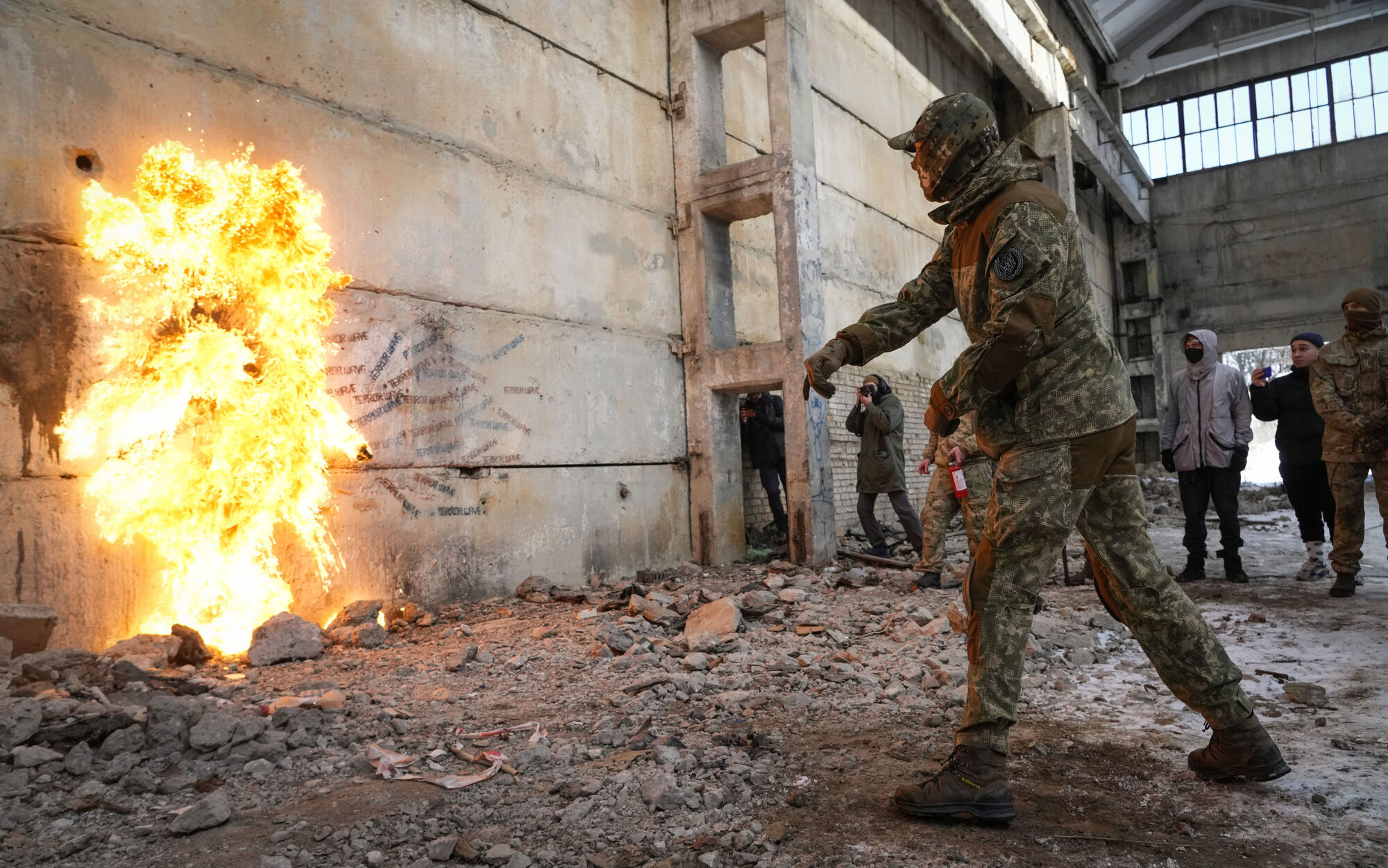
A local resident throws a Molotov cocktail against a wall during an all-Ukrainian training campaign "Don't panic! Get ready!" close to Kyiv, Ukraine, Sunday, Feb. 6, 2022. Picture: AP Photo/Efrem Lukatsky
President Vladimir Putin says Russia is ready for talks with Ukraine but insisted that it must meet Moscow’s demands.
Mr Putin told German Chancellor Olaf Scholz that Ukraine must agree to demilitarise, accept Moscow’s sovereignty over Crimea and surrender territory to Russia-backed rebels in the east, the Kremlin said in its readout of Friday’s call.
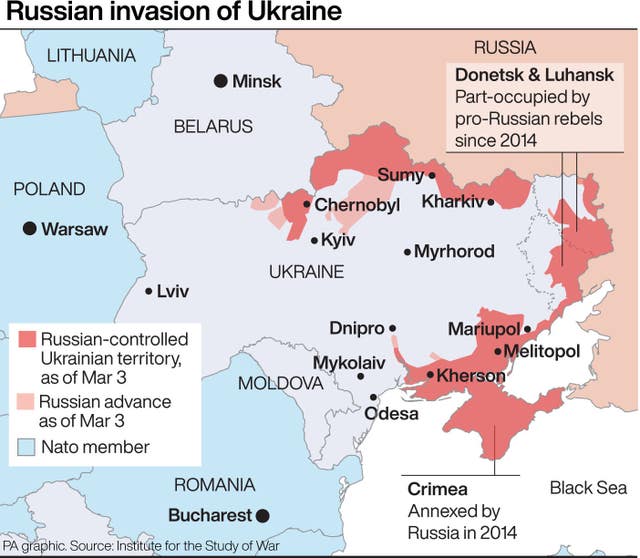
Russia annexed Ukraine’s Crimean Peninsula in 2014 following the ousting of the country’s former Moscow-friendly leaders and cast its support behind the rebels in eastern Ukraine.
Mr Putin recognised the separatist “people’s republics” as independent states just before he launched an invasion of Ukraine on February 24, citing their plea for military assistance.
Russian and Ukrainian negotiators on Thursday held the second of two rounds of talks, reaching a tentative agreement on setting up safe corridors to allow civilians to leave besieged Ukrainian cities and the delivery of humanitarian supplies.
They also agreed to keep talking on ways to negotiate a settlement, but Mr Putin’s tough demands make prospects for a compromise look dim.
Ukrainian negotiators said the parties may conduct another round of talks over the weekend.
President Vladimir Putin urged Russia's neighbours on Friday not to escalate tensions, eight days after Moscow sent its forces into Ukraine.
"There are no bad intentions towards our neighbours. And I would also advise them not to escalate the situation, not to introduce any restrictions. We fulfil all our obligations and will continue to fulfil them," Putin said in televised remarks.
"We do not see any need here to aggravate or worsen our relations. And all our actions, if they arise, they always arise exclusively in response to some unfriendly actions, actions against the Russian Federation."
Putin was shown on TV taking part online, from his residence outside Moscow, in a flag-raising ceremony for a ferry in northern Russia.
Washington is committed to doing everything needed to stop the war in Ukraine, US Secretary of State Antony Blinken said on Friday as he went into a meeting with his EU counterparts praising the bloc for the "historic" steps it has taken against Russia.
"We are faced together with what is President Putin's war of choice: unprovoked, unjustified, and a war that is having horrific, horrific consequences for real people. For mothers, fathers. For children. We see the images on TV, and it has to stop," he told reporters in Brussels.
"We're committed to doing everything we can to to make it stop. So the coordination between us is vital," he added
He said that beyond the risk for Ukrainians, Russia's invasion has also put at risk fundamental principles established after two world wars that are important to keeping peace and security, "principles that President Putin is egregiously violating every single day".
Meanwhile, NATO allies rejected Ukraine's demand for no-fly zones on Friday, saying they were increasing support but that stepping in directly would lead to a broader, even more brutal European war so far limited to Russia's assault on its neighbour.
Ukraine, a former Soviet republic, wants to join the European Union and Western military alliance NATO, whose members are bound in its founding treaty to defend each other from invasion.
"We are not part of this conflict," NATO Secretary-General Jens Stoltenberg told a news conference.
"We have a responsibility as NATO allies to prevent this war from escalating beyond Ukraine because that would be even more dangerous, more devastating and would cause even more human suffering."
Thousands of people are believed to have been killed or wounded and more than 1 million refugees have fled Ukraine since 24 Feb, when Russia's President Vladimir Putin ordered the biggest attack on a European state since World War II.


CONNECT WITH US TODAY



Be the first to know the latest news and updates