UAE intercepts Yemen missile as Israeli president visits
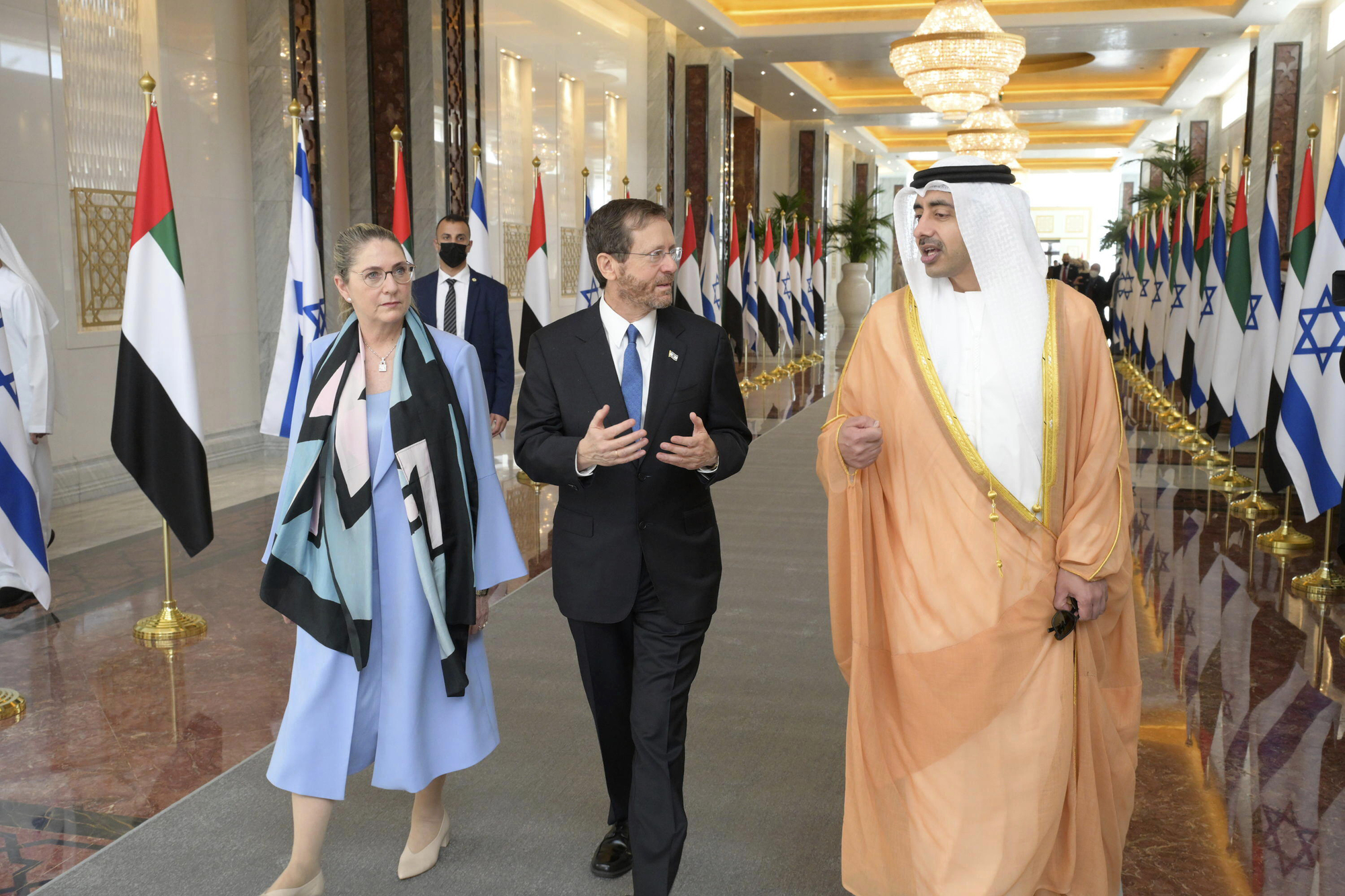
Israeli president Isaac Herzog, centre, and First Lady Michal Herzog are received by UAE Foreign Minister, Sheikh Abdullah bin Zayed Al Nahyan in Abu Dhabi. Picture: GPO via AP
The United Arab Emirates has intercepted a ballistic missile fired by Yemenâs Houthi rebels as the Israeli president visits the country, authorities said â the third such attack in recent weeks.
The attack during Isaac Herzogâs visit only fuels the ongoing tensions affecting the wider Persian Gulf, which has seen a series of attacks as Iranâs nuclear deal with world powers collapsed and Yemenâs war rages.
As negotiators in Vienna now attempt to save the accord and Emirati-backed forces press on the Houthis, the rebels are launching their longest-range attacks yet.
Those assaults represent a major challenge for the Emirates, which long has advertised itself to international businesses as a safe corner of an otherwise-dangerous neighbourhood.
The UAEâs state-run WAM news agency reported the interception, saying that âthe attack did not result in any losses, as the remnants of the ballistic missile fell outside the populated areasâ.
It was not immediately clear where the missile remnants fell. The countryâs civilian air traffic control agency said there was no immediate effect on air travel in the UAE, home to the long-haul carriers Emirates and Etihad.
Already, the countryâs top prosecutor has threatened that people who film or post images of such an incident would face criminal charges in the UAE, an autocratic federation of seven sheikhdoms on the Arabian Peninsula. That makes reporting on such incidents even more complicated for journalists.
In the absence of those videos, the Emirati defence ministry released black-and-white footage it described as showing the destruction of a ballistic missile launcher in Yemenâs al-Jawf province some 30 minutes after the attack.
Another attack last week saw a similar strike launched on al-Jawf in the minutes after, leading analysts to suggest the Emiratis may be receiving intelligence assistance from the West for its strikes.
Al-Jawf is some 840 miles south-west of Abu Dhabi.
Houthi military spokesman Yehia Sarei wrote on Twitter that the rebels would make an announcement about an attack in the coming hours that reached into âthe depths of the UAEâ.
The Houthisâ Al-Masirah satellite news channel later reported that air strikes had begun targeting Sanaa, Yemenâs rebel-held capital.
Mr Herzog, Israelâs ceremonial president in its parliamentary democracy, is in the country on a state visit.
On Sunday, the ceremonial leader met Abu Dhabiâs powerful crown prince, Sheikh Mohammed bin Zayed Al Nahyan.
âI wish to emphasize that we completely support your security requirements and we condemn in all forms and language any attack on your sovereignty,â Mr Herzog told Sheikh Mohammed, according to his office.
Mr Herzogâs office told The Associated Press that the trip was âexpected to continue as plannedâ when asked about the missile interception.
Mr Herzog was scheduled to visit Dubaiâs Expo 2020 worldâs fair, which the Houthis had previously threatened to target.
US state department spokesperson Ned Price condemned the Houthi attack.
In the hours after the Houthi attack early on Monday, Syrian state-run media said an Israeli strike hit near Damascus. The Israeli military did not immediately acknowledge it.
Israeli prime minister Naftali Bennett in December made his first official visit to the Gulf Arab sheikhdom and discussed strengthening relations on a number of fronts with Sheikh Mohammed.
The visits come after the UAE and Bahrain recognized Israel and established diplomatic relations in 2020. Palestinian leaders have condemned the normalisation deal as a betrayal of their cause for statehood.
Last week, a similar attack saw both Emirati and US forces fire interceptor missiles to bring down down a Houthi attack as the missiles came near Al-Dhafra Air Base in Abu Dhabi, which hosts some 2,000 American troops.
The week before that saw a Houthi drone-and-missile attack strike an Abu Dhabi National Oil fuel depot, killing three people and wounding six others.
Another attack targeted Abu Dhabi International Airport, though damage was not seen in satellite photos analysed by AP. That attack came as South Korean President Moon Jae-in visited the Emirates.
The attacks have helped propel benchmark Brent crude oil prices above 90 dollars a barrel, further squeezing a global economy grappling with inflation in the coronavirus pandemic.