Trump lawyers claim protected speech in bid to have January 6 cases thrown out
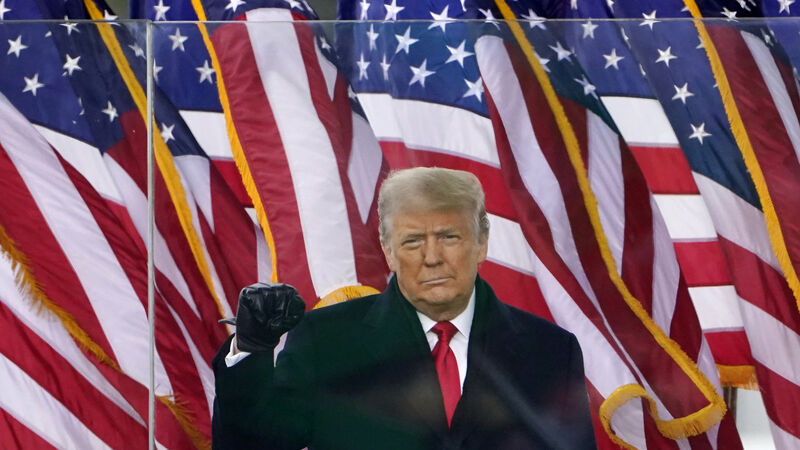
Lawyers for Donald Trump and his associates have argued that incendiary statements by the former president and others last January 6 before the Capitol riot were protected speech and in line with their official duties.
In response to civil suits running parallel to Congress’s own January 6 inquiry, Mr Trump’s lawyers claimed he was acting within his official rights and had no intention to spark violence when he called on thousands of supporters to “march to the Capitol” and “fight like hell” to disrupt the Senate’s certification of the 2020 election result.
“There has never been an example of someone successfully being able to sue a president for something that happened during his term of office,” said his lawyer Jesse Binnall. “That absolute immunity of the presidency is very important.”

The five-hour hearing in Washington before US District Judge Amit Mehta concerned Mr Trump’s attempts to have the civil suits dismissed.
Democratic representative Eric Swalwell brought one of the suits against Mr Trump and a host of others, including Donald Trump Jr, Trump lawyer Rudy Giuliani, Alabama Republican representative Mo Brooks and right-wing group the Oath Keepers, charging responsibility for the violent breach of the Capitol building by Trump supporters.
The other lawsuits, brought by Democratic representatives and two Capitol Police officers, claim that statements by Mr Trump and Mr Brooks on and before January 6 essentially qualify as part of a political campaign, and are therefore fair game for litigation.
Plaintiffs are seeking damages for the physical and emotional injuries they sustained during the insurrection.
“What he spoke about was a campaign issue, seeking to secure an election,” said Joseph Sellers, one of the lawyers representing Mr Swalwell. “This was a purely private act.”
Mr Sellers said Mr Trump’s statements were an overt and unambiguous call for political violence.
“It’s hard to conceive of a scenario other than the president traveling down to the Capitol himself and busting through the doors… but of course he did that through third party agents, through the crowd,” he said.
Mr Binnall argued that Mr Trump’s calls to derail the Senate vote certification process were in line with any executive’s right to comment or criticise a co-equal government branch.
“A president always has the authority to speak on whether or not any of the other branches, frankly, can or should take action,” he said, refencing cases where former president Barack Obama publicly commented on Supreme Court decisions.
Mr Binnall said Mr Trump has already been subject to a trial over January 6 — his second impeachment trial, where he was acquitted by the then-Republican majority Senate.
“That was their remedy and they failed,” he said. “They don’t get another bite of the apple here.”
The judge repeatedly cut off lawyers on both sides with questions and challenges.
Giuliani lawyer Joseph Sibley at one point said: “There’s simply no way you can construe the statements that were made by any of the speakers to be an invitation to join a conspiracy to go to the Capitol and commit crimes.”
District Judge Mehta asked: “Why not?”
The judge then refenced Mr Trump’s own January 6 speech in detail.
“His last words were ‘go to the Capitol’ and before that it was ‘show strength’ and ‘fight’. Why isn’t that a plausible invitation to do exactly what the rioters ended up doing?” the judge asked. ”Those words are hard to walk back.”
District Judge Mehta also focused on the hours-long silence from Mr Trump as his supporters battled Capitol Police and DC police officers and rampaged through the building.
He questioned Mr Binnall at length about whether that failure or refusal to condemn the assault as it was happening could be interpreted as approval.
The lawyer responded: “You cannot have a situation where the president is obligated to take certain actions or say certain things or else be subject to litigation.”
CONNECT WITH US TODAY



Be the first to know the latest news and updates