5,000 evacuated as lava from Spanish volcano heads towards the sea
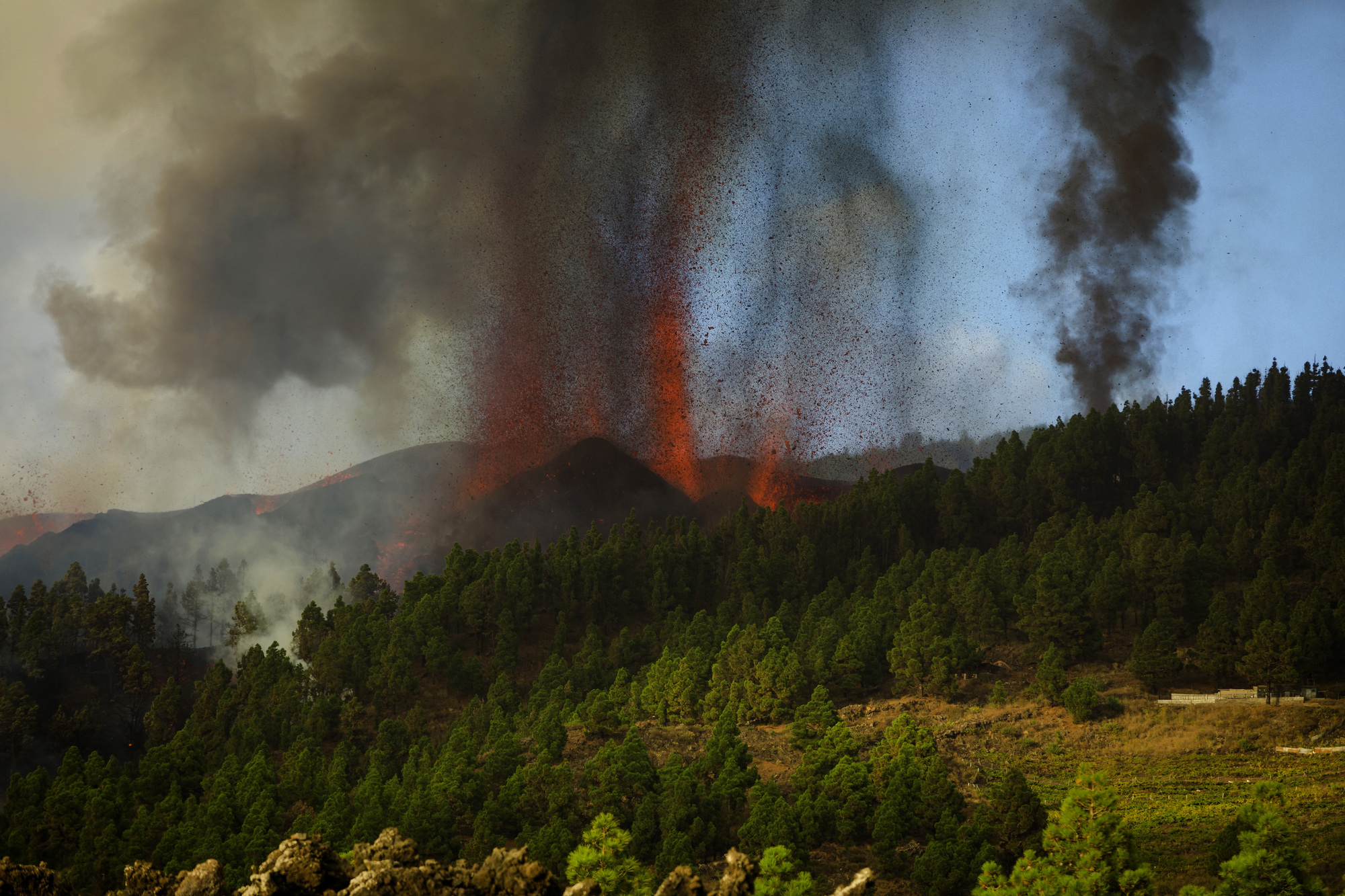
Lava flows from an eruption of a volcano at the island of La Palma. Picture: AP
Lava continues to flow from a volcano that erupted in Spain’s Canary Islands off north-west Africa, but no injuries are expected in the area by officials after some 5,000 people were evacuated.
Lava was flowing on the island of La Palma toward the sea, moving at 700 metres (2,296ft) per hour, according to the Canary Islands Volcanology Institute.
The lava was moving in two streams through a mostly unpopulated area, Canary Islands government chief Angel Victor Torres told SER radio. Some 20 isolated houses were destroyed, SER reported.
“We’re not expecting any other eruptions,” Mr Torres said, adding that air traffic in the area was not affected.

“There will be considerable material damage. We hope there won’t be any personal injuries.”
People on La Palma largely make their living from farming.
Spanish prime minister Pedro Sanchez is due to visit the affected area on Monday after cancelling his trip to New York to attend the UN General Assembly.
The volcano erupted on Sunday after a week-long build-up of seismic activity that was closely monitored by authorities.
The Canary Islands Volcanology Institute reported the initial eruption shortly after 3pm near the southern end of the island, which saw its last eruption in 1971.
Huge red plumes topped with black-and-white smoke shot out along the Cumbre Vieja volcanic ridge, which scientists had been monitoring following the accumulation of molten lava below the surface and days of small earthquakes.

Most of those evacuated were taken in by family or friends, with the rest staying in shelters, officials said.
La Palma, with a population of 85,000, is one of eight volcanic islands in Spain’s Canary Islands archipelago off Africa’s western coast. At their nearest point, the islands are 60 miles from Morocco.
A 4.2-magnitude quake was recorded before the eruption, which took place in an area known as Cabeza de Vaca on the western slope as the ridge descends to the coast.
As the eruptions continued, at least two open mouths belched bright red magma into the air that then flowed in tight streams down the mountain slope.
Mariano Hernandez, president of La Palma island, asked people to stay away from the eruption.

“People should not come near the eruption site where the lava is flowing,” he said.
“We are having serious problems with the evacuation because the roads are jammed with people who are trying to get close enough to see it.”
Itahiza Dominguez, head of seismology of Spain’s National Geology Institute, told Canary Islands Television that although it was too early to tell how long this eruption would last, prior eruptions on the Canary Islands lasted weeks or even months.
The last eruption on La Palma 50 years ago lasted just over three weeks.
The last eruption on all the Canary Islands occurred underwater off the coast of El Hierro island in 2011. It lasted five months.
CONNECT WITH US TODAY



Be the first to know the latest news and updates