Taliban aims to reassure on women's rights and revenge fears, as NGOs call for refugee places
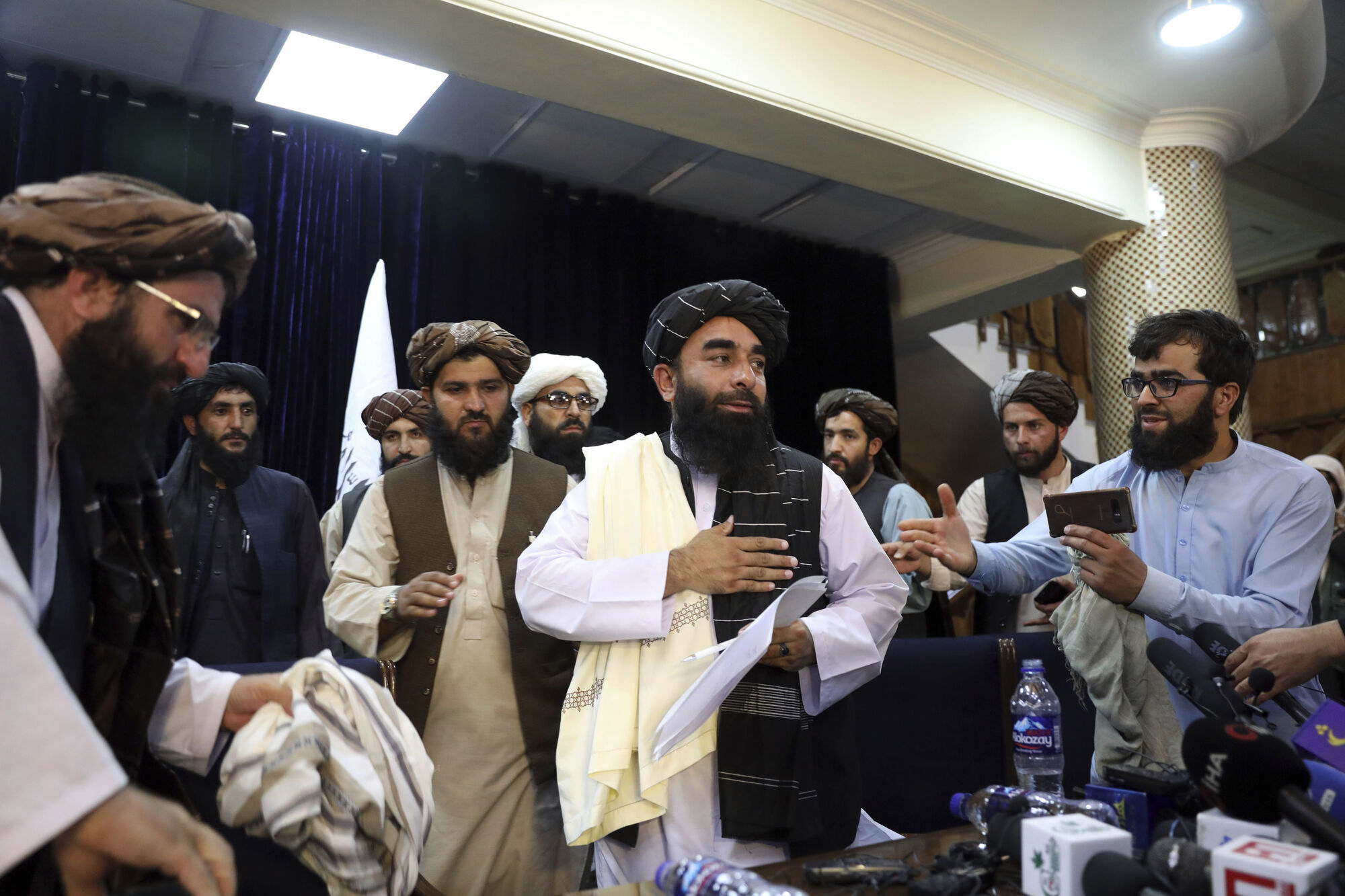
Taliban spokesman Zabihullah Mujahid, center, leaves after his first news conference, in Kabul, Afghanistan, Tuesday, Aug. 17, 2021. Mujahid vowed Tuesday that the Taliban would respect women's rights, forgive those who resisted them and ensure a secure Afghanistan as part of a publicity blitz aimed at convincing world powers and a fearful population that they have changed. Picture: AP Photo/Rahmat Gul
Women will have rights "within the framework of Islamic law", the Taliban has claimed in its first public utterances after retaking control of Afghanistan - but would not elaborate on what that meant in practice.
The long-feared militant group, which ruled the south Asian country with an iron hand from 1996 to 2001, insisted women would "be very active within our society" but declined to say what that meant in relation to employment or dress codes in the soon-to-be established government.
The 75,000-strong Taliban also insisted once again that revenge on those who assisted American occupiers was not on its agenda, as the UN human rights council expressed "serious human rights concerns" ahead of a special session on the international crisis next week.
During the group's first reign, the world was horrified by public stonings, amputations, and other acts of barbarism perpetrated on Afghan citizens, while women were restricted from working or leaving home without a male relative in tow, among other harsh curtailments of freedom.
US President Joe Biden, who has come in for ferocious criticism over his administration's handling of the unfolding situation, has not yet spoken with any world leaders regarding Afghanistan, his national security advisor Jake Sullivan said.
In the first public news conference since the fall of capital city Kabul, Taliban spokesman Zabihullah Mujahid spoke in appeasing terms.
"I would like to reassure all the compatriots, whether they were translators, whether they had military activities or whether they have been civilians, all of them have been pardoned. Nobody is going to be treated with revenge," he said.
It comes as around 300 Afghan refugees are expected to come to Ireland over the coming weeks as part of the Irish Refugee Protection Programme (IRPP).
Foreign Affairs Minister Simon Coveney and International Development Minister, Colm Brophy, announced €1m in funding to the UN High Commission for Refugees (UNHCR).
Mr Coveney said: "The situation in the country is incredibly worrying. Even before the events of the last few weeks, there were already almost three million Afghans displaced from their homes by insecurity. That figure is now rising.
"Ireland will continue to engage, including at the UN Security Council, to support peace in Afghanistan and to protect and promote the human rights of all Afghans, especially for women and girls."
Mr Coveney took part in an emergency meeting of EU Foreign Ministers today to discuss the situation.
The meeting discussed the coordination of evacuation efforts, to ensure that EU citizens seeking to leave Afghanistan are facilitated to do so as soon as possible, as well as the rights of women, girls, and minorities.
A dozen Irish groups working with refugees and migrants have written to the Government, calling on it to take “concrete” action, and resettle at least 1,000 Afghan refugees.
Nick Henderson, CEO of the Irish Refugee Council said: "We believe, through membership of the Security Council, and other diplomatic channels, Ireland can continue to show strong humanitarian leadership on this issue. However, this needs to be backed up by concrete actions, domestically and internationally.
"According to UNHCR there are currently 96,000 Afghan people in neighbouring countries in need of protection. There are at least 1,100 unfilled resettlement places from 2020 and 2021. We are recommending that at least a 1,000 Afghan refugees are resettled."
There are around 211 Afghan people living in direct provision, while 97 Afghan people were refused leave to land in Ireland between January 1, 2020 and May 31 this year, Mr Henderson said.
Asylum seekers in Ireland have spoken of their anguish.
Emal Fiza told the Irish Examiner what is happening in his country is "heartbreaking".
"I am afraid about my two sisters and if anything happened to them by the Taliban I would blame only myself because I can’t help to secure them," he said.

CONNECT WITH US TODAY



Be the first to know the latest news and updates