Campaigners win High Court victory over Stonehenge tunnel project
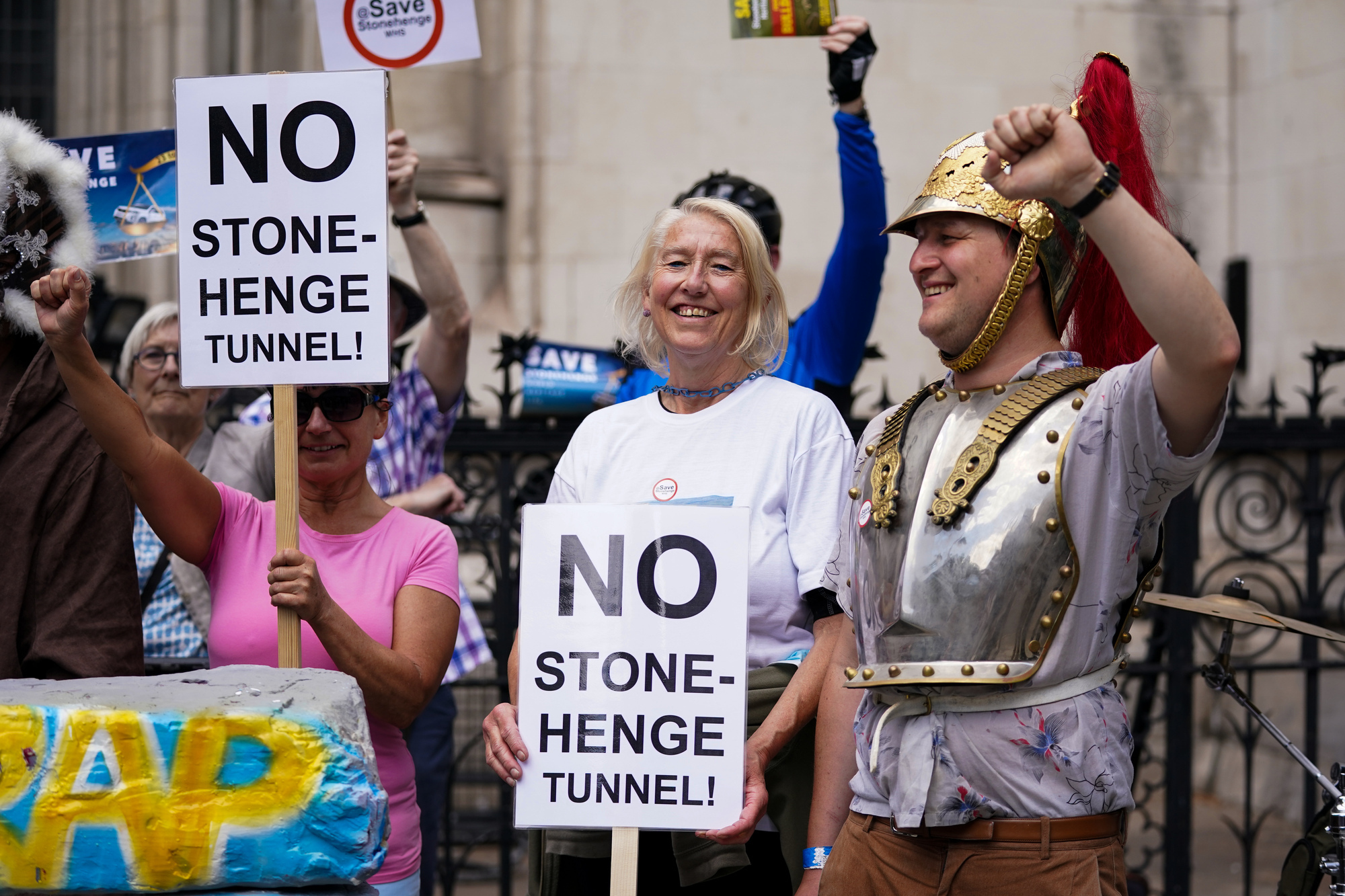
Campaigners have welcomed the courtâs decision (Kirsty OâConnor/PA)
Campaigners have won a High Court battle over Transport Secretary Grant Shappsâ decision to approve a controversial road project which includes a tunnel near Stonehenge.
Save Stonehenge World Heritage Site (SSWHS) challenged his decision to back the ÂŁ1.7bn (âŹ1.9bn) scheme to overhaul eight miles of the A303, including the two-mile tunnel.
The go-ahead was given in November last year, despite advice from Planning Inspectorate officials that it would cause âpermanent, irreversible harmâ to the Unesco World Heritage Site in Wiltshire.
In a ruling on Friday, Mr Justice Holgate found the decision was âunlawfulâ on two grounds.
He concluded that there was a âmaterial error of lawâ in the decision-making process because there was no evidence of the impact on each individual asset at the historic site.
He also found that Mr Shapps failed to consider alternative schemes, in accordance with the World Heritage Convention and common law.
The judge said: âThe relevant circumstances of the present case are wholly exceptional.
âIn this case the relative merits of the alternative tunnel options compared to the western cutting and portals were an obviously material consideration which the (Transport Secretary) was required to assess.
âIt was irrational not to do so. This was not merely a relevant consideration which the (Transport Secretary) could choose whether or not to take into account.
âI reach this conclusion for a number of reasons, the cumulative effect of which I judge to be overwhelming.â
John Adams, SSWHS director and acting chairman of the Stonehenge Alliance, said: âWe could not be more pleased about the outcome of the legal challenge.
âThe Stonehenge Alliance has campaigned from the start for a longer tunnel if a tunnel should be considered necessary.
âIdeally, such a tunnel would begin and end outside the WHS. But now that we are facing a climate emergency, it is all the more important that this ruling should be a wake-up call for the Government.
âIt should look again at its roads programme and take action to reduce road traffic and eliminate any need to build new and wider roads that threaten the environment as well as our cultural heritage.â
Rowan Smith, a Leigh Day solicitor who represented the campaigners, said: âThis is a huge victory, which means, for now, Stonehenge is safe.
âThe judgment is a clear vindication of our clientâs tremendous efforts in campaigning to protect the World Heritage Site.
âThe development consent for this damaging tunnel has been declared unlawful and is now quashed, and the Government will have to go back to the drawing board before a new decision can be made.
âMeanwhile, one of the countryâs most cherished heritage assets cannot be harmed.â
A panel of expert inspectors recommended that development consent should be withheld because the project would substantially and permanently harm the integrity and authenticity of the site, which includes the stone circle and the wider archaeology-rich landscape.
In a report to Mr Shapps, the officials said permanent, irreversible harm, critical to the outstanding universal value of the site, or why it is internationally important, would occur, âaffecting not only our own, but future generationsâ.
The Stonehenge site, together with Avebury, was declared by Unesco to be a World Heritage Site of Outstanding Universal Value in 1986 on account of the size of the megaliths, the sophistication of their concentric plans and the complexes of Neolithic and Bronze Age sites and monuments.
The proposed tunnel is part of a ÂŁ1.7 billion investment in the A303 between Amesbury and Berwick Down.
The road, which is a popular route for motorists travelling to and from the South West, is often severely congested on the single carriageway stretch near the stones.
Highways England says its plan for a two-mile tunnel will remove the sight and sound of traffic passing the site and cut journey times, but some environmentalists and archaeologists have voiced their opposition to the plan due to its potential impact on the area.
The project is classified as nationally significant, which means a development consent order is needed for it to go ahead.
A Historic England spokesperson said: âWe are disappointed in the outcome of the Judicial Review. This is a missed opportunity to remove the intrusive sight and sound of traffic past the iconic monument and to reunite the remarkable Stonehenge landscape, which has been severed in two by the busy A303 trunk road for decades.
âWe believe that the scheme had the potential to deliver a lasting positive legacy for the World Heritage Site and we advised on a rigorous programme of archaeological investigation to ensure the impact on sensitive archaeological remains was minimised.
âStonehenge is one of the most important prehistoric landscapes in the world and has been of deep significance to people for over 5,000 years.
âWe will continue work with partners in the heritage sector and to advise Highways England on any proposals for the A303.â