Zero deaths linked to Covid-19 in Britain for first time since last summer-UK Government
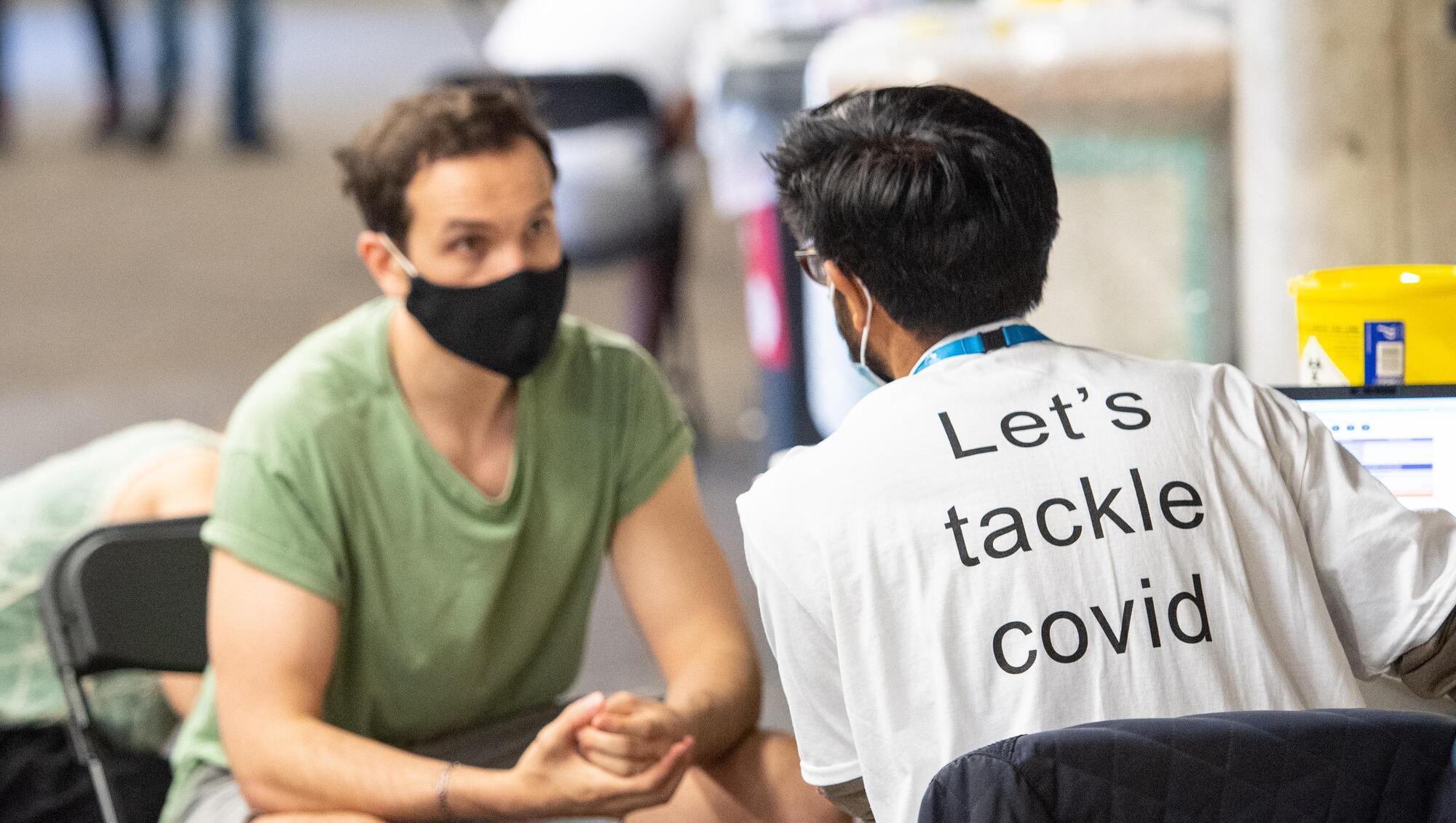
A man receives a coronavirus vaccination at Twickenham rugby stadium. Picture: Dominic Lipinski/PA
The UK has not reported any deaths linked to Covid-19 for the first day since summer last year.
No deaths within 28 days of testing positive for Covid-19 were reported on Tuesday, according to the UK Government.
It is the first time this has happened since July 30, 2020.
Meanwhile scientists continue to debate whether the UK Government should press ahead with the final stages of easing social restrictions later this month.
Downing Street has indicated that British Prime Minister Boris Johnson still sees nothing in the data to suggest the plan to end all legal lockdown restrictions on June 21 will need to be delayed.
Asked about the UK Prime Minister’s plans amid warnings over the spread of the Indian variant, a No 10 spokesman said: “The Prime Minister has said on a number of occasions that we haven’t seen anything in the data but we will continue to look at the data, we will continue to look at the latest scientific evidence as we move through June towards June 21.”
The latest death tally will feed into ministers’ considerations.
They will also consider that the announcement on zero deaths comes after a bank holiday weekend, so there may be a delay in the reporting of the figures.
The UK Government has reported that the total number of deaths within 28 days of testing positive for Covid-19 now stands at 127,782.
But separate figures published by the Office for National Statistics show there have now been 153,000 deaths registered in the UK where Covid-19 was mentioned on the death certificate.
Experts are divided over whether the final stage of easing social restrictions should go ahead on June 21 amid a surge in cases of the new variant first identified in India.
Professor Adam Finn, of the UK Joint Committee on Vaccination and Immunisation (JCVI), said there are still many people who are vulnerable to the effects of Covid-19, as he warned “the idea that somehow the job is done is wrong”.
Prof Finn, from the University of Bristol, told BBC Radio 4’s Today programme: “We’ve still got a lot of people out there who’ve neither had this virus … nor yet been immunised, and that’s why we’re in a vulnerable position right now.”
He told LBC that pressing ahead with the easing of restrictions on June 21 “may be a bad decision”.
Professor Ravi Gupta, a member of the New and Emerging Respiratory Virus Threats Advisory Group (Nervtag), said a delay of a few weeks could have a significant impact on Britain’s battle against the pandemic and recommended it should be made clear to the public that it would be a temporary measure based on the surge in cases of the new variant.
“Even a month delay could have a big impact on the eventual outcome of this,” Prof Gupta told ITV’s Good Morning Britain.
Pat Cullen, acting general secretary and chief executive of the Royal College of Nursing, urged ministers to watch the data, adding: “As the NHS starts the road to recovery now is the time to take cautious steps and not take an unchecked leap to freedom.”
However, Robert Dingwall, professor of sociology at Nottingham Trent University, said it was important to press ahead with the June 21 easing from a societal point of view.

He told Times Radio: “I personally don’t see any case for delay … from a societal point of view, I think it’s really important that we go ahead on June 21 and I’ve not really seen anything in the data that would lead me to doubt that as a proposition on the evidence to date.”
The UK Government’s former chief scientific adviser said ministers need more data before ministers can make a final decision.
“We need to substitute speculation for scientific data, that’s the truth of the matter, as everyone has said in the last few days, the situation is very delicately balanced with some three sets of moving parts,” Professor Sir Mark Walport told BBC Breakfast.
“Firstly, we have got a new, more transmissible, variant, of that there is no doubt, though we don’t know exactly how much more transmissible.
“Secondly, there’s been a change in behaviour following the relaxation of measures on May 17 and the effects of that will just be starting to come through.
“Thirdly, we’ve got a vaccination programme that is very successful, but with a lot of people that still need both their second dose of vaccine and vaccination from scratch.

“I’m afraid that weeks before the Prime Minister has to make the difficult decision it is going to be necessary to bring in the data.”
Asked if the nation is in the foothills of another wave, he added: “I hope not, but it’s not impossible.”
CONNECT WITH US TODAY



Be the first to know the latest news and updates