Mission to demonstrate space debris removal set for launch
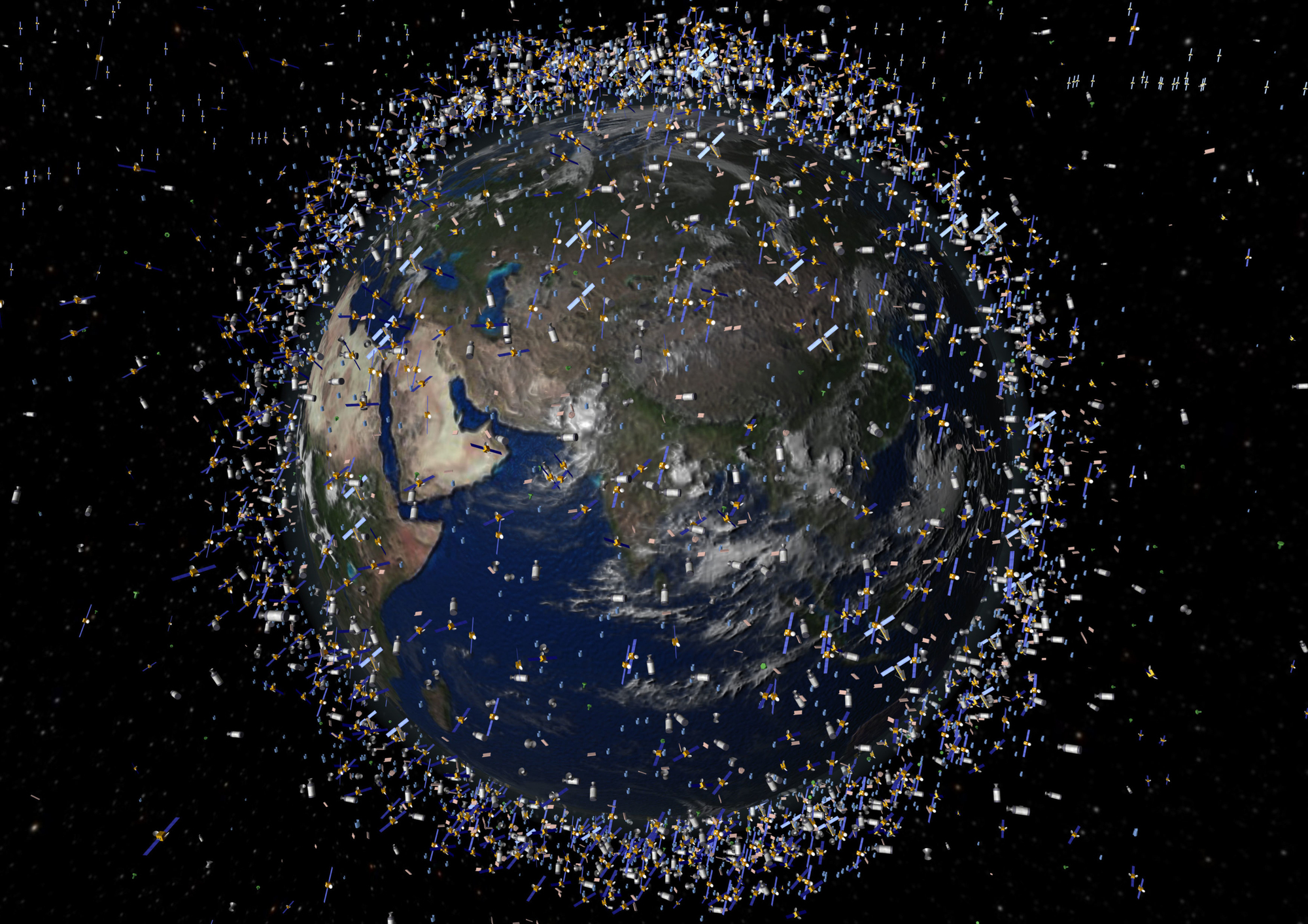
A collision with space debris could have a big impact on satellite services people rely on every day (ESA/PA)
The worldās first mission to demonstrate how space debris could be removed from lower Earth orbit will launch later this week.
Two spacecraft will be blasted into space together ā a servicer satellite to collect the debris, and a client satellite to act as the debris.
According to the European Space Agency there is approximately 9,200 tonnes of space debris, with 34,000 objects greater than 10cm, and 128 million objects from greater than 1mm to 1cm.
š Join our ELSA-d Launch Countdown Livestream š
— Astroscale (@astroscale_HQ) March 17, 2021
šļø 20 March
ā° 5:00am (UTC)
š£ļø Japanese with live English translation
#⣠#GoELSAdhttps://t.co/61ycoVcFxc pic.twitter.com/QCug7y17lV
It estimates there have been more than 560 break-ups, explosions, collisions, or anomalous events resulting in fragmentation.
While rocket launches have placed about 10,680 satellites in Earthās orbit since 1957, around 6,250 of these are still in space, but only 3,700 are still functioning.
A collision with space debris could have a big impact on satellite services people rely on every day, including mobile phones and online banking.
The servicer satellite has been developed to safely remove debris from orbit, equipped with proximity rendezvous technologies and a magnetic docking mechanism.
The client satellite is a piece of replica debris fitted with a plate that enables the docking.
During the mission, the servicer will repeatedly release and dock with the client in a series of technical demonstrations, indicating the capability to find and dock with defunct satellites and other debris.
What's created the most #SpaceDebris, to date?
— European Space Agency (@esa) March 17, 2021
Check out the history of space debris on the @esaoperations/@UNOOSA podcast š https://t.co/5tbzGz9X6P
Demonstrations include looking for the client, inspecting it and meeting up with it, and both tumbling and non-tumbling docking.
Astroscale will launch its End-of-Life Services by Astroscale demonstration (ELSA-d) satellite from the Baikonur Cosmodrome in Kazakhstan on Saturday at 6.07am.
ELSA-d will launch on a Soyuz rocket operated by GK Launch Services.
John Auburn, managing director of Astroscale UK and group chief commercial officer, said: āOur team is very proud to have developed the mission control and ground systems for ELSA-d.
āWe will perform complex manoeuvres to demonstrate the release and capture of this debris, with the first semi-autonomous robotic magnetic capture of a piece of debris, tumbling through space, using advanced software and autonomous control technology.
āThis mission will prepare the way for Astroscale to scale-up our commercial debris removal services for satellite providers and government partners.ā