Pluto spacecraft sends message home from three billion miles away
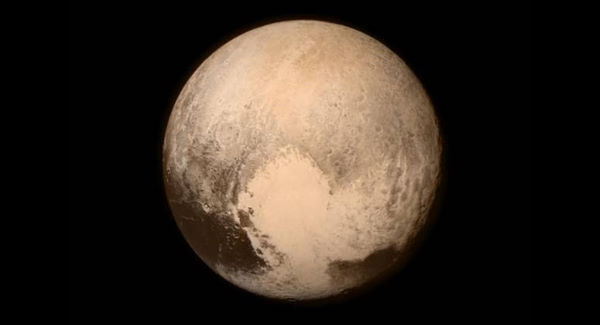
Nasa’s New Horizons spacecraft has got humanity’s first up-close look at Pluto, sending word of its triumph across three billion miles to scientists waiting breathlessly back home.

Pluto spacecraft sends message home from three billion miles away

Nasa’s New Horizons spacecraft has got humanity’s first up-close look at Pluto, sending word of its triumph across three billion miles to scientists waiting breathlessly back home.

Confirmation of mission success came 13 hours after the actual fly-by and, after a day of both jubilation and tension, allowed the New Horizons team to finally celebrate in full force.

Early indications had been encouraging and a cheering, flag-waving celebration swept over the mission operations centre in Maryland at the time of closest approach. But until New Horizons phoned home hours later, there was no guarantee the spacecraft had buzzed the small, icy far away – but no longer unknown - world.

The unprecedented encounter was the last stop on Nasa’s grand tour over the past half-century of the planets in our solar system.

New Horizons arrived at Pluto after an epic journey that began nine and a half years ago, when Pluto was still considered a full-fledged planet.

“This is truly a hallmark in human history,” said John Grunsfeld, Nasa’s science mission chief. “It’s been an incredible voyage.”

According to Nasa, the spacecraft swept to within 7,700 miles of Pluto at 31,000 mph. It was programmed to then go past the dwarf planet and begin studying its far side.

To commemorate the moment of closest approach, scientists released the best picture yet of Pluto, taken on the eve of the fly-by.

Even better images will start “raining” down on Earth later, promised principal scientist Alan Stern.

It takes four and a half hours for signals to travel one way between New Horizons and Earth. The message went out late in the afternoon during a brief break in the spacecraft’s data-gathering frenzy. The New Horizons team kept up a confirmation countdown, noting via Twitter when the signal should have passed the halfway point, then Jupiter’s orbit.

The uncertainty added to the drama. “This is true exploration,” warned Mr Stern, a Southwest Research Institute planetary scientist. “New Horizons is flying into the unknown.”

Among the possible dangers was cosmic debris that could destroy the mission. But with the chances of a problem considered extremely low, scientists and hundreds of others assembled at Johns Hopkins University’s Applied Physics Laboratory erupted in jubilation when the moment of closest approach occurred at 7.49am local time.

The scene repeated itself a little before 9pm. This time, the flight control room was packed compared with earlier, when it was empty because New Horizons was out of touch and operating on autopilot.

“We have a healthy spacecraft. We’ve recorded data of the Pluto system and we’re outbound from Pluto,” announced mission operations director Alice Bowman, to cheers and applause. Mr Stern ran over to give her a hug.

Joining in the day-long hoopla were the two children of the American astronomer who discovered Pluto in 1930, Clyde Tombaugh – some of his ashes are aboard the spacecraft.

Other celestial-minded VIPs included James Christy, discoverer of Pluto’s big moon Charon, and Sylvia Kuiper, daughter of Dutch-American Gerard Kuiper for whom the mysterious zone surrounding Pluto is named.

Earlier the White House and US Congress offered congratulations and physicist Professor Stephen Hawking was among the scientists weighing in.

“Hey, people of the world! Are you paying attention?” planetary scientist Carolyn Porco, part of the New Horizons’ imaging team, said on Twitter. “We have reached Pluto. We are exploring the hinterlands of the solar system. Rejoice!”

The US is now the only nation to visit every planet in the solar system. Pluto was number nine in the line up when New Horizons left Cape Canaveral, Florida, on January 19 2006, but was demoted seven months later to dwarf status.

Scientists in charge of the 720 million-dollar (£461m) mission hope the new observations will restore Pluto’s honour.

Mr Stern and other so-called plutophiles posed for the cameras giving nine-fingers-up “Pluto Salute”.

The picture of Pluto taken on Monday showed a frozen, pockmarked world, peach-coloured with a heart-shaped bright spot and darker areas around the equator. It drew oohs and aahs.

“To see Pluto be revealed just before our eyes, it’s just fantastic,” said Ms Bowman.

The Hubble Space Telescope had offered up the best pre-New Horizons pictures of Pluto, but they were essentially pixelated blobs of light.

Flight controllers held off on having New Horizons send back fly-by photos until well after the manoeuvre was complete; they wanted the seven science instruments to take full advantage of the encounter. After turning towards Earth to send down a snippet of engineering data acknowledging everything was fine, the spacecraft was going to get right back to science work.

New Horizons is also expected to beam back photos of Pluto’s big moon, Charon, and observe its four little moons. It will take 16 months, or until late 2016, for all the data to reach Earth.

On the eve of the encounter, Nasa confirmed that Pluto is, indeed, the King of the Kuiper Belt. New measurements made by the spacecraft show that Pluto is 1,473 miles in diameter, or about 50 miles bigger than estimated.

That is still puny by solar-system standards. Pluto is just two-thirds the size of Earth’s moon. But it is big enough to be the largest object in the Kuiper Belt, a zone rife with comets and tens of thousands of other small bodies.

Mr Stern and his colleagues wasted no time pressing the US Postal Service for a new stamp of Pluto.

The last one, issued in 1991, consisted of an artist’s rendering of the far-away world and the words “Pluto Not Yet Explored”. The words “not yet” were crossed out in a poster held high for the cameras.

More in this section

Cookie Policy Privacy Policy Brand Safety FAQ Help Contact Us Terms and Conditions

© Examiner Echo Group Limited