Clashes at World Cup demonstration in Brazil
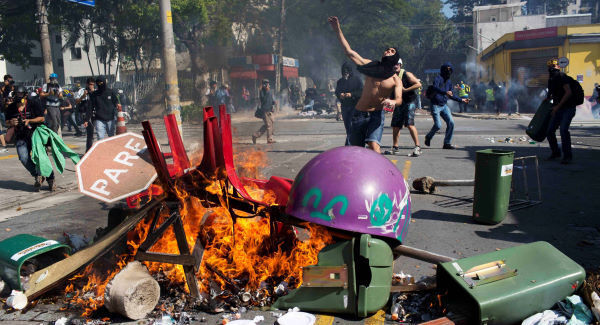
Protesters and Brazilian police have clashed in Sao Paulo, just hours before the first World Cup match was to be played in the city.
More than 300 demonstrators gathered along a main road leading to the stadium. Some in the crowd tried to block traffic, but police repeatedly pushed them back, firing canisters of tear gas and using stun grenades.
A few protesters suffered injuries after being hit by rubber bullets, while others were seen choking after inhaling tear gas.
An Associated Press photographer was injured in the leg after a stun grenade exploded near him. CNN reported on its website that two of its journalists were also injured.
“I’m totally against the cup,” said protester Tameres Mota, a university student at the demonstration. “We’re in a country where the money doesn’t go to the community, and meanwhile we see all these millions spent on stadiums.”
In the crowd were anarchist supporters of the “Black Bloc” tactic of protest, a violent form of demonstration and vandalism that emerged in the 1980s in Germany and helped shut down the 1999 World Trade Summit in Seattle.
Such protesters have frequently squared off against police in several Brazilian cities in the past year, as a drumbeat of anti-government demonstrations have continued since a massive wave of protests hit Brazil last year.
Meanwhile, about 300 protesters gathered in central Rio de Janeiro in another demonstration against the World Cup.
No clashes with police were reported there, as marchers took to streets to denounce lavish public spending on a sports tournament in a nation with profound social needs.
The demonstrations in recent months have paled in comparison to those last year, when a million people took to the streets on a single night. Those protests were largely spontaneous and no single group organised them.
That has now changed, said David Fleischer, a political scientist at the University of Brasilia. He said the recent protests have shrunk, because they are “very specific in their aims, so they are quite easy for the police to control”.
Because the recent protests have been organised by established groups, there are leaders with whom the government can negotiate. For instance, Mr Fleischer said, in the past week the federal government convinced a large activist group of homeless workers not to demonstrate during the World Cup.
But there will remain remnants of protests because people who adhere to the Black Bloc movement and other “anonymous groups are difficult to negotiate with because they have no leaders to dialogue with”, Mr Fleischer said.
It is the first time the South American nation has hosted the football tournament in 64 years.
Nearly half the world’s population, well over three billion spectators, are expected to watch the event and get a glimpse of the country that in two years will host the summer Olympics.
But as the event begins, it is not clear which Brazil will be seen – the nation known for its festive spirit or the country that for the past year has been a hotbed of fury over poor public services, discontent over a political system widely viewed as corrupt, and deep anger over the billions spent on hosting the World Cup.
“The world is going to see multitudes cheering for soccer – but also demanding that our country change,” Helen Santos, a school teacher, said as she walked home in Rio de Janeiro.
“The world needs to see that we’re a serious country. We’re not just a nation of soccer, but a country striving and demanding the government provide better education and health care. The world needs to see the reality of Brazil, not just the sport.”
Meanwhile, air travellers landing in Rio de Janeiro found a portion of airport workers striking for higher wages, but Sao Paulo averted a transportation mess when its subway workers voted against resuming their walkout on the World Cup’s opening day.
In Rio, where fans are arriving ahead of a match on Sunday between Argentina and Bosnia-Herzegovina, check-in counter clerks, baggage handlers and janitorial staff who have been demanding raises of at least 5.6% for several months voted to strike from midnight.
The work stoppage will affect the city’s Galeao international airport as well as the Santos Dumont airport that connects Rio to other Brazilian destinations
A union representative said only 20% of workers would stay off the job for 24 hours, abiding by a labour court order that threatened to fine unions more than 22,000 dollars (£13,000) if staffing fell below 80% of normal levels.
Teachers also remain on strike in Rio and routinely block streets with rallies, and subway workers in that city briefly threatened a walkout. Police in several cities have also gone on strike in recent weeks, but are back at work now.