China hails lunar mission a success
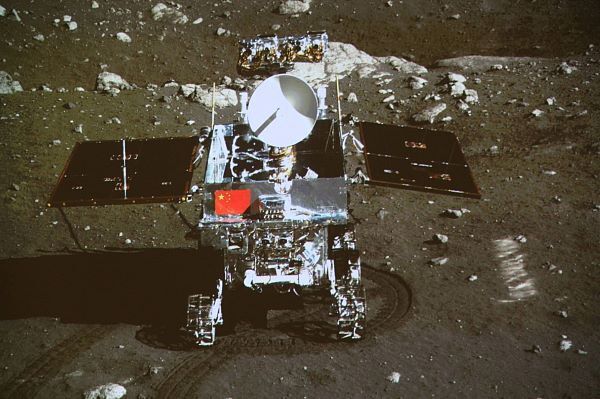
China has hailed its lunar probe mission a success after the country’s first moon rover and the landing vehicle that carried it there took photos of each other on the surface, state media reported.
The six-wheeled rover moved to a spot about 9m (10 yards) north of the landing vehicle last night and the pair took photos for about a minute, the official Xinhua News Agency reported.
The colour images transmitted back to Earth showed the Chinese flag on the Yutu, or Jade Rabbit, rover, named after a mythological creature.
President Xi Jinping and Premier Li Keqiang were at the Beijing Aerospace Control Centre to hear lunar programme chief commander Ma Xingrui declare the Chang’e 3 mission a success.
In a congratulatory message, the Communist Party’s central committee, State Council or China’s Cabinet, and the Central Military Commission hailed the mission as a “milestone” in the development of China’s space programmes, a “new glory” in Chinese explorations and the “outstanding contribution” of China in mankind’s peaceful use of space, Xinhua said.
The Chang’e 3 landed on a relatively flat part of the moon known as Sinus Iridum, or the Bay of Rainbows, on Saturday evening, marking the world’s first soft landing of a space probe on the moon in nearly four decades. China is the third country to do that after the former Soviet Union and United States.
The lander and rover have now embarked on separate scientific explorations. The 140kg (300lb) rover will survey the moon’s geological structure and surface and look for natural resources for three months at a speed of 200m (200 yards) per hour. The landing vehicle will conduct scientific examinations for one year at the landing site.
Xinhua said the two will have more chances in the coming days to take photos of each other at different angles.
The Chang’e 3 mission is named after a mythical Chinese goddess of the moon and the Yutu rover, or Jade Rabbit in English, is the goddess’ pet.
China’s military-backed space programme has made methodical progress in a relatively short time, although it lags far behind the United States and Russia in technology and experience.