Investigation continues into Spanish train disaster
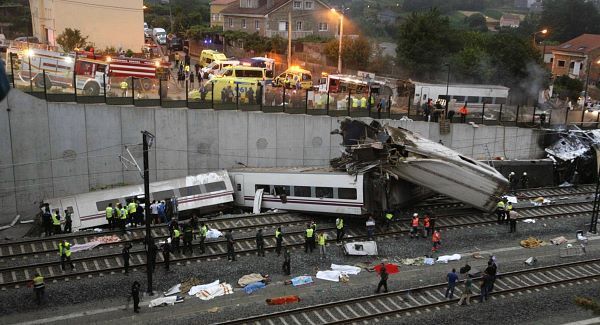
Investigators probing the Spanish rail disaster are focusing on the key question of why the train was going so fast.
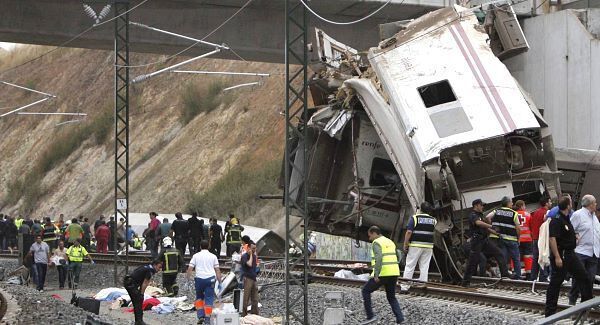
At least 80 people were killed and scores injured as the train derailed two miles south of Santiago de Compostela in Galicia, north-west Spain, with 218 passengers and five crew members on board.
Spanish authorities have yet to identify 13 of the 80 passengers killed.
Investigators are looking into possible failings by the 52-year-old driver and the train’s in-built speed-regulation systems.
Experts said one, or both, must be at fault for Spain’s deadliest rail disaster in decades.
Rafael Catala, a senior transport official in Spain’s Development Ministry, said the train appeared to be going much faster than the track’s maximum speed of 50mph as it approached the city.
“The testimony of the driver will help us identify the causes,” Mr Catala said.
Spain’s lead investigator in the crash, Judge Vazquez Tain, ordered detectives to question the driver.
The Interior Ministry, responsible for law and order, ruled out terrorism as a cause.
While sections of the Spanish press pointed an accusatory finger at the driver, government officials and railway experts cautioned that a fault in systems designed to keep trains at safe speeds could be to blame.
Jose Antonio Santamera, president of Spain’s College of Civil Engineering, said one of the train’s fail-safe mechanisms could have failed.
“The security system will detect any fault of the driver, (for example) if he has suffered a blackout and does not answer calls, and then starts the train’s security systems. So I almost rule out human error,” he said.
He said the crash happened at a point where one speed-regulating system gave way to another, suggesting a possible failure at the handover point.
Renfe identified the driver, Francisco Jose Garzon Amo, as a 30-year employee of the state rail company who became an assistant driver in 2000 and fully qualified in 2003.
Renfe’s president, Julio Gomez-Pomar Rodriguez, told Spain’s Cadena Cope radio network that the driver had worked on the route for more than a year.
Train company Renfe said it and Adif, the state-owned company that manages tracks, signals and other railway infrastructure, were co-operating with Judge Tain.
Several injured passengers said they felt a strong vibration just before the cars jumped the tracks, according to Xabier Martinez, a photographer who talked with them after arriving at the scene as rescue workers were still removing bodies.
One passenger, Ricardo Montero, told the Cadena Ser radio station that some carriages ended up on top of others, trapping many people.
“We had to get under the carriages to get out,” he said.
Another passenger, Sergio Prego, told Cadena Ser the train “travelled very fast” just before it derailed and the cars flipped upside down, on their sides and into the air“.
“I’ve been very lucky because I’m one of the few able to walk out,” Mr Prego said.
The Alvia 730 series train started from Madrid and was scheduled to end its journey at El Ferrol, about 60 miles north of Santiago. Alvia operates high-speed services, but they do not go as fast as Spain’s fastest bullet trains, called AVEs.
The maximum Alvia speed is 155mph on tracks made especially for the AVEs, and they travel at a maximum speed of 137mph on normal-gauge rails.
The stunned city of nearly 100,000, which was preparing for its internationally celebrated annual festival honouring St James, a disciple of Jesus whose remains are said to rest in a church shrine, instead had to convert its sports arena into a shelter for the dead and the grieving.
“All Spaniards feel the pain of the families,” said Spain’s head of state, King Juan Carlos, as he and Queen Sofia met survivors of the crash. The royal couple dressed in funereal black.
“For a native of Santiago like me, this is the saddest day,” said prime minister Mariano Rajoy, who toured the crash scene and declared a national three-day mourning period.
“July 24 will no longer be the eve of a day of celebration but rather one commemorating one of the saddest days in the history of Galicia,” said Alberto Nunez Feijoo, regional president of Galicia.
CONNECT WITH US TODAY



Be the first to know the latest news and updates










