Brazil’s head breaks silence on demos
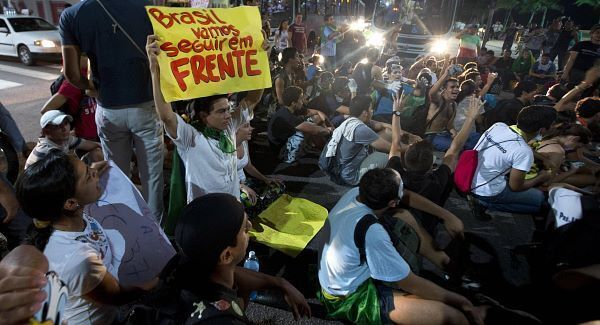
Brazil’s president has broken her silence after more than a week of massive, violent protests rocked the country.
Dilma Rousseff said during a prime-time TV broadcast that peaceful demonstrations were part of a strong democracy but that violence could not be tolerated.
Ms Rousseff, standing before a Brazilian flag, said the government knew there were many things “we can do quicker and better” and that Brazil “fought hard to become a democratic country”, but added that she could not accept the violence carried out by a minority of protesters.
The leader, a former Marxist rebel who fought against Brazil’s 1964-85 military regime and was imprisoned for three years and tortured by the junta, pointedly referred to sacrifices her generation made to free the nation from dictatorship.
“We need to oxygenate our political system ... and make it more transparent,” she said.
Trying to decipher the president’s reaction to the unrest had become a national guessing game, especially after a million anti-government demonstrators took to the streets the night before across the country to denounce everything from poor public services to the billions of euro spent preparing for next year’s World Cup football tournament and the 2016 Olympics.
The protests continued on Friday, as about 1,000 people marched in western Rio de Janeiro city, with some looting stores and invading an enormous US$250m arts centre that remains empty after several years of construction.
Police tried to disperse the crowd with tear gas as they were pelted with rocks, adding that some in the crowd were armed and firing at officers.
Local radio was also reporting that protesters were heading to the apartment of Rio state governor Sergio Cabral in the upmarket neighbourhood of Ipanema.
Other protests broke out in the country’s biggest city, Sao Paulo, where traffic was paralysed but no violence reported, and in Fortaleza in the country’s north east. Demonstrators were calling for more mobilisations in 10 cities later today.
The National Conference of Brazilian Bishops came out in favour of the protests, saying that it maintains “solidarity and support for the demonstrations, as long as they remain peaceful”.
“This is a phenomenon involving the Brazilian people and the awakening of a new consciousness,” church leaders said in the statement. “The protests show all of us that we cannot live in a country with so much inequality.”
Ms Rousseff had never held elected office before she became president in 2011 and remains clearly uncomfortable in the spotlight.
She is the political protege of former president Luiz Inacio Lula da Silva, a charismatic ex-union leader whose popularity helped usher his former chief of staff to the country’s top office. A career technocrat and trained economist, Ms Rousseff’s tough managerial style under Mr da Silva earned her the nickname “the Iron Lady”, a name she has said she detests.
While Ms Rousseff stayed away from the public eye for most of the week, Roberto Jaguaribe, the nation’s ambassador to Britain, told news channel CNN the government was first trying to contain the protests.
He labelled as “very delicate” the myriad demands emanating from protesters in the streets.
“One of our ministers who’s dealing with these issues of civil society said that it would be presumptuous on our part to think we know what’s taking place,” Mr Jaguaribe said. “This is a very dynamic process. We’re trying to figure out what’s going on because who do we speak to? Who are the leaders of the process?”
Brazil watchers outside the country were puzzled by the government’s long silence amid the biggest protests in decades, although Peter Hakim, president emeritus at the US-based Inter-American Dialogue think-tank, said he appreciated the complicated political picture, especially with protests flaring in some areas where political opponents to Ms Rousseff hold sway.
Social media and mass emails are buzzing with calls for a general strike next week, although Brazil’s two largest nationwide unions, the Central Workers Union and the Union Force, said they knew nothing about such an action, though they do support the protests.
A Thursday night march in Sao Paulo was the first with a strong union presence, as a drum corps led members wearing matching shirts down the city’s main avenue. Many protesters have called for a movement with no ties to political parties or unions, which are widely considered corrupt here.
In the absence of such groups, the protests have largely lacked organisation or even concrete demands, making a coherent government response nearly impossible. Several cities have cancelled the transit fare hikes that originally sparked the demonstrations a week ago, but the outrage has grown more intense.
Saturday’s demonstrations have been called by a group opposing a federal bill that would limit the power of prosecutors to investigate crimes.
The one group behind the reversal of the fare hike, the Free Fare Movement, said it would not call any more protests. However, it was not clear what impact that might have on a movement that has moved far beyond its original complaint.
Foreign Minister Antonio Patriota hit back at protesters the morning after his modernist ministry building was attacked by an enraged crowd on Thursday night. At one point, smoke billowed from the building, while demonstrators shattered windows along its perimeter.
Standing before the ministry, Mr Patriota told reporters he was “very angry” that protesters attacked a structure “that represents the search for understanding through dialogue”. He called for protesters “to convey their demands peacefully.”
Most protesters have been peaceful and crowds have taken to chanting “No violence! No violence!” when small groups have prepared to burn and smash. The more violent demonstrators have usually taken over once night has fallen.
At least one protester was killed in Sao Paulo state on Thursday night when a driver apparently became enraged about being unable to travel along a street and rammed his car into demonstrators. News reports also said a 54-year-old cleaning woman died on Friday after inhaling tear gas the night before.
Ms Rousseff said she would soon hold a meeting with leaders of the protest movement, governors and the mayors of major cities, but it remains unclear who could represent the massive and decentralised groups of demonstrators.
Though offering no details, Ms Rousseff said her government would create a national plan for public transportation in cities – a hike in bus and subway fares in many cities was the original complaint of the protests. She also reiterated her backing for a plan before congress to invest all oil revenue royalties in education and a promise she already made to bring in foreign doctors to areas that lack physicians.
“I’m going to meet with the leaders of the peaceful protests, I want institutions that are more transparent, more resistant to wrongdoing,” she said in reference to perceptions of deep corruption in Brazilian politics, which is emerging as a focal point of the protests.
“It’s citizenship and not economic power that must be heard first.”
“My generation fought a lot so that the voice of the streets could be heard,” Ms Rousseff added. “Many were persecuted, tortured and many died for this. The voice of the street must be heard and respected and it can’t be confused with the noise and truculence of some troublemakers.”
CONNECT WITH US TODAY



Be the first to know the latest news and updates