Boston bombs 'were packed in duffel bags' with 'shards of metal'
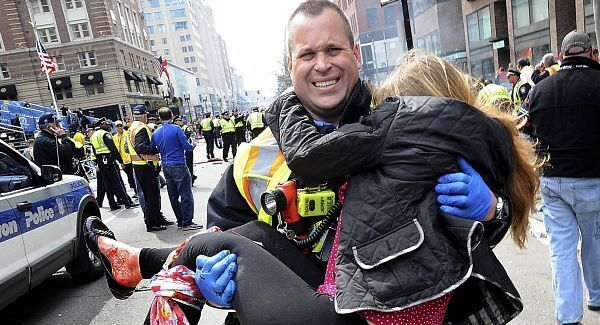
The Boston marathon bombs were explosives packed in 6-litre pressure cookers and placed in black duffel bags, according to a source close to the investigation.
They said the explosives were placed on the ground and contained shards of metal, nails and ball bearings. They did not want to be named.
The source said police have some of the bomb components but did not yet know what was used to set off the explosives.
RT @ap: BREAKING: Person briefed on probe: Boston explosives made of pressure cookers with metal, ball bearings -MM
— The Boston Globe (@BostonGlobe) April 16, 2013
One of the bombs contained shards of metal and ball bearings, and another contained nails, the source said.
Pressure cooker explosives have been used in Afghanistan, India, Nepal and Pakistan, according to a July 2010 joint FBI and Homeland Security intelligence report. One of the three devices used in the May 2010 Times Square attempted bombing was a pressure cooker, the intelligence report said.
“Placed carefully, such devices provide little or no indication of an impending attack,” the report said.
Typically, these bombs have an initiator, switch and explosive charge, according to the Homeland Security Department.
President Barack Obama said today the bombings were an act of terrorism but investigators do not know if they were carried out by an international or domestic organization, or perhaps by a “malevolent individual.”
The investigation into the bombings is in full swing with a police raid on a private home and an appeal for any video, audio or still images of the blasts.
The FBI said no one had claimed responsibility and president Barack Obama was careful not to use the words “terror” or “terrorism” but one White House official said the bombings were being treated as an act of terrorism.
The president promised: “We will find out who did this. We’ll find out why they did this. Any responsible individuals, any responsible groups, will feel the full weight of justice.”
“We still don’t know who did this or why,” he said, adding: “Make no mistake: We will get to the bottom of this.”
With scant official information to guide them, members of Congress said there was little or no doubt it was an act of terrorism.
“We just don’t know whether it’s foreign or domestic,” said Republican Michael McCaul, chairman of the House Committee on Homeland Security.
Richard DesLauriers, FBI agent in charge in Boston, said that investigators had received “voluminous tips” and were interviewing witnesses and were analysing the crime scene.
“We will go to the ends of the Earth to identify the subject or subjects who are responsible for this despicable crime, and we will do everything we can to bring them to justice,” he said.
One European security official said initial evidence indicates that the attacks were not the work of suicide bombers.
“So far, investigators believe it was not the work of suicide bombers, but it is still too early to rule it out completely,” said the official, who did not want to be named.
The Pakistani Taliban, which has threatened attacks in the United States because of its support for the Pakistani government, denied any role in the marathon bombings.
Defence Secretary Chuck Hagel called the bombing a “cruel act of terror.” He said that any event with explosive devices is clearly an act of terror and he promised that a thorough investigation will determine whether the perpetrators were foreign or domestic. The Pentagon chief vowed that those responsible will be brought to justice.
Massachusetts governor Deval Patrick said no unexploded bombs were found at the marathon site. He said the only explosives were the ones that went off.
Police searched an apartment in the Boston suburb of Revere. Investigators were seen leaving carrying brown paper bags, plastic trash bags and a duffel bag.
Police refused to give any specifics on the bombs and say, for example, where they might have been hidden or whether they were packed with shrapnel for maximum carnage, as is often the case in terror bombings overseas.
The bombings occurred about four hours into the race and two hours after the men’s winner crossed the finish line. By that point, more than 17,000 of the athletes had finished the marathon, but thousands more were still running.
The attack may have been timed for maximum carnage: The four-hour mark is typically a crowded time near the finish line because of the slow-but-steady recreational runners completing the race and because of all the friends and relatives clustered around to cheer them on.


CONNECT WITH US TODAY



Be the first to know the latest news and updates