Delay and confusion at nuclear power plant
Emergency workers forced to retreat from the wrecked Japanese nuclear power plant by soaring radiation levels were able to go back in tonight, but the delay could prove catastrophic.
The pullback cost precious time in the fight to prevent a nuclear meltdown, further escalating the country’s crisis.
It was unclear what happened in the Fukushima Dai-ichi nuclear plant’s overheating reactors after late morning local time, when the workers stopped pumping in seawater trying to cool their fuel rods. Officials gave only sparse information about the reactors.
But conditions at the plant appeared to be worsening. White steam-like clouds drifted up from one reactor which, the government said, probably emitted the burst of radiation that led to the workers’ withdrawal. The plant’s operator reported a fire at another reactor for the second time in two days.
Officials are facing increasing criticism over poor communication and co-ordination.
Even the chief of the UN International Atomic Energy Agency, Yukiya Amano, said today he would visit Japan as soon as possible to obtain “firsthand information” about the nuclear crisis and improve the flow of information from the Japanese government.
“The anxiety and anger being felt by people in Fukushima have reached a boiling point,” the governor of Fukushima prefecture, Yuhei Sato, warned. He criticised preparations for an evacuation if conditions worsen and said centres already housing people moved from nearby the plant do not have enough hot meals and basic necessities.
The nuclear crisis has triggered international alarm and partly overshadowed the human tragedy caused by Friday’s earthquake and tsunami.
Millions of people struggled for a fifth day with little food, water or heat, and already chilly temperatures turned to snow in many areas. Police say more than 452,000 people are staying in temporary shelters, often sleeping on the floor in school gyms.
More than 4,300 people are officially listed as dead, but officials believe the toll will climb over 10,000 since several thousand more are listed as missing.
In an extremely rare address to the nation, Emperor Akihito expressed condolences and urged Japan not to give up.
“It is important that each of us shares the difficult days that lie ahead,” said Akihito, 77, a figure deeply respected across the country. “I pray that we will all take care of each other and overcome this tragedy.”
He also expressed his worries over the nuclear crisis, saying: “With the help of those involved I hope things will not get worse.”
Since the quake and wave hit, authorities have been struggling to avert an environmental catastrophe at the complex, 140 miles
In the city of Fukushima, about 40 miles inland, hundreds of harried government workers, police officers and others struggled to stay on top of the situation in a makeshift command centre.
Today’s burst of radiation was believed to have come from Unit 3, where workers are struggling with a fuel storage pond thought to be leaking radiation, as well as possible damage to the containment vessel – the thick concrete armour built around the reactor – that would allow radiation to escape.
“The workers cannot carry out even minimal work at the plant now,” Chief Cabinet Secretary Yukio Edano said this morning. “Because of the radiation risk we are on standby.”
With no workers on site, efforts to cool the reactors probably ceased altogether, experts said.
Elevated levels of radiation were detected well outside the 20-mile emergency area around the plants. In Ibaraki prefecture, just south of Fukushima, they were about 300 times normal by late morning. It would take three years of constant exposure to these higher levels to raise a person’s risk of cancer.
A little radiation was also detected in Tokyo, triggering panic buying of food and water.
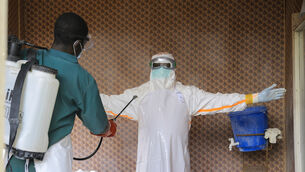
Given the reported radiation levels, John Price, a nuclear safety expert, said he saw few health risks for the public so far. He was concerned for the workers, who he said were almost certainly working in full body suits and breathing through respirators.
Those at the forefront of the fight – a core team of about 180 – had been regularly rotated in and out of the danger zone to minimise their radiation exposure.
Mr Price said he was surprised by how little information the Japanese were giving.
“We don’t know even the fundamentals of what’s happening, what’s wrong, what isn’t working. We’re all guessing,” he said. “I would have thought they would put on a panel of experts every two hours.”
There are six reactors at the plant. Units 1, 2 and 3, which were operating last week, shut down automatically when the quake hit. Since then, all three have been rocked by explosions. Compounding the problems, yesterday a fire broke out in Unit 4’s fuel storage pond, an area where used nuclear fuel is kept cool, causing radioactivity to be released into the atmosphere.
Units 4, 5 and 6 were shut at the time of the quake, but even off-line reactors have nuclear fuel – either inside the reactors or in storage ponds – that needs to be kept cool.

CONNECT WITH US TODAY



Be the first to know the latest news and updates