Gaddafi planes strike rebel troops
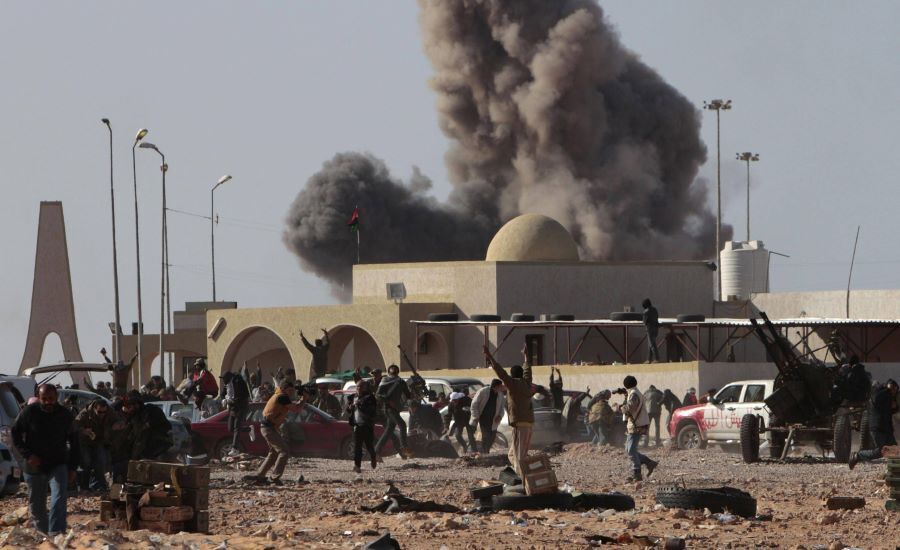
Libyan warplanes have launched multiple air strikes on opposition fighters regrouping at an oil port on the Mediterranean coast.
It was the second day of a government counter-offensive to thwart a rebel advance toward Muammar Gaddafi’s stronghold in the capital Tripoli.
President Barack Obama said the US and its Nato allies are still considering a military response to the violence and Britain and France were drafting a UN resolution that would establish a no-fly zone.
UN aid officials said up to one million foreign workers and others trapped in Libya are expected to need emergency aid because of the fighting.
The anti-government forces trying to oust Gaddafi say they will be outgunned if the regime continues to unleash its air power on them and are pleading for the international community to impose a no-fly zone to protect them from more strikes.
However, they oppose foreign troops on the ground.
“We don’t want a foreign military intervention, but we do want a no-fly zone, said rebel fighter Ali Suleiman. ”We are all waiting for one,“ he added. The rebels can take on ”the rockets and the tanks, but not Gaddafi’s air force“ he said.
The government has managed to halt for now a rebel advance that began last week when fighters ventured beyond the opposition-controlled eastern half of the country.
The rebels are now struggling to maintain supply lines for weapons, ammunition and food, with many living off junk food, biscuits and cans of tuna.
They are waiting for rocket launchers, tanks and other heavy weapons to arrive with reinforcements from their headquarters in the eastern city of Benghazi.
Meanwhile, the US has moved military forces closer to its shores to back up its demand that Gaddafi step down. But enforcing a no-fly zone could take weeks to organise, and US Defence Secretary Robert Gates has noted that it must be preceded by a military operation to take out Libya’s air defences.
British Foreign Secretary William Hague said on Sunday that a no-fly zone over Libya is still in an early stage of planning and ruled out the use of ground forces.
Obama said the US will stand with the Libyan people as they face “unacceptable” violence.
He said he has authorised millions of dollars in humanitarian aid. He also sent a strong message to Gaddafi, saying he and his supporters will be held responsible for the violence there.
Libya appears to be sliding toward a civil war that could drag on for weeks, or even months.
Resorting to heavy use of air attacks signalled the regime’s concern that it needed to check the advance of the rebel force toward Sirte – Gaddafi’s home town and a bastion of support for the long-time leader.
Anti-Gaddafi forces would get a massive morale boost if they can blast through Sirte, a major obstacle on the march toward Tripoli.
Libya’s main population centres lie along the country’s main east-west highway on the Mediterranean coast and the struggle for control of the country is being waged between the government and the rebels trying to push the front line westward toward the capital.
A force estimated at 500 to 1,000 fighters was pushing steadily down the road toward Tripoli when it was driven out of the town of Bin Jawwad, 375 east of the capital, on Sunday by pro-Gaddafi forces using helicopter gunships, artillery and rockets.
Gebril Hewadi, a doctor at Al-Jalaa Hospital in Benghazi, said 30 have been killed on the rebel side in the past three days of fighting and 169 wounded.
The rebels regrouped about 40 miles to the east in Ras Lanouf, where MiG fighters circled over rebel positions today before launching air strikes behind their front lines in the morning and afternoon.
In and around Bin Jawwad, pro-regime forces were running patrols Monday and there were minor reports of skirmishes with rebels on the outskirts.
One strike hit a road near the town’s only petrol station, destroying at least three vehicles and wounding at least two people.
The opposition also holds two main battleground cities close to Tripoli, and the government appears to have solidified control of one of them – Zawiya. Just 30 miles outside Tripoli, Zawiya had been the city closest to the capital in opposition hands.
A Zawiya resident said government tanks and artillery opened fire on rebels around 9 am and the attack hadn’t stopped when he left the city at 1:30 pm. All entrances to the city were under government control and the rebels had been driven out of the city’s central Martyr’s Square and a nearby mosque by the heaviest attack in several days.
“The tanks are everywhere,” he said. “The hospital is running out of supplies. There are injured everywhere who can’t find a place to go.”
Rebels also held much of Misrata, to the east of Tripoli about halfway to Sirte.
But Valerie Amos, United Nations under-secretary-general for humanitarian affairs and emergency relief co-ordinator, said in a statement that the Benghazi Red Crescent reported that Misrata was under attack by government forces again today.
There have been repeated government attempts to regain control of Misrata.
“Humanitarian organisations need urgent access now,” she said. “People are injured and dying and need help immediately.”
Hundreds if not thousands of people have died since Libya’s uprising began, although tight restrictions on media make it near impossible to get an accurate tally. More than 200,000 people have fled the country, most of them foreign workers.
The exodus is creating a humanitarian crisis across the border with Tunisia - another North African country in turmoil after an uprising in January that ousted its long-time leader.
The turmoil is being felt more broadly still in the form of rising oil prices. Libya’s oil production has been seriously crippled by the unrest.
CONNECT WITH US TODAY



Be the first to know the latest news and updates