Thai government imposes curfew
Thai authorities today announced they plan to impose a curfew in parts of Bangkok that have been wracked by clashes between Red Shirt protesters and the army.
Army spokesman Colonel Sansern Kaewkamnerd said on national television that authorities would announce later today which parts will come under curfew.
The timing of the curfew will also be announced later.
He also said that authorities plan to send the Red Cross and other neutral agencies into Bangkok's deadly protest zone to evacuate women, children and the elderly.
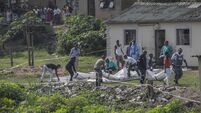
Since Thursday at least 25 people have been killed in violence in parts of central Bangkok.
A towering column of black smoke rose over the city as protesters facing off with troops set fire to tyres serving as a barricade. Elsewhere, they doused a police traffic post with petrol and torched it.
The spiralling violence has raised concerns of sustained, widespread chaos in Thailand - a key US ally and south-east Asia's most popular tourist destination that promotes its easygoing culture as the "Land of Smiles".
Speaking on his weekly television programme, Prime Minister Abhisit Vejjajiva insisted the military operation to quell protests was the answer in ending the country's two-month-long crisis.
"Overall, I insist the best way to prevent losses is to stop the protest. The protest creates conditions for violence to occur. We do realise at the moment that the role of armed groups is increasing each day," he said.
The Red Shirt protesters have occupied a one-square-mile zone, barricaded by tyres and bamboo spikes, in one of the capital's ritziest areas, Rajprasong, for about two months to push their demands for Abhisit to resign immediately, dissolve Parliament and call new elections.
Colonel Kaewkamnerd said the government will send the Red Cross and voluntary organisations into the protest zone to "invite or persuade people, especially women, children and older people to leave the area".
About 5,000 people are believed to be camped in the protest zone, down from about 10,000 before fighting started on Thursday after a sniper shot and seriously wounded a Red Shirt leader.
It quickly spread to nearby areas, which became a no-man's land after the army set up barriers in a wider perimeter around Rajprasong. The area already resembled a curfew zone with no public transport or private vehicles.
Most shops, hotels and businesses in the area are also shut. The government has shut off power and water supplies to the core protest zone. Schools were ordered to close tomorrow in all of Bangkok.
At least 54 people have been killed and more than 1,600 wounded since the protests began mid-March, according to the government. The dead include 25 killed since Thursday.
Yesterday soldiers blocked major roads and pinned up notices of a "Live Firing Zone" in one area of Bangkok.
Protesters launched a steady stream of rudimentary missiles at troops who fired back with live ammunition in several areas around a key commercial district of Bangkok.
Army snipers were perched with high-powered rifles atop tall buildings, viewing the action below through telescopic sights.
The clashes are the most prolonged and deadliest bout of political violence that Thailand has faced in decades despite having a history of coups - 18 since it became a constitutional monarchy in 1932.
The crisis appeared to be near a resolution last week when Abhisit offered to hold elections in November, a year early. But the hopes were dashed after Red Shirt leaders made more demands.
The political uncertainty has spooked foreign investors and damaged the vital tourism industry, which accounts for 6% of the economy, south-east Asia's second largest.
The Red Shirts, drawn mostly from the rural and urban poor, say Abhisit's coalition government came to power through manipulation of the courts and the backing of the powerful military, and that it symbolises a national elite indifferent to the poor.
The New York-based Human Rights Watch yesterday called on the Thai government to revoke the fire zones and negotiate an end to the fighting.
"By setting out these 'live fire zones' the Thai authorities are on a slippery slope toward serious abuses. It's a small step for soldiers to think 'live fire zone' means 'free fire zone,' especially as violence escalates," the rights watchdog said in a statement.
The Red Shirts especially despise the military, which forced Thaksin Shinawatra, the populist premier favoured by the Red Shirts, from office in a 2006 coup.
Two subsequent pro-Thaksin governments were disbanded by court rulings before Abhisit became prime minister.