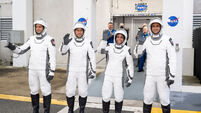
Astronauts 'in no danger' after CO2 alert
Two astronauts cut short their spacewalk and hurried back to the safety of the international space station after a suit problem caused rising carbon dioxide levels for one of them.
Nasa chiefs stressed today that spacewalker Christopher Cassidy was never in any danger and experienced no symptoms of carbon dioxide build-up, however.
The trouble happened in yesterday's spacewalk, the third for shuttle Endeavour's crew.
Mission Control notified the crew five hours into the spacewalk that the canister for removing carbon dioxide from Cassidy's suit did not seem to be working properly.
Flight controllers wanted him back inside quickly and that meant fellow spacewalker David Wolf had to go in too.
Their battery replacement work outside the space station was left unfinished. Only two of four new batteries ended up being installed.
Cassidy immediately headed for the hatch. He waited there for Wolf, who was further out on the space station. Their work site was on the far left side of the orbiting complex, along the framework that holds the huge solar wings and more than 150 feet from the hatch.
"I'm just going to sit here and I'm going to wait for Dave and enjoy the view," Cassidy said.
Both men were back inside and the spacewalk was over 30 minutes after Mission Control's initial call to cut it short. It ended up lasting six hours, a half-hour shorter than planned.
The unfinished battery work will be added to tomorrow's spacewalk, the fourth of five planned for this mission. Battery work had already been scheduled for tomorrow but now astronauts will have to install four for a total of six by the flight's end.
Neither Cassidy nor Wolf - nor any of the 11 astronauts inside - sounded particularly stressed as they dropped everything and headed back in. Wolf noted that his idea for stringing safety tethers together, with minimal hook-ups in case of an emergency, "worked like a charm".
"Never thought we'd use it," he said as he made his way toward the hatch, hand over hand.
Flight director Holly Ridings said Cassidy's carbon dioxide level stayed well within allowable limits for the shuttle and station atmospheres. But because of the upward trend, she did not want to take any chances.
"A spacesuit is a very small spacecraft, and there's just really not much margin for error," she said.
An engineering team is looking into the problem to ensure it does not happen again. The bad canister of lithium hydroxide will be returned to Earth for analysis.
Until the suit trouble, the spacewalk had been progressing without any major problems except some stubborn bolts on the batteries.
The astronauts were running behind, though, because of the difficult work. They had removed three of the nine-year-old batteries from the space station and plugged in two new ones when they got the call to wrap it up.
The large nickel-hydrogen batteries are critical, storing the power collected by the space station's solar wings. The old batteries were launched in 2000. Nasa is uncertain how long those original batteries might last and wants new ones installed before the old ones die.
The new batteries cost around €2.6m each.
All of the old batteries will be returned to Earth aboard Endeavour. The shuttle will undock from the space station on Tuesday and landing is set for July 31.
CONNECT WITH US TODAY



Be the first to know the latest news and updates