UN Security Council hold emergency meeting
The United Nations Security Council was this evening holding an emergency meeting to consider further possible sanctions against North Korea, after the secretive Communist state conducted a second nuclear weapons test.
This morningâs test sparked widespread international condemnation US President Barack Obama saying that the test was âa blatant violation of international lawâ and recklessly endangered the people of north-east Asia.
Mr Obama said that the US and the international community âmust take action in responseâ.
North Koreaâs state-controlled national news agency said today that the regime had âsuccessfully conducted one more underground nuclear test... as part of measures to bolster its nuclear deterrent for self-defenceâ.
Seismologists registered underground activity at magnitude 5.3 in the north-east of North Korea, in the area where Pyongyang tested an earlier nuclear device in 2006.
Russian defence officials said that the blast was far more powerful than the previous test, estimating its yield at around 10 to 20 kilotons â comparable to the US bombs dropped on Hiroshima and Nagasaki in World War II.
British Prime Minister Gordon Brown said: âI condemn North Koreaâs nuclear test in the strongest terms as erroneous, misguided and a danger to the world.
âThis act will undermine prospects for peace on the Korean peninsula and will do nothing for North Koreaâs security.
âThe international community will treat North Korea as a partner if it behaves responsibly. If it does not, then it can expect only renewed isolation.â
Some analysts said pressure should be put on North Korea to return to the six-party talks designed to resolve security fears over its nuclear ambitions, which also involve the US, China, South Korea, Japan and Russia.
After apparent progress in 2007, when Pyongyang agreed to shut down nuclear facilities, the talks broke down last year.
Tension has escalated further over the past two months, after North Korea launched a rocket in breach of international obligations on April 5, in what it claimed was an attempt to put a satellite into orbit but was widely seen as cover for missile testing.
Following international censure, the regime defiantly announced it would never return to the negotiating table, but would restart its nuclear programme, conduct an atomic test and carry out long-range missile tests.
Reports from South Korea suggested that todayâs underground blast was accompanied by the test-firing of a short-range ground-to-air missile.
Korea-watchers believe that the defiant actions may be linked to preparations for the succession to reclusive leader Kim Jong-Il, who is believed to be seriously ill.
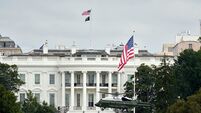
Speaking in the Rose Garden of the White House ahead of this eveningâs Security Council meeting, Mr Obama said: âThe record is clear: North Korea has previously committed to abandoning its nuclear programme. Instead of following through on that commitment it has chosen to ignore that commitment.
âThese actions have also flown in the face of United Nations resolutions.
âAs a result North Korea is not only deepening its own isolation, itâs also inviting stronger international pressure - thatâs evident overnight, as Russia and China, as well as our traditional allies of South Korea and Japan, have all come to the same conclusion: North Korea will not find security and respect through threats and illegal weapons.â
UN Secretary-General Ban Ki-moon said that if North Koreaâs claims are confirmed, the test would represent âa clear violationâ of a Security Council resolution.
âI sincerely hope that the Security Council will take necessary corresponding measures,â Mr Ban told reporters.