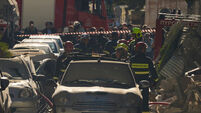
Soldiers scour buried villages as quake death toll rises
Soldiers who hiked over landslide-blocked roads to reach the epicentre of China’s devastating earthquake searched through collapsed buildings today for survivors, with the death toll certain to rise to near 20,000 as the buried are found.
The official death toll from the earthquake has risen to 14,866.
It was not clear if the official number included all the dead discovered in hard-to-reach mountain villages at the earthquake’s epicentre.
Tens of thousands of homeless in wrecked towns across hilly stretches of Sichuan province spent a second night outdoors after Monday’s 7.9-magnitude quake – China’s deadliest in three decades – some sleeping under plastic sheeting, others bussed to a stadium in the city of Mianyang, on the edge of the disaster area.
At one school in the province 178 children have been confirmed dead.
Xinhua News Agency said they were taking a nap in the building in Qingchuan in northern Sichuan when their three-story building collapsed.
Another 139 students escaped while 23 others are still missing.
Price gouging also was seen in Mianyang. A package of instant noodles normally selling for 21c now costs 71c. In stores that were open, prices appeared to have doubled.
The road north from Mianyang to Beichuan was blocked 12 miles short of the city.
In an indication of how serious the destruction was in Beichuan, the official Xinhua News Agency said it was “in desperate need of 50,000 tents, 200,000 cotton-padded quilts, 300,000 cotton-padded jackets, plus food, drinking water and drugs”.
Both places are in a triangle area close to the epicentre of the quake just north of the Sichuan provincial capital of Chengdu.
Along the road, people had gathered outdoors after the roofs of their houses had collapsed, with the luckier ones huddled under plastic sheets strung up between tree branches.
State television broadcast touching scenes of premier Wen Jiabao at the Mianyang stadium comforting children whose parents were killed in the earthquake.
“The government will take care of you. The government will take care of your livelihood, your studies,” Mr Wen told a little girl who looked about nine.
“This is a disaster. Since you survived, you must live your life well,” Mr Wen said to the girl, who cried and covered her face with one hand.
The industrial city of 700,000 people – home to the headquarters of China’s nuclear weapons design industry – was turned into a thronging refugee camp.
“I’m cold. I don’t dare to sleep, and I’m worried a building is going to fall down on me,” said Tang Ling, a 20-year-old waitress wrapped in a borrowed pink down jacket and camped outside a restaurant with three co-workers.
“What’s happened is so cruel. In one minute to have so many people die is too tragic.”
Today is also expected to bring another jump in the death toll as a first wave of 200 troops searched the town of Wenchuan, near the epicentre, after trudging across ruptured roads and mudslides, state television said. Initial reports from soldiers said one nearby town could account for only 2,300 survivors out of 9,000 people, China Central Television said.
The death toll so far was at least 12,012 in Sichuan while another 323 died in five other provinces and the metropolis of Chongqing. Up to 18,000 people were believed to be trapped in rubble, most in Beichuan.
The military said it was planning to air-drop aid to Wenchuan. “Once the weather is OK, the army will start dropping food and medicines to the town,” Li Shiming, commander of the Chengdu Military Area Command, said.
Buses carried survivors away from Beichuan, which was flattened – a few buildings standing amid piles of rubble in a narrow valley, according to CCTV video.
More than 10,000 people from there and surrounding areas packed Mianyang’s Jiuzhou Gymnasium, with empty water bottles, boxes of instant noodles and cigarette cartons littering the ground.
The government’s high-gear response aimed to reassure Chinese while showing the world it was capable of handling the disaster and was ready for the August 8-24 Olympics in Beijing.
Although the government said it welcomed outside aid, officials said it would accept only money and supplies, not foreign personnel.
Mr Wen criss-crossed the disaster area to oversee relief efforts, while Xinhua said the Defence Ministry had sent 20,000 soldiers and police into the disaster area, with 30,000 more on the way by plane, train, truck and on foot.
The Finance Ministry said it had allocated €77.2m in quake aid.
At Wolong National Nature Reserve, all 86 pandas were reported safe yesterday in the first word since communications with the preserve were cut off. A group of 31 British tourists panda-watching in the preserve also returned safely to Chengdu, the British Foreign Ministry said, although there was no word on 12 missing Americans on a World Wildlife Fund tour.
In the town of Juyuan, close to Chengdu, weeping parents held a vigil in a steady outside a collapsed school, where more than 900 high school pupils were initially trapped. Only one survivor has been found: a girl pulled free by rescue team.
Residents complained that delays in aid had caused more deaths in the immediate aftermath of the quake.
Zhang Chuanlin, a 27-year-old factory worker, said his 52-year-old mother was trapped while watching television with her friend. No rescue workers were around so he started to dig by himself.
“No one was helping me and then two strangers came and dug through the rubble. They found her an hour later,” he said.
“When they pulled her out I couldn’t look, I just couldn’t look when they pulled her out.”
A man who gave only his surname Li said he had suffered a double tragedy. His wife was killed while watching TV with Zhang’s mother and his daughter died when her school collapsed.
The child did not die right away and could be heard saying, “Please help me daddy, please rescue me”, right after the earthquake, he said, but there were no authorities to save her.
In Dujiangyan, a mother pleaded with police for information about her husband who was working in Wenchuan, blocking one of the few roads leading to the epicentre.
“I’ve begged and begged them to help me look for my husband,” Li Zhenhua said, showing her husband’s ID card to a crowd of onlookers. “I can’t go by myself because I’ve got a little baby and elderly parents here, so I can’t leave.”
“The government is doing nothing for us. The government won’t help us,” she said, over and over.

CONNECT WITH US TODAY



Be the first to know the latest news and updates