US troops clash with suspected Sunni insurgents
US troops clashed with suspected Sunni insurgents holed up in a mosque north of Baghdad and launched an air-to-ground Hellfire missile into the structure.
One American soldier was killed in the fighting, the military said today.
Prime Minister Nouri Maliki, meanwhile, travelled to Saddam Hussein’s hometown of Tikrit to meet with Sunni tribal leaders as he worked to drum up support for a new alliance seeking to save his crumbling US-backed government.
The Shiite leader has threatened to turn to local Sunni officials who have joined forces against al-Qaida in Iraq if he cannot reach agreement with prominent Sunni politicians who have balked at his efforts.
“There is more uniting us than dividing us,” he said. “We do not want to allow al Qaida and the militias to exist for our coming generations. Fighting terrorism gives us a way to unite.”
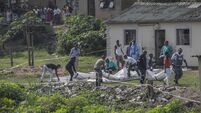
With the Iraqi government bogged down in its political crisis, hospital officials in north-western Iraq pleaded for more help as cleanup efforts continued after the deadliest wave of suicide attacks since the war started in March 2003.
Kifah Mohammed, the director of the Sinjar hospital, which was closest to the blast site, said bodies were decomposing under the rubble and warned an even larger tragedy loomed if the shattered communities did not get food, water and medicine soon.
“We will see diseases more dangerous than the explosion itself and this will spill over to nearby areas,” Mohammed said.
The US soldier was killed and another was wounded when troops stationed at a nearby outpost came under heavy small-arms fire from the Honest Mohammed Mosque last night in Tarmiyah as they targeted about six insurgents who were believed sheltered inside, according to the military.
The US forces then cordoned off the area and, unable to find the mosque’s preacher, sent the Sunni mosque’s groundskeeper into the building to persuade those inside to come out after they refused calls on loudspeakers, the military said.
“About 20 left the mosque and stated there was no one left in the mosque. This was not true,” said Lt. Col. Michael Donnelly, a military spokesman for northern Iraq. He said those 20 had been detained.
The missile was fired at the mosque after troops spotted gunmen on the roof, Donnelly said.
A police officer and a witness, who spoke on condition of anonymity because they feared retribution, said US troops stationed near the mosque came under fire before sunset prayers and the raid occurred as worshippers left the building after the services.
The missile left a hole in the minaret, they said. The military said the roof of the mosque sustained only minor damage.
Mindful of the sensitivities surrounding places of worship, US forces generally avoid directly raiding mosques in Iraq, instead providing a cordon while allied Iraqi security forces search the buildings.
But the military claims Shiite and Sunni militants take advantage of the reluctance to use mosques as hideouts or as storage for weapons caches.
US forces recently have launched a series of offensives aimed at chasing Sunni and Shiite extremists who have fled crackdowns in Baghdad and surrounding areas.
Tarmiyah, a predominantly Sunni town 30 miles north of Baghdad, was the site of a co-ordinated attack involving a suicide car bombing and gunfire against a US combat post in mid-February.
Two soldiers were killed and 17 wounded in that ambush.
South of the capital, a member of the militant arm of Iraq’s largest Shiite party was elected governor of Qadasiyah province after his predecessor was killed along with the provincial police chief in an ambush last Saturday.
The new governor, Sheikh Hamid al-Khudhari, is the secretary-general of the Badr Brigade, the militant arm of the Supreme Islamic Iraqi Council, a group led by powerful Shiite politician Abdul-Aziz al-Hakim that has been competing with fighters loyal to radical Shiite cleric Muqtada al-Sadr’s Mahdi Army militia for dominance in the oil-rich south.
Al-Khudhari was elected by a narrow majority, with 22 of the 40 members of the provincial council voting for him, council member Ghanim Abid Dahash said.
Maliki’s trip to Tikrit, 80 miles north of Baghdad, came under heavy security a day after announcing a new Shiite-Kurdish coalition that he said was a first step toward unblocking the paralysis that has gripped his Shiite-dominated government since it first took power in May 2006. But the reshaped power bloc included no Sunnis and immediately raised questions about its legitimacy as a unifying force.
The key disappointment was the absence of Iraq’s Sunni Vice President Tariq al-Hashemi and his moderate Iraqi Islamic Party, part of the main Sunni parliamentary bloc the Accordance Front, which maintained a hard-line today.
“The Accordance Front calls upon political groups to exert pressure on the government to offer real roles in political decision-making, not superficial participation that lacks any authority,” it said.
The new Shiite-Kurdish coalition will retain a majority in parliament – 181 of the 275 seats – and apparently have a clear path to pass legislation demanded by the Bush administration, including a law on sharing Iraq’s oil wealth among Iraqi groups and returning some Saddam Hussein-era officials purged under earlier White House policies.
A crucial progress report by US Ambassador Ryan Crocker and commander Gen David Petraeus is due in the US Congress in less than a month.
The quadruple bombings on Tuesday swept through Yazidi communities near the Syrian, collapsing entire blocks of mud and stone houses and leaving huge piles of rubble.
The US military has blamed al Qaida in Iraq for the attacks and the choice of the minority religious group and the remote area as targets suggested the extremist group could be pushing into new areas in northern Iraq after being driven from strongholds by US-led offensives.
Mohammed said some 520 people had been killed, echoing previous estimates by local officials. Interior Ministry spokesman Brig. Gen Abdul-Karim Khalaf said today that at least 400 had died.
CONNECT WITH US TODAY



Be the first to know the latest news and updates