Microphone hears no sound from trapped miners
A tiny microphone lowered deep into the earth this morning picked up no evidence that six coal miners are alive four days after they were caught in a cave-in.
However, crews drilling a hole for the microphone and other gear might have missed the chamber where the miners are believed to be trapped, and an air sample indicated the miners had enough oxygen to breathe if they survived the collapse, officials said.
Using a steel drill bit to bore a 21/2-inch wide hole more than 1,800 feet into the mountain site of Monday’s cave-in, rescuers reached their targeted spot last night.
But the drill might have drifted into a neighbouring sealed chamber.
“The advantage of the 21/2-inch hole is that it’s fast. The disadvantage is that it’s not as accurate,” said Richard Stickler, head of the Mine Safety and Health Administration.
The mine’s co-owner remained hopeful that the six men were still alive despite the silence at the Crandall Canyon mine in central Utah near Huntington.
“I wouldn’t look at it as good or bad news. The work is not done,” said Bob Murray, chairman of Murray Energy Corp.
Mining officials were able to take an air reading from the pocket and said the air quality was good, with 20.5 percent oxygen, some carbon monoxide and no methane.
“That means if they’re alive, they’re going to stay alive in that atmosphere,” Murray said during a news conference this morning.
The air sample was drawn more than 1,800 feet through a steel tube, which remained in the narrow hole to keep the slender lifeline open in case the miners heard a tone from the microphone and tried to respond.
The sample, however, did not pick up carbon dioxide, the gas that is exhaled from the lungs when people breathe. Still, mine officials warned that the lack of carbon dioxide did not necessarily mean that the miners were dead.
“What you got was a quick sample from a crude instrument, so you don’t get all the constituents reported,” said Christopher Van Bever, a lawyer for Murray Energy.
Drilling continued on a wider hole, which could accommodate a powerful camera to provide a view inside the pocket, deliver food and water, and hopefully give a more definitive answer about the miners’ fate.
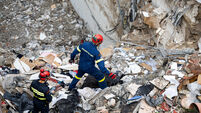
Work also continued in the mine itself, where workers were slowly burrowing through the debris to try to reach the site where the miners were when the walls caved in on Monday.